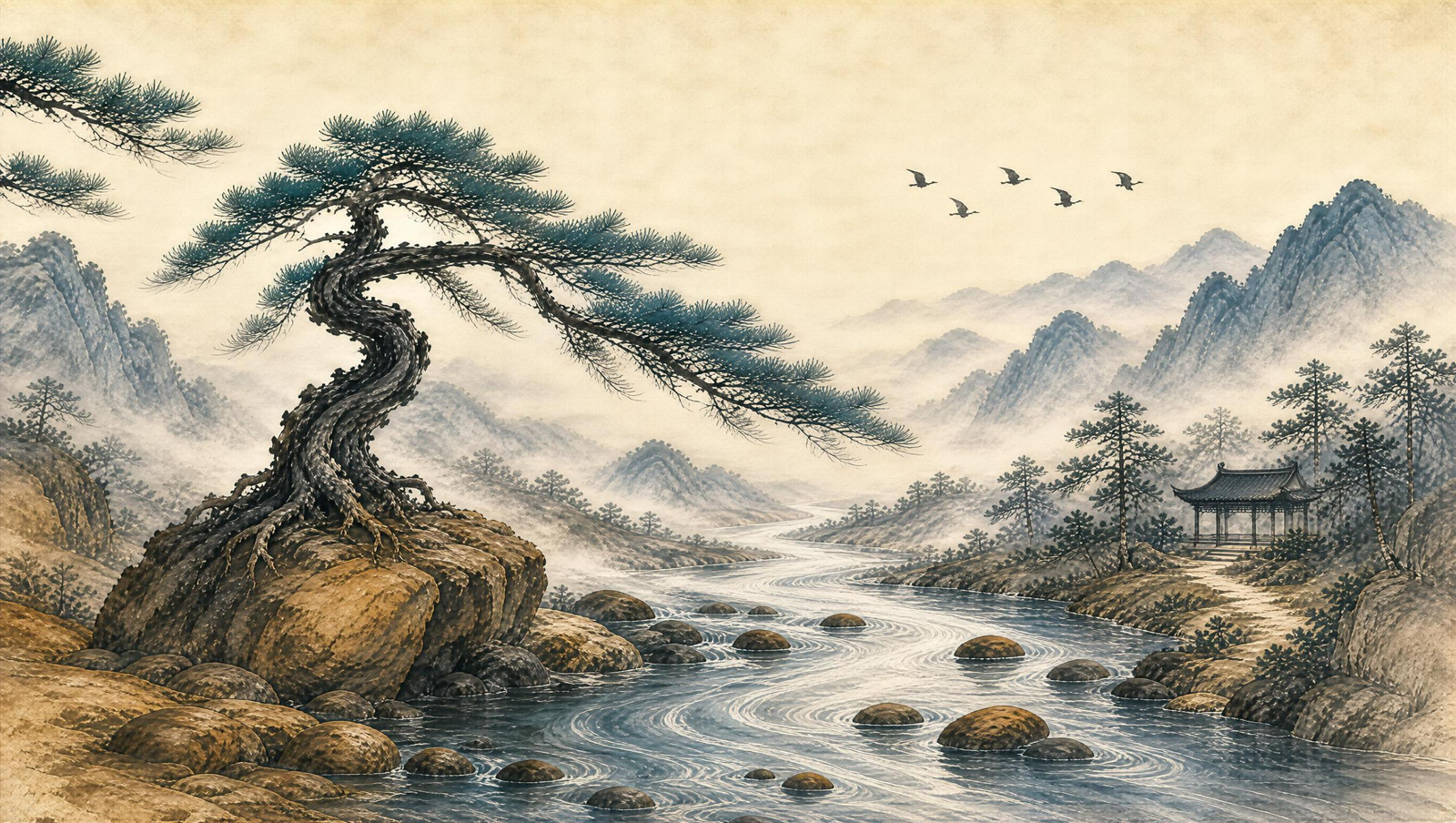

Feng Shui (风水, "wind and water") is not a layer of folk superstition pasted onto Taoism from the outside. It is Taoist practice turned toward space: the same insight that the Tao moves as Qi, and that human life flourishes when it aligns with that movement, applied to how we arrange a room, a home, or a temple. Asking whether Feng Shui "belongs" to Taoism is a little like asking whether breathing belongs to it - the two grew from one root (source, the major professional Feng Shui bodies still describe the art in exactly these terms).
Feng Shui begins with Qi, not with compasses
The mistake most outsiders make is to reduce Feng Shui to compass directions and lucky objects. In the Taoist view recorded by practitioners such as the Feng Shui Society (UK), the real subject is Qi - the same vital energy cultivated in meditation, Qigong, and medicine. A well-ordered space is one where Qi enters, circulates gently, and leaves without stagnating, much like a healthy river. A blocked space pools Qi the way a clogged channel pools water: friction, fatigue, and a run of small misfortunes follow. This is why a Feng Shui consultation and a Taoist health reading are really two readings of one thing.
How the Tao shows up in a floor plan
Taoist Feng Shui reads a building the way the Tao Te Ching reads the world - by relationship, not by isolated rules. Light, air, clear sight-lines, and repaired breaks matter more than a perfectly placed crystal. The principle of Wu Wei ("non-forcing") appears here too: rather than fighting a space, you trim it to its natural flow. The International Feng Shui Guild and similar associations consistently stress that the goal is balance and livability, not ritual theater. A room that works is a room where nothing fights itself.
The Five Elements as a spatial grammar
Feng Shui expresses the Five Elements - wood, fire, earth, metal, water - as a grammar of arrangement. Publishers such as WOFS (World of Feng Shui) present the elements as interacting cycles: generating, controlling, and balancing. This is the same Five Elements system that underlies Taoist medicine, Ba Zi, and internal alchemy, so a Feng Shui consultation and a Ba Zi reading are two windows onto one cosmology. When an element dominates a space, the cure is almost never a talisman but a redistribution of color, material, and movement.
Why a Taoist temple cares about arrangement
Temples are the original Feng Shui laboratories. The sitting of a hall, the height of a threshold, the axis toward a mountain or water - all are placed so that the gathered Qi serves ritual rather than scattering it. Our own lineage treats the altar's orientation and the flow of approach as part of the ceremony itself. This is why Feng Shui and Taoism cannot be neatly separated: the temple is the doctrine made spatial, the teaching you can walk through.
Practical takeaways for any home
You do not need to convert or to buy anything to apply this. Open what is stuck, let light reach the center, fix what is broken, keep pathways clear, and let the most-used room breathe. These plain moves are enough to shift the feeling of a space. At its Taoist core, Feng Shui is simply respect for the current you already live inside. The tradition asks only that you notice the flow, then cooperate with it.
Learn the basics in our Feng Shui guide, see how the Five Elements shape your Qi, and read the direct answer in our FAQ on Feng Shui.
每週智慧,直送你的電郵
隨筆、時令指引與能量洞察——每週一信,絕無雜訊。