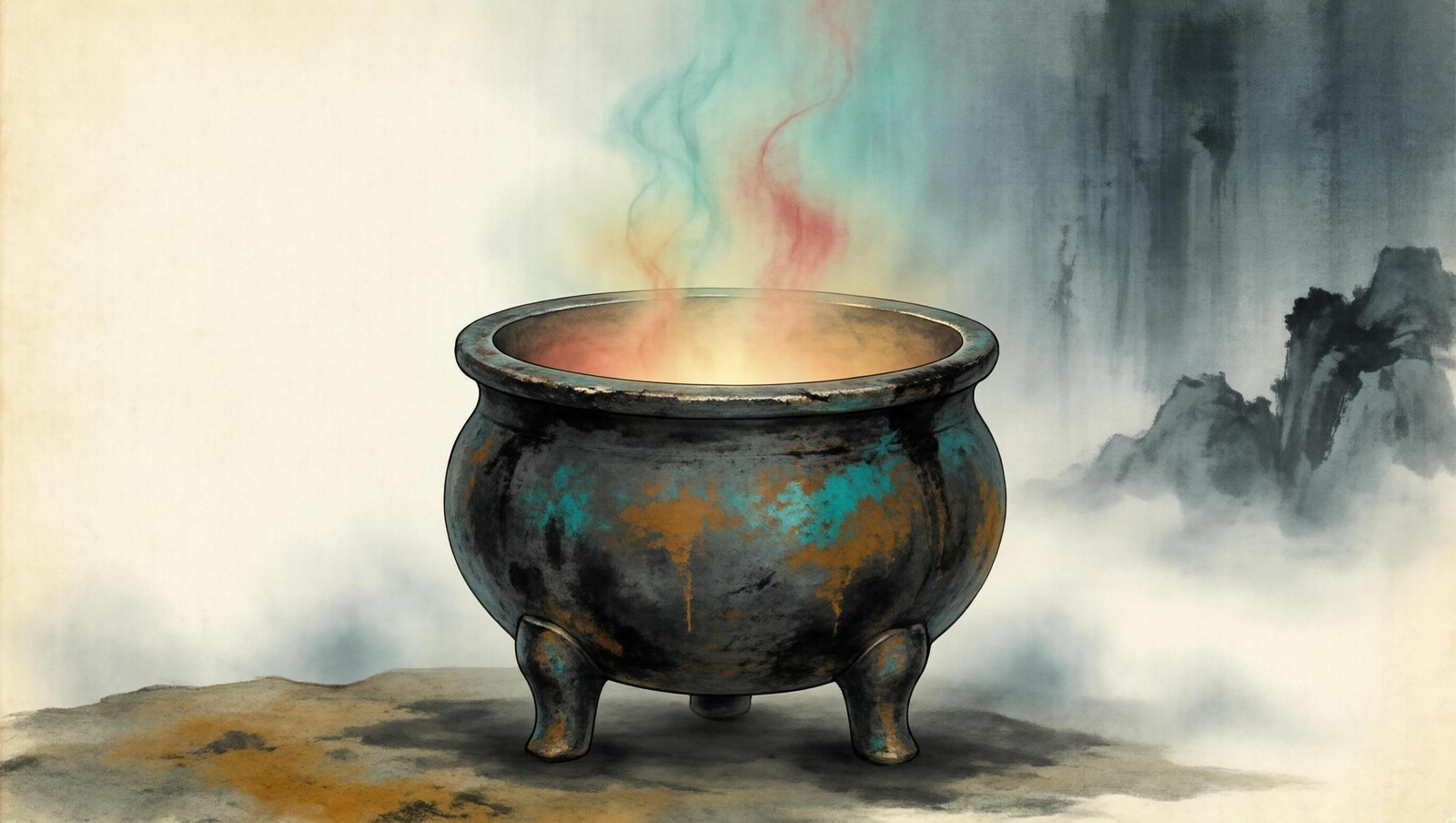
Neidan is alchemy turned inward
Neidan (内丹, "internal elixir") is the Taoist practice of refining the body's own essence, breath, and spirit - jing, qi, and shen - back into the Golden Elixir that, the tradition insists, everyone already possesses. Where external alchemy (waidan) heated minerals in a crucible, Neidan moves the crucible inward: the ingredients are the substance of your own body, and the finished elixir is not a substance at all but the realization of your original nature. The work is usually set out in three stages - refine essence into breath, refine breath into spirit, refine spirit into emptiness - and its goal is less to acquire something new than to return to something that was never lost. (For the one-paragraph version, see the Neidan FAQ.)
One root: the Elixir, outside and inside
The scholar of Taoist alchemy Fabrizio Pregadio, in his 2025 introduction The Taoist Tradition, notes that the root meaning of the Chinese word dan (elixir) is "essence" - it names the most basic and significant principle of a thing, its true nature. Chinese alchemy, in both its forms, sets out to reveal that principle.
The first form, Waidan (External Alchemy), compounds the elixir by heating minerals in a crucible. Chinese alchemical practice of this kind is attested from around the 3rd century CE, and its earliest identifiable tradition, Taiqing (Great Clarity), grew up in Jiangnan, the region south of the lower Yangzi that was equally crucial to the early history of Taoism as a whole. Its central act was to cause matter to "revert" to its state of essence - to take it back to the inchoate state from which the cosmos formed.
The second form, Neidan (Internal Alchemy), transfers this entire vocabulary onto the person. The inside of the body becomes the crucible; breath becomes the fire; essence, breath, and spirit become the ingredients. Neidan texts borrow the language of the Daode jing, the imagery of the Zhuangzi, the cosmological emblems of the Book of Changes, the physiology of traditional medicine, and the alchemical vocabulary of Waidan itself. The earliest extant Neidan texts date from around 700 CE, and their authors regularly trace the tradition back to the Cantong qi (Seal of the Unity of the Three), a work that influenced both the later Waidan and the birth of Neidan. Pregadio's site carries the full introduction, and our own Library publishes the classical texts of the tradition.
The three stages: essence, breath, spirit
Every major school of Neidan shares one structural idea: to "invert the course" (ni) of ordinary life. Where the cosmos runs downward from the One to the ten thousand things, the practitioner walks the path back. The standard formulation runs in three stages:
- Refining the essence (jing) to transmute it into breath (qi)
- Refining the breath (qi) to transmute it into spirit (shen)
- Refining the spirit (shen) to return to emptiness (xu)
The 13th-century master Li Daochun (fl. 1288-1306) read these stages against the Daode jing line "the Dao generates the One, the One generates the Two, the Two generate the Three, the Three generate the ten thousand things": the practice is the same generative sequence walked in reverse, from the multiplicity of a conditioned life back to the Dao. The point is not, however, to escape the world of matter and image, but to see that matter and image are themselves only temporary supports for something that lies beyond Yin and Yang.
This is why Neidan's metaphors must not be read literally. "Lead and mercury," "Kan and Li" (the two trigrams that stand for the moon and the sun), the "dragon and tiger" - all are terms, the tradition repeats, and beneath the terms there is only one work on one's own nature. The 13th-century master Xiao Tingzhi put it bluntly: "The way of alchemy entirely consists of images... one must know that the Kan Boy and the Li Girl are nothing but empty terms."
The body as laboratory: a small dictionary
Once you know the metaphors are metaphors, the classical vocabulary becomes readable. A few of the most common Neidan terms, following the Neidan dictionary of Golden Elixir Press:
- Dantian (丹田) - literally "cinnabar field," the three energy centers of the body where the work is done: lower abdomen, heart region, and head.
- Xiao zhoutian (小周天) - the "lesser celestial circuit," the loop that carries refined qi up the spine and down the front of the body.
- Heche (河车) - the "river chariot," the image of the spine as a waterwheel that raises the essence upward.
- Kan and Li (坎离) - the trigrams of water and fire; in the body, the movement of "water" upward and "fire" downward is the basic task from which every other practice arranges itself.
- Xing and Ming (性命) - "nature and existence," the two poles of practice: realizing one's original nature (xing) and vitalizing one's embodied life (ming).
These terms are a language, not an instruction manual. They describe in body-oriented terms exactly what the stages above describe in process-oriented terms.
Why the "Golden Elixir" is not gold
Golden Elixir Press takes its name from a line by Liu Yiming (1734-1821), one of the great Qing-dynasty Neidan masters, which is worth quoting in full:
"Golden Elixir is another name for one's fundamental Nature, inchoate and yet accomplished... All human beings have this Golden Elixir complete in themselves: it is entirely achieved in everybody. It is neither more in a sage, nor less in an ordinary person."
This - not gold, not a medicine, not an external substance - is what the tradition means by its central term. Neidan exists because the nature it names is obscured by the habits of a conditioned mind, not because it is absent. Liu Yiming pairs this with the Daode jing distinction between "non-doing" (wuwei) and "doing" (youwei): the person who realizes the elixir directly is practicing superior virtue, while the person who works through the stages is practicing inferior virtue - but both roads, he says, lead to the same goal. The stages exist for those who need a road; the insight the stages point at is available to everyone.
This also explains Neidan's long history of caution about literal practice. Because the tradition is transmission-based - master to disciple, text to informed reader - a little correct reading of the stages above goes further than a great deal of mechanical effort pursued without it.
What Neidan looks like today
Neidan is not a weekend course, and most of its classical texts were never meant to be self-applied from a page. But its working assumptions are quietly useful to any practitioner of Taoist health and longevity, and to anyone who meditates:
- Breath and body before philosophy. The stages begin with essence and breath, not with doctrine. The daily practices of the Taoist daily routine - warm water, slow breath, seated stillness - are already, in miniature, the stage of refining breath.
- Regulation beats acquisition. Neidan assumes your original nature is complete; the work is to stop obscuring it. Most "blocked" states of body and mind respond better to removal of obstruction than to addition of technique - the same logic that underlies signs your qi is blocked.
- Maps are not the territory. The terms above are empty terms, useful exactly insofar as they are not taken literally. A practice that requires you to picture an actual furnace is a practice misunderstood.
For a first step, the plain answer on what Neidan is belongs in the FAQ; from there, the Golden Elixir texts in our Library and Pregadio's own Introduction to Taoist Alchemy are the two honest next doors. The crucible, as the old texts remind us, is the body you already live in - and the elixir, as Liu Yiming says, is the nature you already have.
Weekly wisdom, straight to your inbox
Essays, seasonal guidance, and energy insights - one letter a week, no noise.
DaoMind Pro
Read your own chart
Generate your full Ba Zi chart and elemental balance - the same data a practitioner opens with.
Open Destiny Atlas →