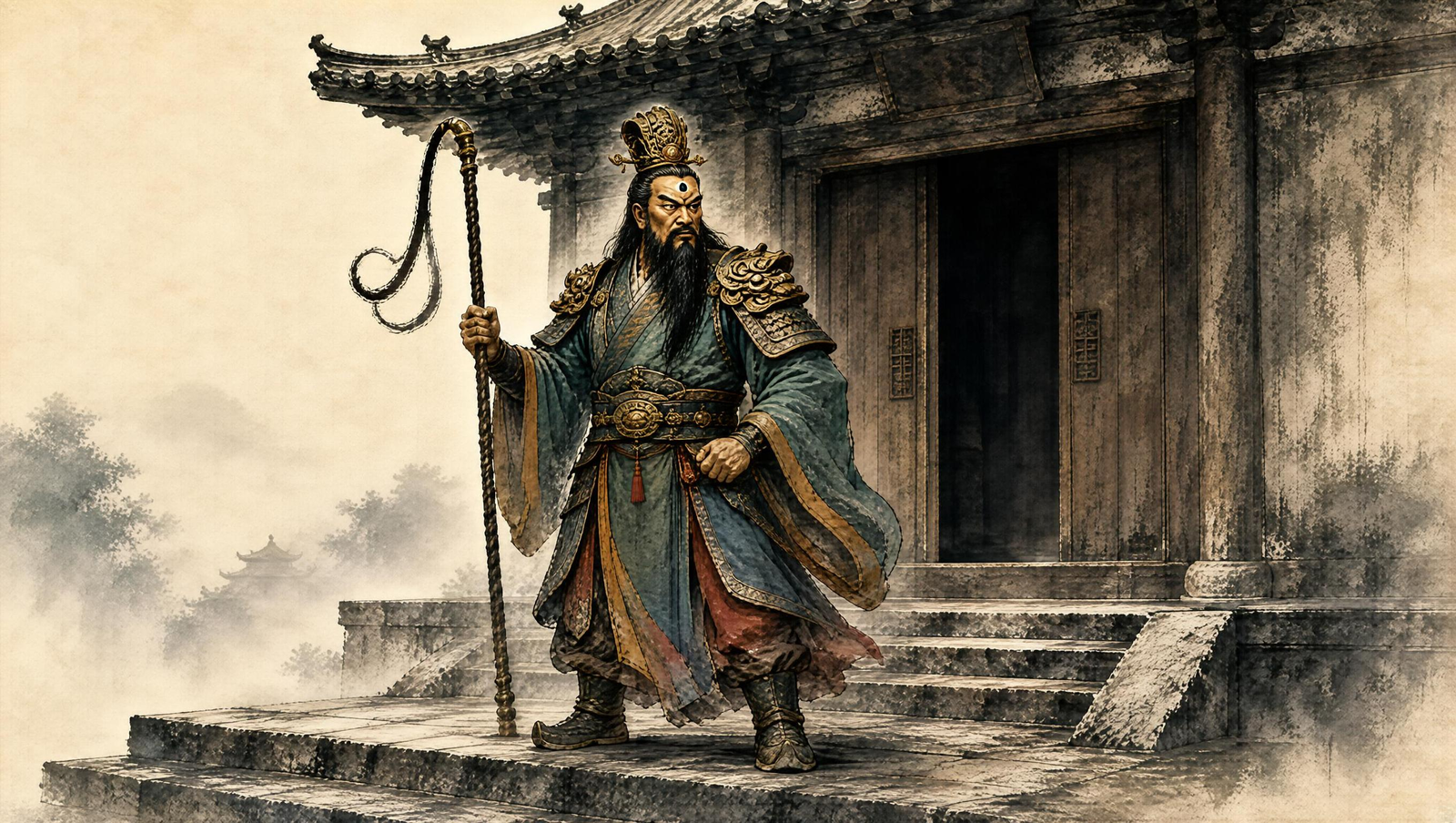
Wang Lingguan is the protector who stands at the entrance of a Zhengyi temple - red-faced, three-eyed, holding a staff, watching everyone who crosses the threshold. He is not a god you petition for wealth or health. He is the guard. Understanding him means understanding what a temple is guarding, and from what.
The officer of the thunder department
He is formally an officer of the Thunder Department, the celestial bureau that Taoism associates with corrective force. His name is Wang Shan (王善), and in the pantheon he holds the office often rendered as Marshal of the Thunder Department, or Protector of the Way.
The standard iconography is unusually fixed across temples:
- A red face, marking fierce and upright energy rather than human complexion.
- Three eyes, the vertical eye in the forehead seeing what ordinary sight misses.
- A staff or whip, usually a metal rod, held as an instrument rather than a weapon of war.
- Armour, because his function is enforced rather than merciful.
In many temples he stands opposite another protector at the second gate, forming a pair. He faces the entrance. He is not turned toward the worshippers; he is turned toward whoever arrives.
The third eye and what it means
The vertical eye is the detail most often noticed and least often explained. In Chinese religious iconography it marks a deity whose perception is not limited to the visible.
That reading matters for how he is honoured. Wang Lingguan is not approached with requests. He is approached with conduct. Traditionally, the offerings at his station are minimal, and the expectation is that the person entering has come for a legitimate reason. His role is to distinguish motive, and the third eye is the statement of that role.
This is why the figure is used in ritual contexts to close a space. A protective boundary in Taoist practice is not primarily a wall of force; it is a declaration of who belongs inside it. Wang Lingguan is the personification of that declaration.
The staff, and why it is not a sword
A staff is a tool of correction. A sword is a tool of killing. The distinction is deliberate.
Taoist protective deities are usually armed with instruments that imply restraint - staffs, seals, cords, bells. The tradition is consistent about this: the point of enforcement is to restore order, not to destroy the disorderly.
The same logic appears in the ritual texts, where the guardian is invoked to stand at the boundary rather than to pursue. Practitioners who work with protection rites will tell you the aim is containment.
Where he stands in a working temple
In a temple of the Zhengyi tradition, the layout runs from the gate inward through progressively more sacred halls. Wang Lingguan belongs to the front.
That placement is functional. The outer halls are where visitors move freely, where shoes come off, where questions get asked. The inner halls are where the lineage's own rites happen. The protectors mark the line between the two.
For anyone visiting a Taoist temple for the first time, knowing the outer-hall figures helps. You will see them before you see anything else, and they are not there to be worshipped in passing - they are there to set the terms of entry. Our Pantheon room walks through the halls in order if you want the fuller map.
How he is honoured
Honouring Wang Lingguan is one of the simpler practices in the tradition.
There is no festival of his own that dominates the calendar, and no elaborate offering pattern in household practice. What is traditional is a lamp, clean water, and conduct. Some lineages include him in the opening invocation of protective rites; that is a priestly matter rather than a household one.
Where he does appear in household settings, it is usually at the door and usually as an image rather than a full altar - the same function as in a temple, scaled to a home. If you are setting up a place of honour at home, the practical guide to a home altar covers placement and upkeep; the guardian's station, if you keep one, belongs nearer the entrance than the altar itself.
What he is not
Two misunderstandings are worth clearing.
He is not a general-purpose luck deity. There is no tradition of asking Wang Lingguan for fortune. Requests of that kind belong to other figures in the pantheon.
He is not interchangeable with every fierce-looking guardian. Temples shelter several protective figures with distinct offices and distinct lineages of transmission. Treating them as one "temple guard" flattens a structure that the tradition keeps deliberately specific.
Anyone who has looked at the pantheon from outside tends to assume the fierce figures are decorative. They are the opposite: they are the part of the system that states where the sacred space begins. Where the major Taoist deities sit in relation to one another gives the upper end of that hierarchy; the guardians hold the lower threshold of it.
Why the Zhengyi tradition keeps him close
Our own lineage is twentieth-generation Zhengyi, with its dharma root at Wuliang Guan on Longhu Mountain. In that tradition the protector at the door is not background scenery. He is invoked at the start of work.
The reason is straightforward. A tradition that performs ritual on behalf of others is claiming the right to do so, and a claim of that kind needs a boundary around it - who may act, in what space, under what authority. Wang Lingguan is the visible form of that boundary.
For a visitor, this changes what the figure is for. He is not watching you as a threat. He is watching to make sure that the room you are about to enter is the room it claims to be. The third eye, the staff, and the red face are all parts of the same sentence.
If you want to see the lineage's own practice rather than read about it - ritual, consecration, or a consultation on a protective matter - you can enquire through the Shop. We answer every enquiry personally, and we ask about the situation before we discuss anything else.
每週智慧,直送你的電郵
隨筆、時令指引與能量洞察——每週一信,絕無雜訊。