The Oath in the Peach Garden
Three men in a blooming peach garden swear brotherhood — not asking to be born the same day, but wishing to die the same day. Guan Yu's loyalty to that oath is the root of his divinity.

關聖帝君
The Sage of Loyalty
Festival · 13th day of the 5th lunar month
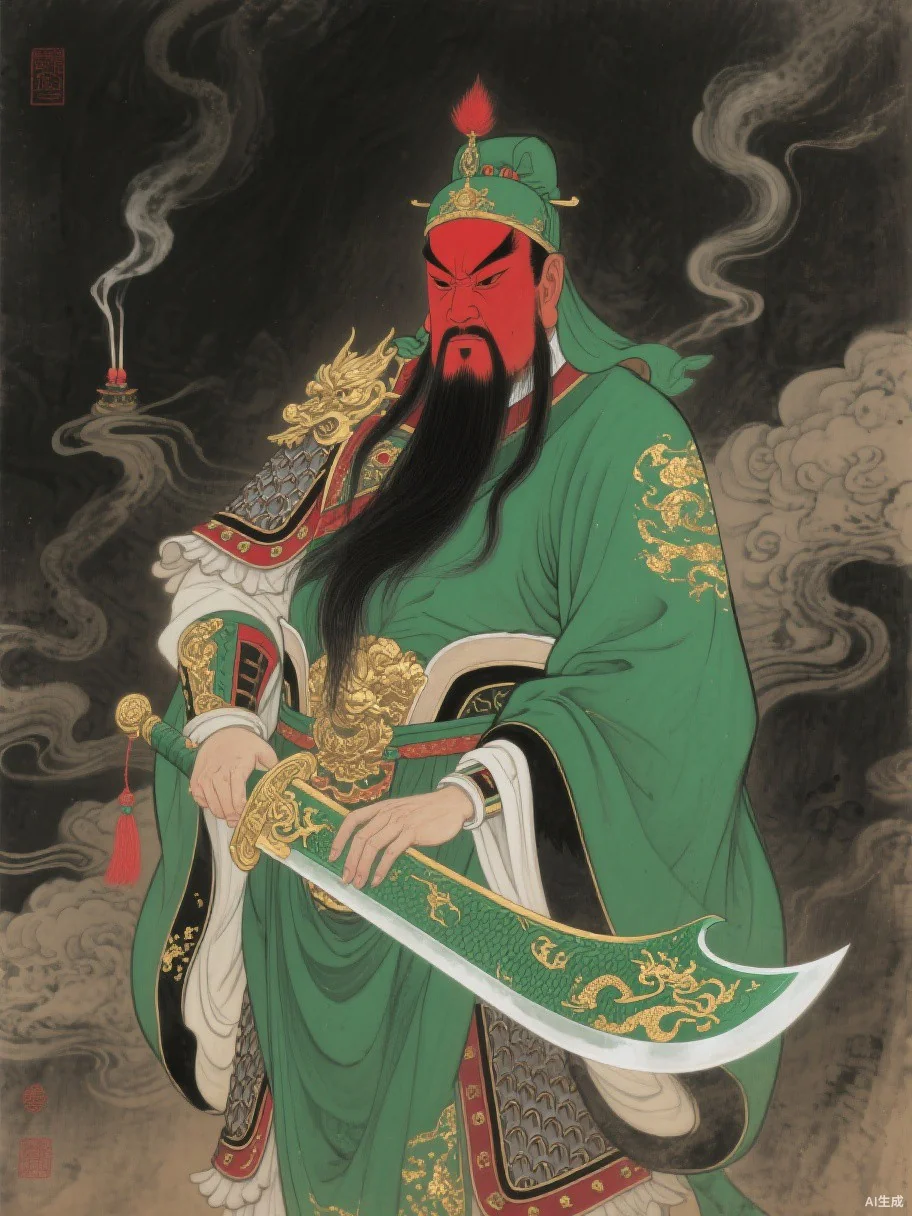
The Sage of Loyalty
The historical general Guan Yu of the Three Kingdoms era, whose loyalty and righteousness were so admired that he was progressively ennobled — by emperors into a god. Police, merchants and martial artists all claim him as patron.
Festival · 13th day of the 5th lunar month
History · 史记
Guan Yu was history before he was god: a general of Liu Bei in the late Han, recorded in the Sanguo Zhi, captured and killed in 220 CE. His deification was slow and cumulative — local temples by the Tang, royal enfeoffments by the Song, the title of Dijun by the Ming — propelled above all by the Sanguo Yanyi, which made his loyalty and righteousness the moral center of China's most beloved novel.
He is patron of war, of business (contracts sealed with his faithfulness), of brotherhood — worshipped in Taoist temples as Guansheng Dijun, in Buddhist monasteries as Sangharama, and in every Chinatown guildhall on earth.
Three men in a blooming peach garden swear brotherhood — not asking to be born the same day, but wishing to die the same day. Guan Yu's loyalty to that oath is the root of his divinity.
Captured by the warlord Cao Cao and showered with gold and honors, Guan Yu sealed the gold, hung up the seals, and rode a thousand li with Liu Bei's wives through five passes, beheading six generals who barred him — fidelity that wealth could not buy.
The classic image: Guan Yu by candlelight, stroking his beard, reading the Spring and Autumn Annals — the warrior as scholar, whose every act was measured against history's judgment.
三國志·關羽傳
The historical record of the man before the god.
三國演義
The Ming novel that turned Guan Yu's loyalty into China's moral archetype.
明史·禮志
Records the Ming imperial enfeoffments that raised him to Guansheng Dijun.