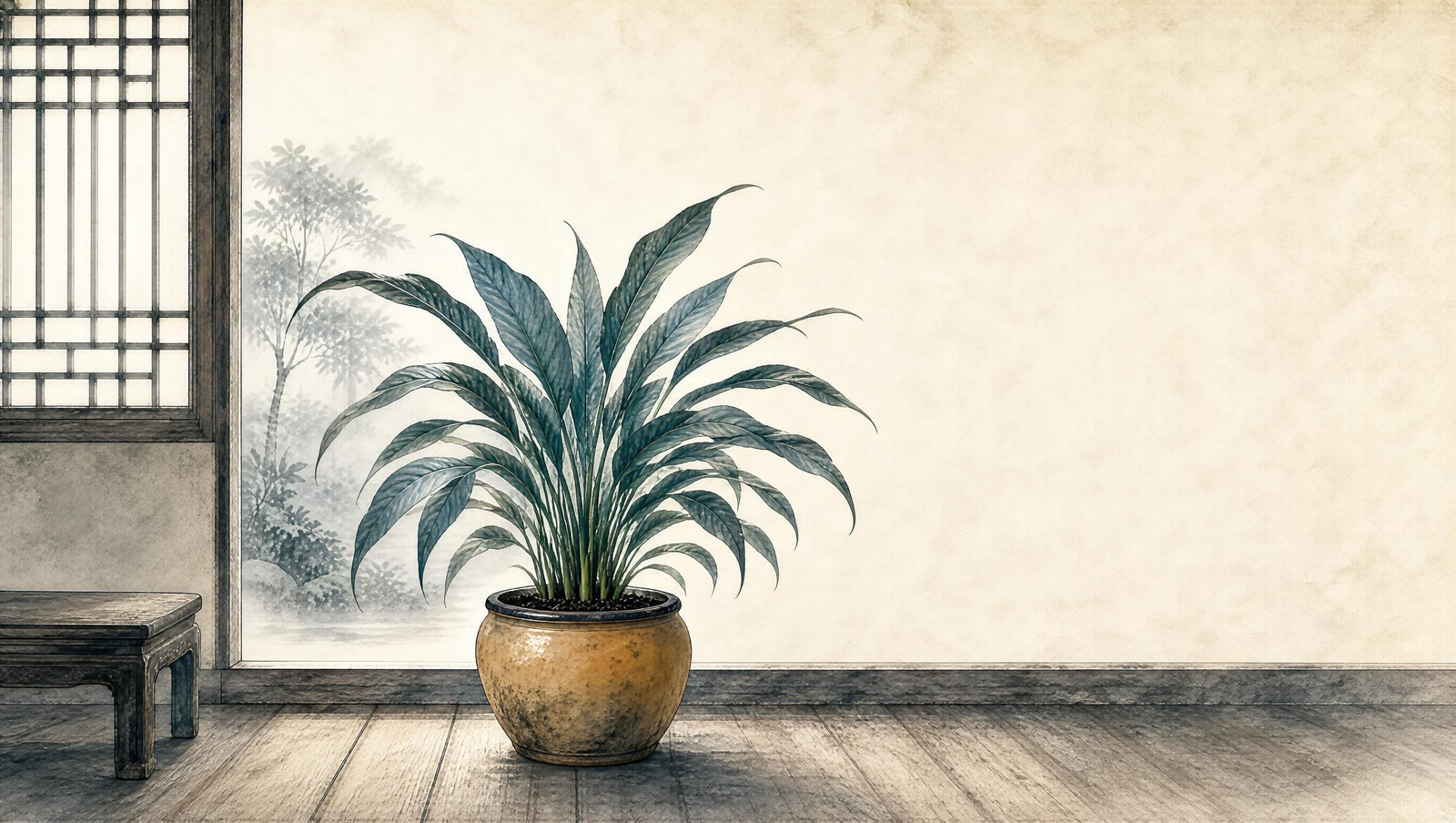
A plant is the cheapest way to add living wood to a room, and the easiest way to block a doorway without noticing. Indoor plants feng shui answers one narrow question: given that the plant stays, where should it stand? The short answer is that a plant belongs where growth is wanted and where nobody has to walk around it — near a window with soft daylight, off the main path between rooms, and never in the straight line between a door and a seat.
Why indoor plants carry more weight than they look
Leaves are the only thing in most homes that is actively growing. That single fact changes how a room reads. Furniture holds its shape; a plant changes weekly, which means the eye keeps returning to it.
The practical consequence is that a badly placed plant is worse than no plant at all. A dead ficus in a corner announces neglect more loudly than an empty corner ever could. Placement is not decoration here. It is the difference between a room that looks maintained and one that looks abandoned.
What a plant actually adds to a room
Three things, and the tradition counts all three.
Wood as an element. In the five-phase cycle, wood feeds fire and restrains earth. A green mass in a corner reads as growth in that sector; a green mass beside a stove or a bank of electronics reads as fuel next to flame.
Slowed air. Leaves break the draught that runs between a window and a door. A room with two or three plants feels less hurried than the same room with none, because the moving air has somewhere to sit.
A fixed point of attention. On entering a room, the eye lands on the largest living shape first. Whatever the eye hits is what the room says. This is why placement outranks species: a modest plant in the right place beats an expensive one in the wrong one.
Where indoor plants should stand
Off the walking line. The most common fault is a planter beside a door, half in the path. Qi is not the only thing that stops moving there — people do too, and every stagger past a pot registers as friction.
Not centred on the front door. A large plant facing the entry reads as a screen. If you want green at the entrance, put it to the side of the doorway rather than dead centre on the opening.
Beside a seat, not behind it. A tall plant behind a chair behaves like a wall; beside it behaves like company. At a desk, the low plant goes to one side of the working surface, never between the desk and the door.
East or southeast for living wood. Those two sectors are the conventional home for a growing plant: east for health and family, southeast for accumulation. A plant there is doing what the sector already wants to do.
Out of the bedroom, unless it is one small pot. Bedrooms are where plants get into trouble. Several large plants in a sleeping room ask the body to share that air all night. One small pot on a shelf is fine; a jungle is not.
Never in the middle of a walkway. A rug, a table or a lamp can centre a space. A plant in the centre of a passage splits the room into two halves that both feel small.
Which plants, and which to leave outside
Classical practice did not name many indoor plants; the tradition grew up around courtyards and potted trees rather than the supermarket shelf. The reasoning transfers if you ask one question: does this plant read as upright growth, or as disorder?
Upright growth — jade plant, rubber plant, bamboo, money tree, clean-fronded ferns — reads as support. It holds a shape and needs little instruction.
Disorder — trailing vines spilling off a shelf, thorns at eye height, anything dying and not yet thrown out — reads as an unresolved problem in the room.
Two cautions recur. Thorned plants such as cactus and bougainvillea belong outdoors, or at least away from seats, because the points are read as directed energy. And a spiky, reaching plant should never sit beside a bed or in the place where you sit to work.
Light, water, and the part feng shui cannot fix
The tradition can tell you where a plant should stand. It cannot keep it alive. A plant moved into a dark corner because that corner "needs energy" will decline within weeks, and a declining plant drags the whole reading down with it.
So the order of operations runs the other way. Find out how much light a wall actually receives, choose a plant that suits that light, then place it where the rules above allow. A south-facing windowsill suits the greediest plants; an internal bathroom with no window suits almost none.
Water behaves the same way. Overwatering kills more houseplants than any other cause, and a pot standing in water reads as damp stagnation. Drainage matters more than frequency.
A five-minute check
Stand at the room's main door and look in.
- Is a large plant in the walking line? Move it half a metre.
- Is the first thing your eye lands on a plant — and is it healthy? Healthy, keep it; failing, replace it.
- Is there a plant beside the bed, behind a chair, or centred on the entry? Relocate it before buying anything else.
If you want the framework behind those calls — what wood does to a sector, and how sectors are drawn — the feng shui FAQ covers it in a few short answers, and the free tools include a bagua map you can lay over a floor plan. For the wider picture, read feng shui basics and clearing stagnant qi.
每週智慧,直送你的電郵
隨筆、時令指引與能量洞察——每週一信,絕無雜訊。