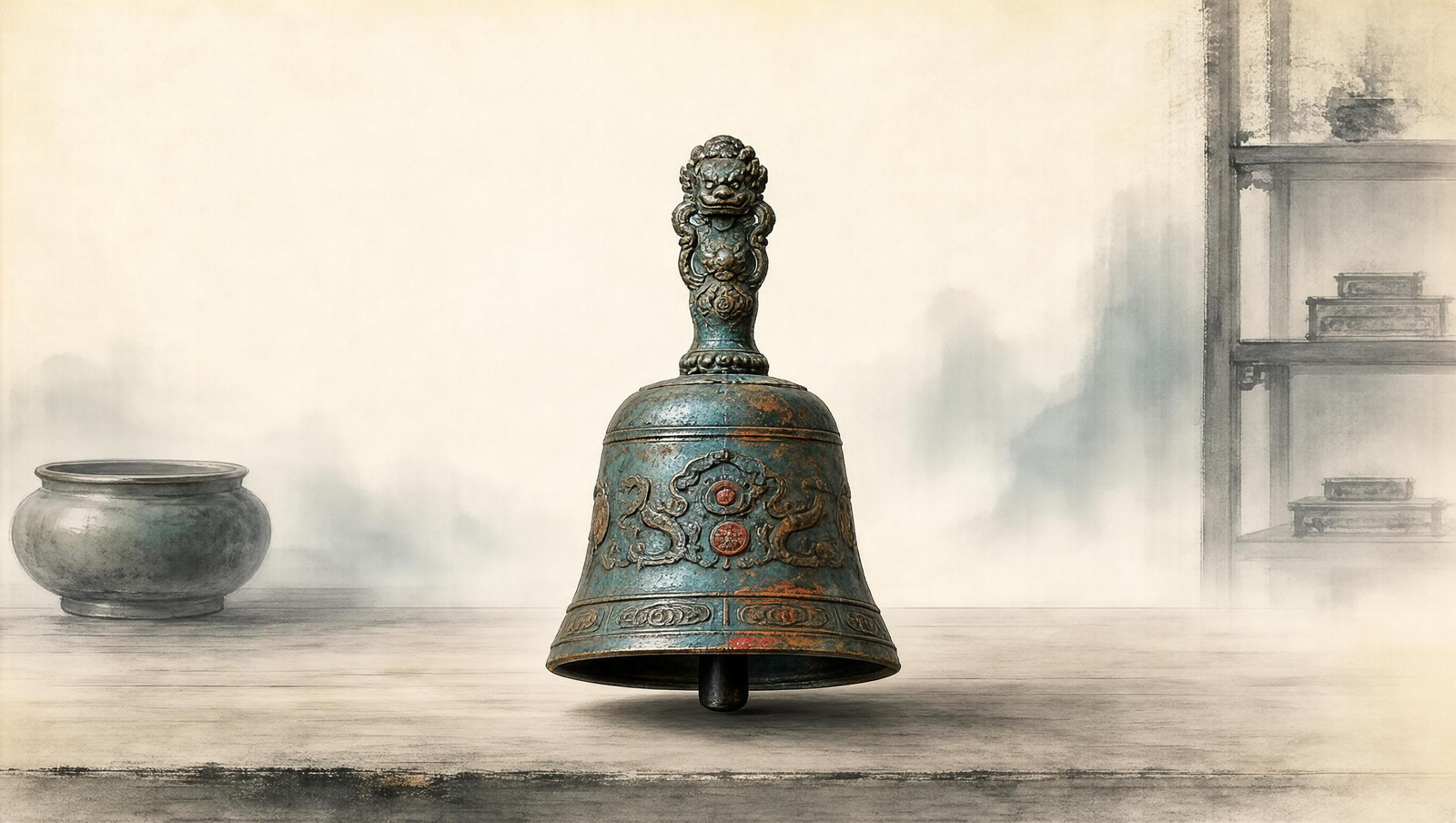
Taoist ritual objects are read in three layers: what the object does, who was allowed to use it, and when it was made. Most visitors stop at the first layer — a censer is a censer — and miss the two that carry the actual information.
Function, rank, date: the three layers
A temple hall is not a collection of antiques on display. It is a working room, and every object in it is placed where it is needed during a ritual. That gives you the first layer: function. Where does the object stand in relation to the altar, the celebrant and the congregation?
The second layer is rank. In a Taoist temple, and in the daomind documentation of a collection, an object's material, size and colour often encode the status of whoever commissioned it. A bronze censer and a ceramic censer are not interchangeable; one was paid for by a patron with money and obligation attached.
The third layer is date. Inscriptions, casting marks and the style of a deity's crown narrow an object down to a century, and sometimes to a workshop. That is where a gallery label usually stops, and where the interesting questions start.
Censers and incense burners
The censer is the object most visitors recognise and least often look at properly. Three details repay attention:
- The legs. Tripod censers echo ancient bronze ritual vessels, a deliberate reference rather than a manufacturing default.
- The handles. Ears or upright handles indicate how the censer was lifted and moved, which tells you how heavy ritual days were.
- The lid and openings. A censer with a pierced lid for smoke release was built for indoor halls; a shallow open bowl was built for courtyards.
Note also what sits inside the censer. Accumulated ash is not dirt; in many halls it is maintained deliberately, and visitors are asked not to add or disturb anything.
Seals, registers and talisman blocks
A working temple needs paperwork as much as it needs furniture. Seals authenticate a document; registers record names submitted for a ritual; printing blocks are what actually produce a talisman at scale — a carved wooden block, inked and pressed, is the origin of the sheets handed to worshippers.
When you see a seal or a block in a collection, the useful question is what it was for: a temple's administrative seal, a lineage's transmission seal, and a talisman block with a specific deity's title all look like carved stone or wood and mean completely different things.
Talismans themselves are covered separately in the article on the origin of the fu, where the writing conventions are explained.
Robes, crowns and rank
Textile is fragile, so robes and crowns survive less often than bronze, and what survives is therefore more informative. Colour, the number of embroidered panels, and the presence of a five-peak crown all indicate the celebrant's rank and the tradition the hall belonged to. A patched robe in a collection is not a poor object; it is evidence that the hall's celebrants were working, not performing.
Inscriptions: the part most people skip
Four kinds of text appear on ritual objects: donor inscriptions, date marks, scriptural quotations, and deity titles. Donor inscriptions are the richest. They usually carry a year, a place name, a family name and a stated purpose — a vow fulfilled, a safe return, a birth.
If you read only one thing on an object, read the donor inscription. It converts a beautiful item into a dated event.
Practical notes for a first visit
The Jakarta Post's guide to temple etiquette puts the essentials plainly: dress modestly, do not touch altars or objects, and step aside when worshippers are praying rather than filming over their shoulders. Collections held outside active temples have looser rules but the same courtesy. Ask before photographing, and never handle an object a case was built to protect.
Where to start on this site
The collection gallery is the fastest way to see the categories above side by side. If you have an object at home and want to know whether it belongs on an altar, the home altar guide covers placement and upkeep.
For questions about what an object is used for, the FAQ hub answers concept-level questions directly, and the free tools cover the calendar and direction tools that go with ritual practice. If you want a specific object identified or a piece assessed for altar use, a consultation is the appropriate route — bring photographs, and note any inscription exactly as it appears.
每週智慧,直送你的電郵
隨筆、時令指引與能量洞察——每週一信,絕無雜訊。