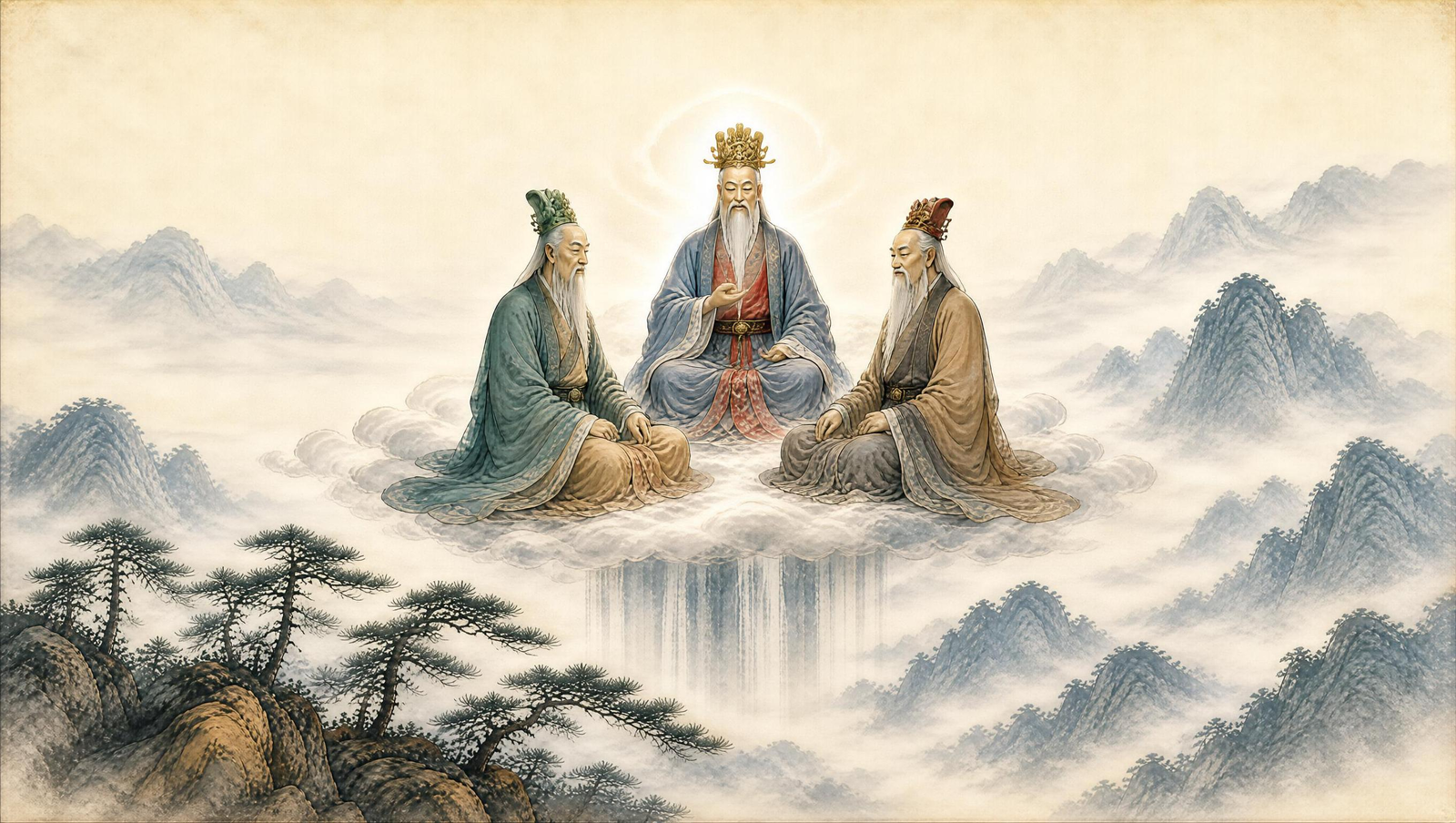
The Three Pure Ones (三清, Sānqīng) sit at the summit of the Taoist pantheon. They are not distant kings but three emanations of the Tao itself—primordial, numinous, and manifested—enshrined at the heart of virtually every major Taoist temple. To meet them is to meet the Tao looking back at itself in three mirrors.
The Three Figures
- Yuanshi Tianzun (元始天尊), the Celestial Worthy of Primordial Beginning, source of all that is.
- Lingbao Tianzun (靈寶天尊), the Celestial Worthy of Numinous Treasure, who reveals scripture and method.
- Daode Tianzun (道德天尊), the deified Laozi, who teaches the Way through the Tao Te Ching.
The CBETA digital canon preserves the liturgical texts that venerate them, anchoring their worship in written tradition (cbeta.org).
Emanations, Not Rulers
Unlike a heavenly emperor, the Sanqing do not govern by command. The Global Daoism Archive describes them as the Tao's self-expression at three registers of reality—beginning, treasure, and virtue (dao.jic.io/resources). The Chinese Academy of Social Sciences' Institute of World Religions places their emergence within the organized Taoist religion that took shape from the second century CE (iwr.cass.cn).
The Tao Te Ching Connection
Daode Tianzun is venerated as the author of the Tao Te Ching, the foundational scripture attributed to Laozi. In this light the Three Pure Ones are not only gods but the living voice of the tradition's core text—primordial source, revealed teaching, and embodied wisdom held together as one.
The Sanqing in Ritual
In daily liturgy the Sanqing receive the first and highest offerings. Their hall stands at the centre of the temple plan, oriented so that every rite passes through their presence. Academia Sinica's classical-text resources document how their icons and titles stabilized across dynasties (hanchi.ihp.sinica.edu.tw).
The Three Pure Ones in Art
In painting and statuary the Sanqing are usually shown seated, serene, and richly robed. Yuanshi often holds a tablet or radiates light; Lingbao bears a scroll or a ruyi scepter; Daode carries the Tao Te Ching or a feather fan. Their triad crowns the altar's vertical axis, visually teaching that all rites ascend toward the source.
Sanqing Across Taoist Schools
Both the Zhengyi (正一) and Quanzhen (全真) lines venerate the Sanqing, though they emphasize different practices beneath them. Our own Zhengyi lineage, rooted in Longhu Mountain, places the Sanqing Hall at the center of every service—a constant reminder that whatever the method, the aim is reunion with the Tao.
Why Three, and Not One?
The number three reflects the Taoist grammar of generation: from the Tao comes the One, from the One the Two, from the Two the Three, and from the Three all things. The Sanqing personify this cascade—not a committee of gods but the Tao describing itself in stages the human mind can approach.
A Living Triad
Devotees do not relate to the Sanqing as an abstract doctrine but as presence. In a temple one bows first to Yuanshi, receives method from Lingbao, and seeks daily guidance from Daode—a rhythm of source, teaching, and practice that mirrors the believer's own path from confusion to alignment.
Where You Meet Them
Step into any orthodox temple and the Sanqing Hall (三清殿) greets you first. One of the three, Daode Tianzun, is the focus of our dedicated profile of Tai Shang Lao Jun; for a concise overview, see Who are the Three Pure Ones? in our FAQ.
To honor the Three Pure Ones is to remember that the highest in Taoism is not power over others, but the Tao expressing itself as light, teaching, and virtue.
繁體中文版本:三清:道教最高的三尊神
每週智慧,直送你的電郵
隨筆、時令指引與能量洞察——每週一信,絕無雜訊。