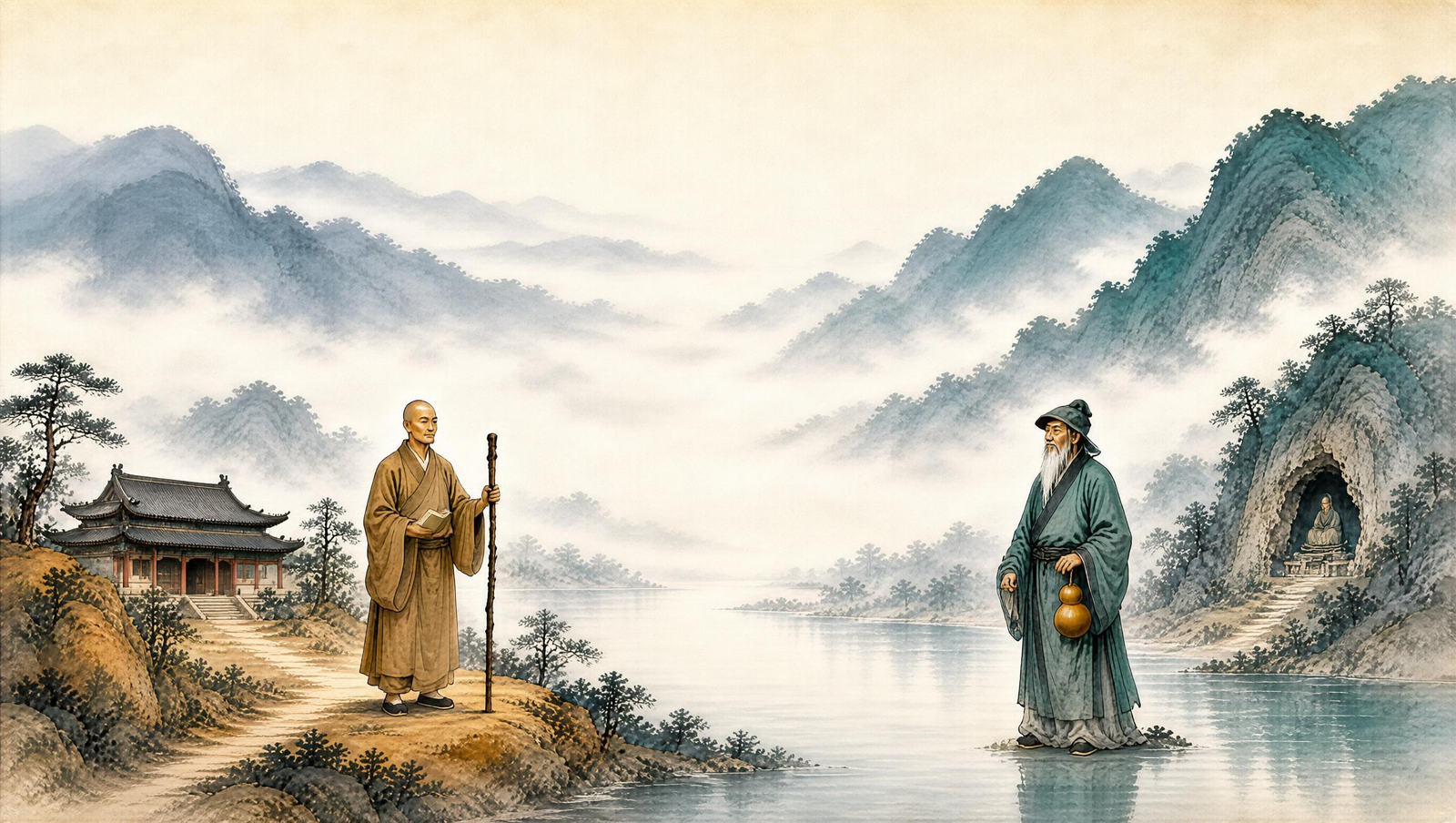

Taoism as an organized religion developed a clearer institutional shape somewhat later than Buddhism in China - but this is a story about structure, not about which wisdom is older. The philosophical roots of Taoism (Laozi, Zhuangzi) predate organized Buddhism, while Buddhism arrived as a fully formed monastic religion and forced Taoism to organize in response.
The philosophical roots came first
Taoist thought begins with the Tao Te Ching and Zhuangzi, dating to the centuries around 500-300 BCE. These are philosophical, not institutional: no clergy, no temples, no order. So although taoism and buddhism both speak to the spiritual life, early Taoism was a stream of thought, not a church with buildings and ranks. The ideas were already ancient when Buddhism appeared; what was missing was not insight but organization.
Buddhism arrived as a ready-made institution
Buddhism entered China from India around the first century CE with monasteries, ordained monks, a canon, and a clear community structure. That made it easy to spread and to gain court patronage. The Institute of Ethnology at Academia Sinica notes that Buddhism's imported monastic model gave it an organizational head start in Chinese society, letting it plant roots quickly (Academia Sinica). A tradition that already had abbots, rules, and a library could be transplanted wholesale, whereas Taoism had to be assembled from scattered teachers and local cults.
Taoism's organized response
Religious Taoism consolidated only around 142 CE, when Zhang Daoling founded the Celestial Masters (Tianshi Dao) - the Zhengyi lineage root. Fu Jen Catholic University's Centre for Daoist Studies documents how Taoist institutions then built their own canon, clergy, and rites to stand beside Buddhism (Fu Jen Centre for Daoist Studies). The Journal of Daoist Studies likewise frames this as a period of deliberate institutional-building rather than decline. Faced with a rival that was visible, funded, and organized, Taoist communities chose to formalize - and in doing so created the religion we recognize today.
Why the delay is not a defeat
The later formalization does not make Taoism younger in wisdom. Its core insight - living in harmony with the Tao - is among the oldest native Chinese teachings. The two traditions then grew side by side for two millennia; how Taoism differs from Buddhism explains where their centers of gravity diverge, and Who founded Taoism? tells the founding story. A philosophy does not need a headquarters to be profound, and the Taoist impulse was never absent - it was simply expressed through nature, family, and craft before it was expressed through institutions.
A note on evidence and dates
The dates here are scholarly conventions, not dogma. The Tao Te Ching's final redaction, the rise of the Celestial Masters, and Buddhism's first footholds in Luoyang all fall within ranges that specialists still debate at the edges. What is not in serious doubt is the pattern: a native philosophy became an organized religion only once it met an imported one that was already organized. Structure followed contact, not the other way around, and that sequence says more about sociology than about truth.
Living side by side today
Rather than rivals, taoism and buddhism in China long borrowed from each other - shared festivals, shared temples in some regions, shared vocabulary. Our comparison Taoism vs. Buddhism walks through the differences a seeker actually meets, from views of the self to practices of cultivation. To ask which came first as an institution is interesting, but the more useful question is how each can serve a life lived in harmony with the way things are.
中文讀者請見:為什麼道教發展晚於佛教?
每週智慧,直送你的電郵
隨筆、時令指引與能量洞察——每週一信,絕無雜訊。