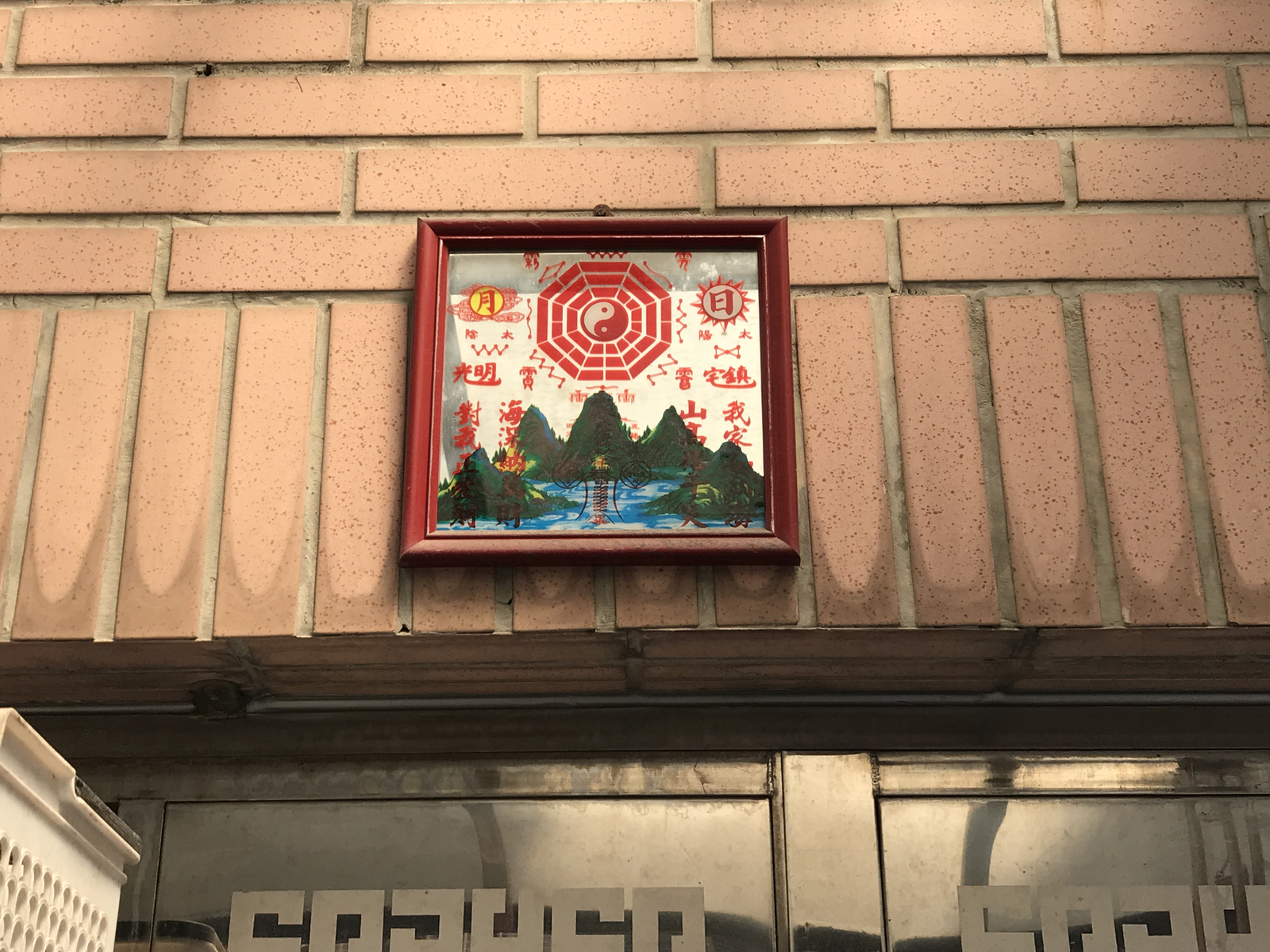
A reader in Kuala Lumpur sent a photograph last month: a small convex mirror bolted above her front door, angled at the lift lobby. Her neighbour had hung one first, she explained, and she wondered whether copying him was the right move. That question — not any diagram — is what bagua mirror placement really comes down to. A mirror is a reactive tool, and a mirror answers a mirror.
Three shapes, three different jobs
Chinese household mirrors are not interchangeable. Shape decides function.
- Flat mirrors (平鏡) return an image undistorted. They are the mildest option and the least controversial.
- Convex mirrors (凸鏡) compress a wide angle into a small disc. Their traditional job is to spread and scatter whatever arrives, which is why they hang outdoors facing outward.
- Concave mirrors (凹鏡) gather rather than scatter. Older manuals reserve them for collecting what has been dispersed, and they are the shape most often hung indoors.
A second distinction matters just as much: the eight-sided frame. The 八卦 outline is not decoration. Each side carries a trigram, so the disc is read as a small model of the eight directions — which is why the object must be oriented, not merely nailed up.
Where a bagua mirror belongs
Outside is the short answer. Traditionally the disc sits above or beside an exterior door, tilted slightly downward, aimed away from the household at whatever the door faces: an opposing corner, a service shaft, a sharp roofline, a long straight corridor.
Height matters more than angle in practice. A mirror mounted at head height catches the eye of everyone who enters, including guests, and guests who feel watched do not settle. Mount it above the doorframe so it reads as part of the lintel rather than as a warning.
One mirror per exposure is enough. Stacking three discs on a single door, which is common in older residential blocks, adds noise without adding protection.
Places that should stay mirror-free
Interior placement splits practitioners more than exterior placement does, but a few rules hold across lineages.
- Bedrooms. A mirror that faces a sleeping person is the single most common complaint. It doubles the room's activity at the hour when the body is trying to release it.
- Directly facing an inward door. A disc hung inside, aimed at your own entrance, sends arriving movement back out again.
- Above a dining table or desk. Seated work and shared meals want a settled surface overhead, not a reflective one.
- Facing a shrine or altar. Reflective surfaces near a household altar create a second, offset shrine in the glass.
If a mirror is already fixed and cannot be removed — a mirrored wardrobe, a rental flat's wall panel — covering it with fabric after dark is the usual compromise. Nothing needs to be bought.
When a neighbour's mirror faces your door
This is the scenario that generates the most correspondence, and the answer is usually deflating: do nothing dramatic.
A disc aimed at your entrance is a disc aimed at an entrance. It has no mechanism, no stored intent, and no reach beyond the doorway it occupies. What it does create is a daily irritation every time you leave the flat, and sustained irritation is worth treating on its own terms.
Practitioners suggest, in order of escalation:
- Close the door properly. A solid door already does most of the work.
- Place a leafy plant between the two exposures, or hang a heavier curtain.
- Hang a small gourd, which is a soft, rounded remedy rather than a competing mirror.
- Hang a mirror of your own only if you accept that the exchange never ends at two.
The last option is the one most Taoist practitioners decline. Adding a mirror to answer a mirror is an arms race with no floor.
Aligning the remedy with Taoist practice
Within Taoist practice, mirrors belong to the class of objects called 法器 — ritual implements rather than décor. The 照妖鏡 of temple tradition is used by priests in a defined liturgical setting, with a purpose beyond domestic tidiness. A shop-bought disc above a door inherits the shape of that tradition without its context, which is why lineages differ on how much weight to give it.
The practical version, and the one DaoMind's practitioners use, is subtractive: fix the door, fix the light, fix what the entry looks at, and treat the mirror as the last five per cent. If you want to see which direction an entry actually opens toward before deciding, the free bagua layer inside our Ba Zi and feng shui tools will plot the eight sectors of a home from its facing direction — no account needed.
For homes where the entrance sits opposite a lift, a stairwell, or a building corner and rearrangement is not possible, a short consultation is usually more useful than a purchase. The booking page lists what a session covers, and it starts with photographs rather than prescriptions. If you only want the underlying concept first, what feng shui actually measures is the better starting point, and the plain-language definition in our FAQ covers the vocabulary.
What practitioners actually advise
Ask three practitioners where to hang the mirror and you will get three answers, because the object is a ritual gesture dressed as a remedy. The gesture is not useless. Marking an entrance with care changes how a household uses that entrance, and how a household uses its entrance changes the house.
Hang one only if you can explain, out loud, what it is for. If the honest answer is "the neighbour has one", leave the door bare. A quiet entrance is not a vulnerable one.
Weekly wisdom, straight to your inbox
Essays, seasonal guidance, and energy insights - one letter a week, no noise.
DaoMind Pro
Read your own chart
Generate your full Ba Zi chart and elemental balance - the same data a practitioner opens with.
Open Destiny Atlas →