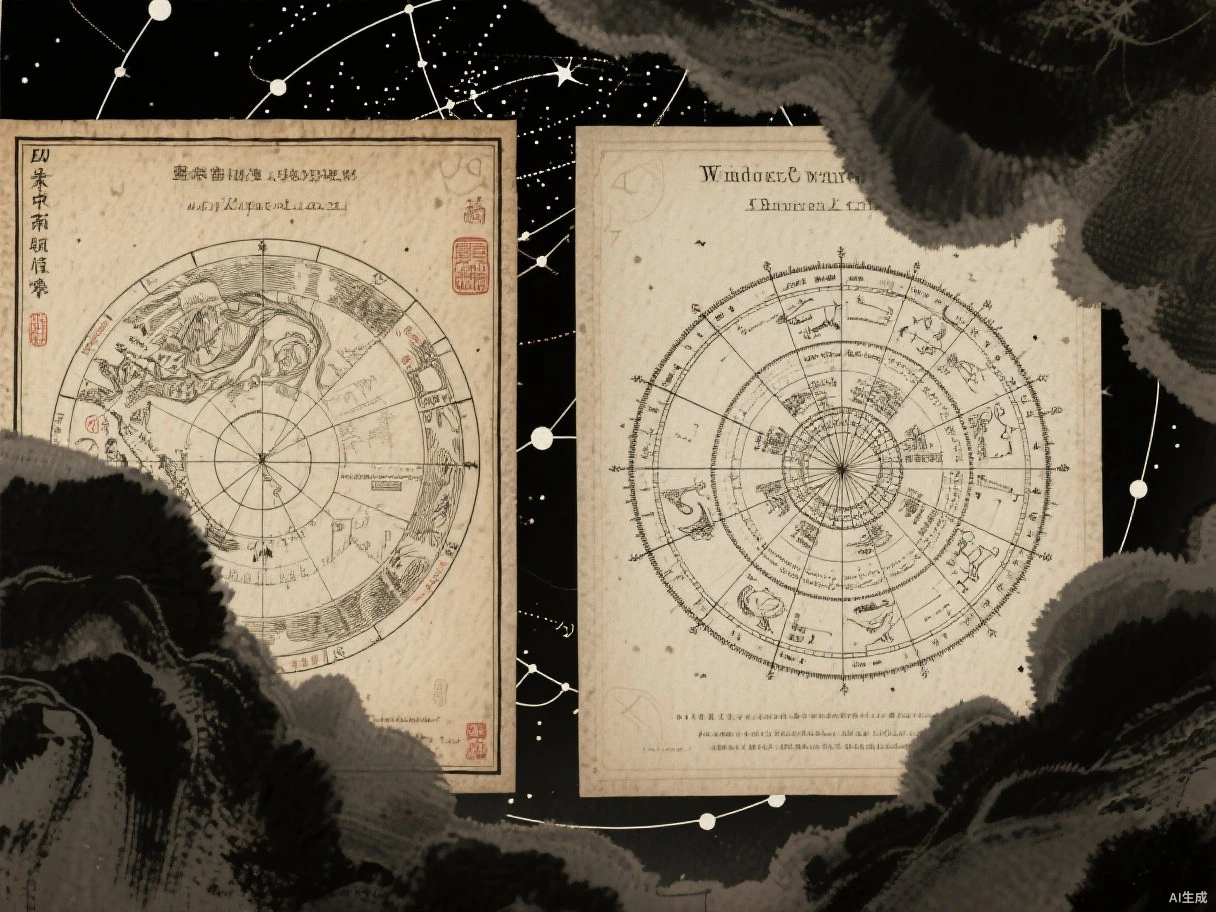
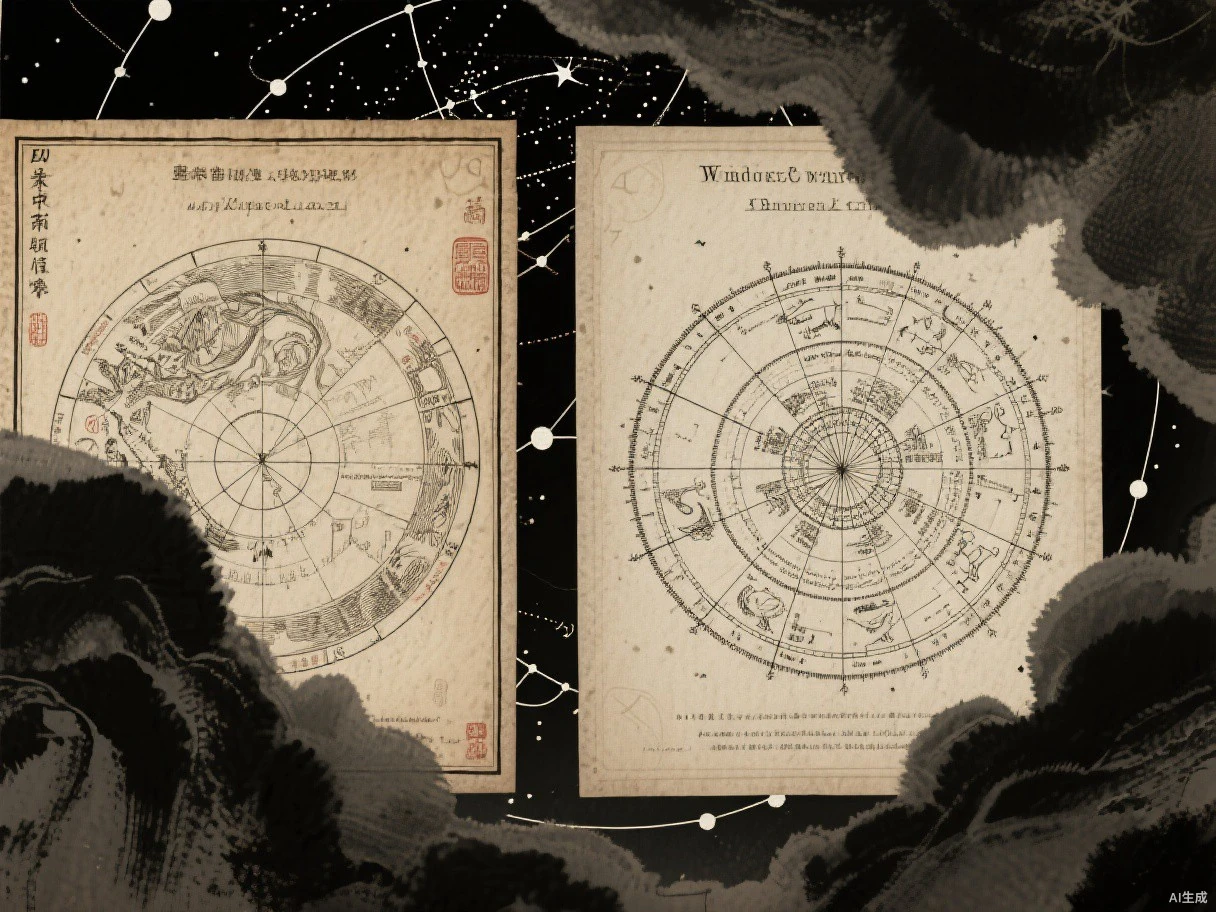
Two systems, one human question
Both Chinese and Western astrology answer the same question - "what is the shape of the life I entered?" - but they were built from different observations. Western astrology tracks the sky as seen from Earth: the planets' positions along the ecliptic, divided into twelve equal zodiac signs of 30 degrees each. Chinese astrology, in the ba zi (Four Pillars) system, tracks time as cycles of qi: the year, month, day, and hour converted into ten Heavenly Stems and twelve Earthly Branches, each carrying an element and a phase. (The short version is in the astrology FAQ.)
The difference is not which one is right. They are two cameras pointed at the same event from different angles - one from the planets outward, one from the calendar inward. Knowing what each measures tells you when to use which.
How the chart is computed
Western natal chart - you need the date, time, and place of birth. From the place, the local sidereal time is calculated; from that, the ascendant and the house cusps are fixed. The Sun, Moon, and planets are then placed in signs and houses. The chart is a 360-degree wheel of the sky at the moment of birth.
Ba Zi (Four Pillars) - you need the date and time of birth, but not the place (the place only matters for true solar time correction, a small adjustment). The calendar is the sexagenary cycle: 10 stems x 12 branches = 60-pair cycle. Four pillars are built from the year, month, day, and hour:
- Year pillar - the broadest context, the ancestry, the social environment you were born into
- Month pillar - the season, the dominant element, the deepest single influence on your day-master
- Day pillar - your "self," the day-master element that everything else is read against
- Hour pillar - your aspirations, your children, your late-life direction
Each pillar is one stem (element + yin/yang) and one branch (animal + element + hidden stems). A full chart has eight characters - hence the name Ba Zi, "eight characters."
What each measures
| Dimension | Western | Ba Zi |
|---|---|---|
| Frame of reference | Sky (planets) | Time (cycles) |
| Foundational unit | Sign (30° of ecliptic) | Pillar (stem + branch) |
| Element system | 4 elements + qualities | 5 elements + generating/controlling cycles |
| "Self" indicator | Sun sign | Day-master stem |
| Reading method | Aspects (angles) | Generating/controlling relationships |
| Strength | Psychological portrait, archetypes | Elemental balance, life timing |
| Cultural register | Greek-Roman mythic | Chinese classical + relational |
Where Western astrology is stronger
Western astrology is a refined language for psychological texture. Because it tracks ten bodies across twelve signs and twelve houses, it generates dense, nuanced portraits of inner life - the way a person holds tension, where they project, what kind of love they seek. The archetypes (Sun/Moon/Venus/Mars, the twelve signs) are widely understood, which makes the reading shareable. If you want to talk about your chart at a dinner party, Western astrology is the lingua franca.
It is also stronger for understanding relationships through synastry - the overlay of two natal charts to see where one person's Venus falls in the other's seventh house, where the Saturn contacts land, where the chemistry and the friction live.
Where Ba Zi is stronger
Ba Zi is a refined language for timing and elemental balance. Because it is built from time cycles rather than sky positions, it generates an unusually clear read on the phases of a life - the ten-year luck periods, the annual pillars, the moments when the support shifts from one element to another.
It is also stronger for relational and material pattern recognition. The day-master's relationship to the other seven characters - which elements generate it, which control it, which it controls - tells a story about resources, authority, expression, and outcome that maps cleanly onto how a life unfolds in practice.
And because the system is built on the five elements with their generating and controlling cycles, the diagnosis is actionable in a way Western aspects are not: if your day-master is weak Wood and the chart is dominated by Metal (which chops Wood), the cure is Water (because Water generates Wood and exhausts Metal). The reading points at a direction, not just a description.
Can you use both?
Yes, and many practitioners do. The two systems rarely contradict each other on the large strokes - a Western chart with Sun in Aries and a prominent Mars will, almost invariably, also show a strong Fire/Wood signature in the Ba Zi. Where they differ is emphasis and precision. Western tells you what kind of person; Ba Zi tells you when and through what elemental pattern.
For a starting read of your own, the Destiny Atlas generates a full Ba Zi chart with the day-master analysis, elemental distribution, and pattern recognition. For the Western side, the Celestial Compass gives you the natal chart, planets in signs, houses, and aspects - the same data a Western astrologer would use.
The honest answer to "which is better" is: neither. They were built for different terrains. Ba Zi for time and balance, Western for psyche and relationship. A full picture uses both.
Weekly wisdom, straight to your inbox
Essays, seasonal guidance, and energy insights - one letter a week, no noise.
DaoMind Pro
Read your own chart
Generate your full Ba Zi chart and elemental balance - the same data a practitioner opens with.
Open Destiny Atlas →