A home altar is a fixed place where you put your attention, not a shelf of lucky objects. The traditional rules for a home altar - where it faces, what stands on it, what it must never face - all exist to protect one thing: that the spot stays quiet, clean, and undisturbed. Get that right and the rest is detail.
Where a home altar belongs
The classical preference is a room that is not a bedroom and not a passage. A study, a spare room, or a deep corner of the living room all work. What matters is that no one walks through the space on the way to somewhere else.
Three placements are traditionally avoided. Do not set the altar facing a bathroom door, a kitchen stove, or the foot of a bed. The reasoning is not magical fear but attention: a place of stillness pointed at a place of waste, fire, or sleep cannot hold its character. It becomes furniture.
Height matters too. The altar surface should sit above waist level and, when you stand before it, roughly at eye level or a little below. You should be looking slightly up or level - never down. This is why a chest of drawers often serves better than a low coffee table.
If the household has no spare room, a wall-mounted shelf in a quiet corner is entirely acceptable. Many practising families keep exactly that: one small shelf, one lamp, one image, kept scrupulously clean.
Direction: what the tradition actually says
Direction is the part most often over-thought. Two rules cover most cases.
First, the altar should not face the main door directly. An altar aimed straight at the entrance sits in the path of every coming and going - the qi of the household passes through it rather than settling. If the room only allows this, angle it slightly, or place a screen between.
Second, the altar should not be placed under a staircase, under a beam, or directly beneath a ceiling slope. These are all versions of the same objection: something presses down on the spot. Practitioners describe it as pressure on the head of whoever stands there.
Everything beyond these two rules is lineage-specific and can be adjusted by a practitioner who has seen the actual room. What a Taoist spiritual diagnosis looks at covers how the layers of a space get read together.
What stands on the altar
Keep the arrangement spare. A crowded altar turns into a display case, and display cases do not hold attention.
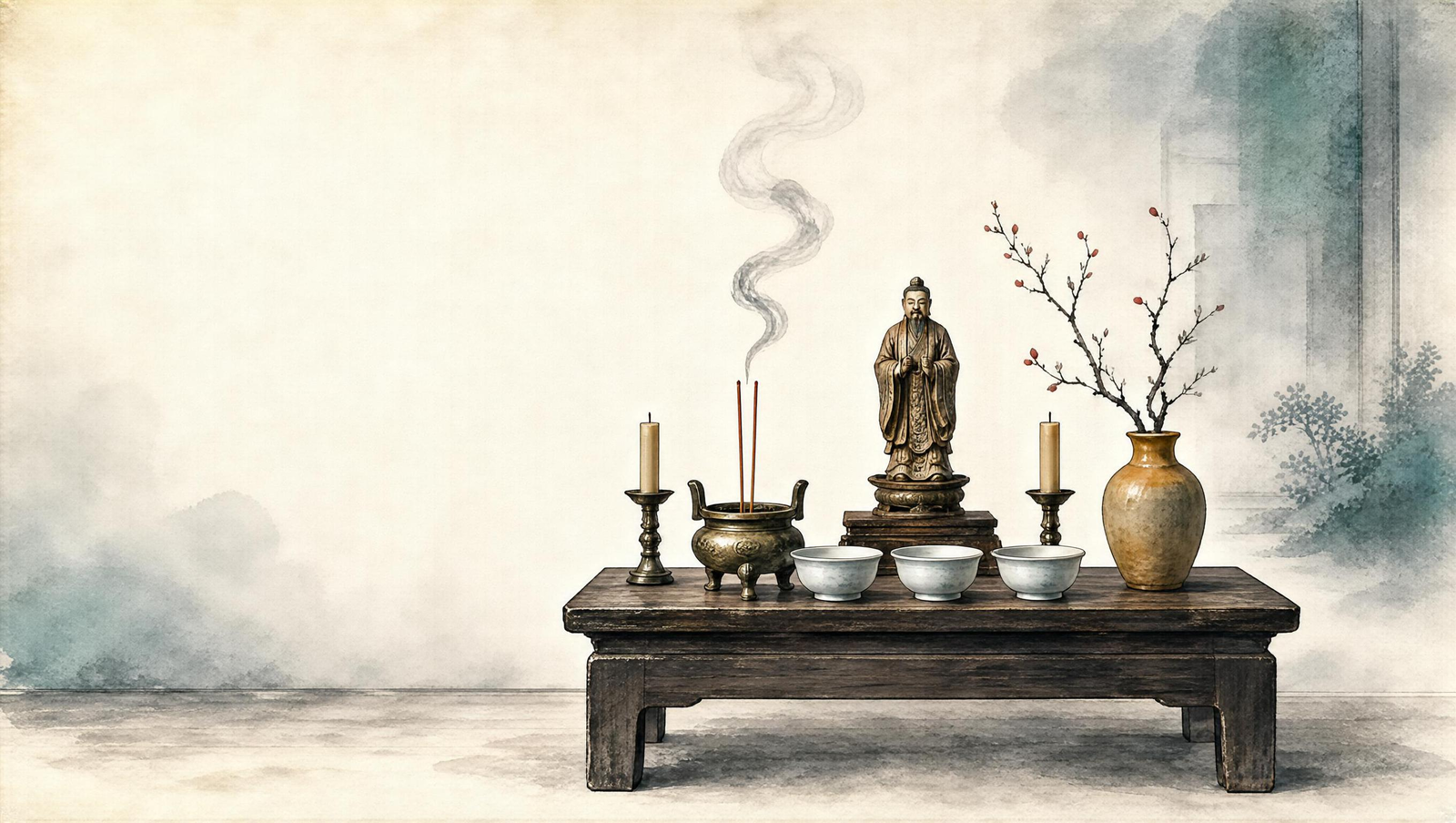
The core is three things: a light, a vessel for water, and an image or tablet of the deity or ancestor you are honouring. A small incense holder is the fourth if smoke is acceptable in the room.
- Light. A single lamp or candle. Electric is fine; many temples now use it. The lamp marks the altar as awake.
- Water. A small cup, changed daily. This is the practice most people drop first and the one that matters most - the daily act of changing it is the altar's heartbeat.
- Image or tablet. A statue, a print, or a written name. If you honour ancestors rather than a deity, a tablet with names serves.
- Incense. Optional. One stick, not a bundle.
Everything else - coins, crystals, collected trinkets - should be kept off the altar surface. Store them elsewhere or not at all. The tradition is not against objects; it is against a surface that has stopped meaning anything.
Fresh fruit may be offered and should be removed before it spoils. This is a practical instruction as much as a ritual one: an altar with rotting fruit is an altar nobody is tending.
The altar and the rest of the room
An altar does not need its own room, but it does need visual quiet. Do not place it above a television, a computer that stays on, or a stack of unfinished paperwork. If the room is shared, the altar corner should read as a different kind of space even from across the room.
Mirrors deserve a note. A mirror facing the altar doubles it, and while some lineages accept this, most advise against it - the doubled image reads as restless rather than settled. The simplest fix is to move one of the two.
Keeping the altar, week by week
An altar is maintained, not installed. The traditions that treat this seriously give very ordinary instructions.
| Cadence | Action |
|---|---|
| Daily | Change the water; light the lamp for a few minutes |
| Weekly | Wipe the surface; dust the image; clear anything that drifted onto it |
| Monthly | Check fruit and flowers; air the space |
| Yearly | Clean the whole shelf; review whether the arrangement still means what it did |
The daily water change does more than any elaborate rite. It is the one act that keeps the altar from becoming decoration, because it forces you to stand in front of it every single day.
If you miss days, do not add penance. Resume. The tradition has no interest in guilt, only in the pattern.
Offerings and what to do with them
Fruit, flowers, and clean water are the standard offerings. Meat is generally not used in home settings, and alcohol depends on the deity and the lineage.
Offerings are not payments. They are the physical form of attention. When they are removed, they should be disposed of respectfully - fruit can simply be eaten by the household, which is the usual practice. Nothing about the altar requires waste.
If you keep a deity statue, a consecrated statue and an ornament are different things, and the difference is worth understanding before you buy one.
Common mistakes worth avoiding
- Putting the altar in the busiest room. Attention cannot settle where traffic does not.
- Facing the bathroom or the stove. These are the two placements most consistently cautioned against.
- Filling the surface. Every extra object divides the attention the altar is meant to gather.
- Setting it and forgetting it. The water must change. That is the whole discipline.
- Treating direction as the only question. Placement matters, but a badly kept altar in a good position is worse than a well-kept one in a merely acceptable position.
A home altar asks very little: one quiet corner, one clean surface, one cup of fresh water a day. Households that keep to that find the arrangement lasts for decades. Households that treat it as an installation find it abandoned within a season.
If you want the room assessed rather than the shelf alone - direction, layout, and the flow through the whole flat - that is what a Feng Shui consultation reads, and it is usually the more useful starting point. If you are still building your understanding of the system underneath, the FAQ's answer on what Feng Shui is is the short version, and our free tools let you check directions against your own chart before you move anything.
每週智慧,直送你的電郵
隨筆、時令指引與能量洞察——每週一信,絕無雜訊。