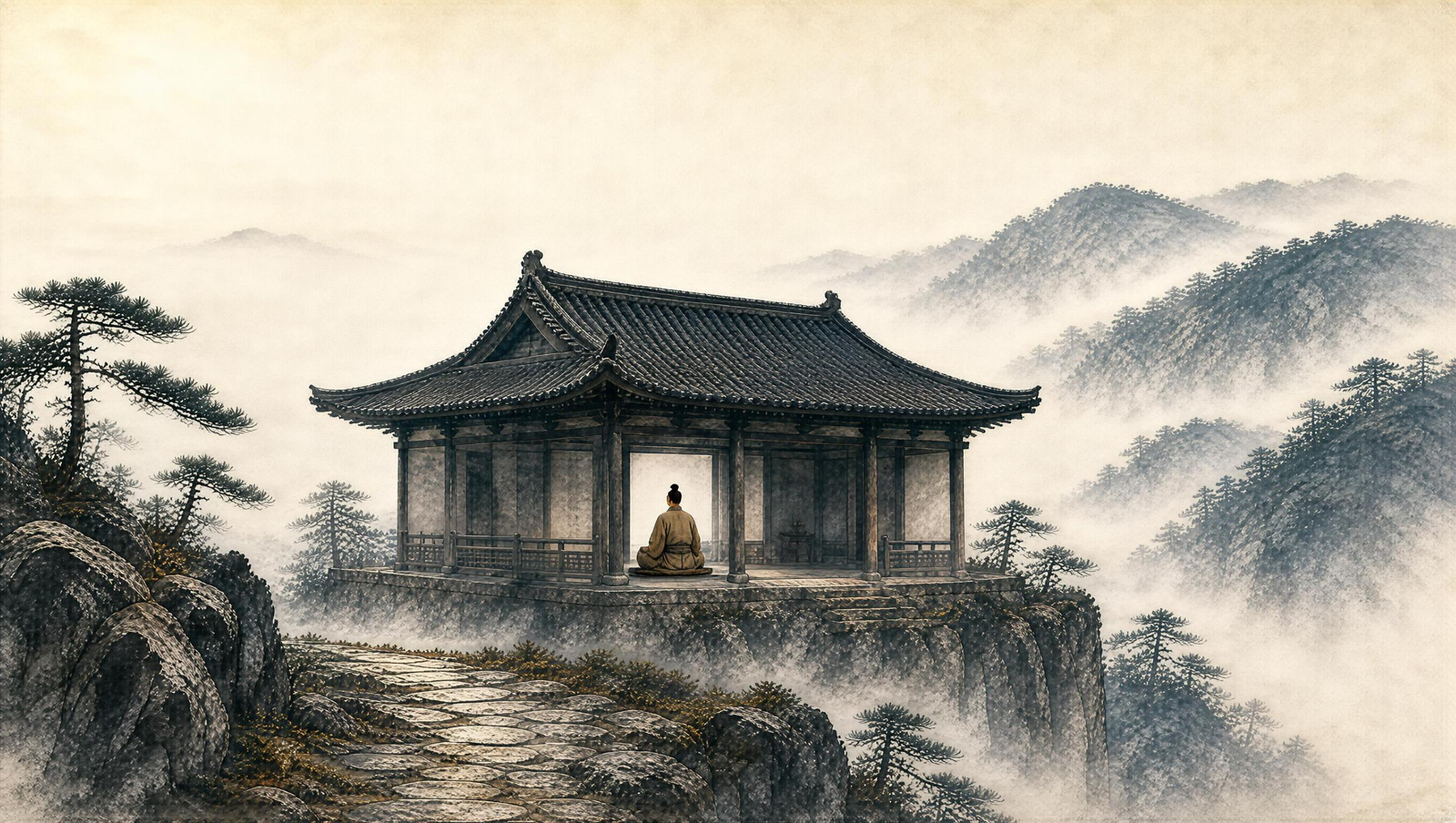
Longmen Xinfa is precept cultivation, preached aloud
Longmen Xinfa (龍門心法, "Mind Method of the Dragon Gate") is a cycle of sermons delivered in 1656 by Wang Changyue (王常月), the seventh-generation master of the Longmen lineage of Quanzhen Taoism, at Beijing's White Cloud Temple (白雲觀); later editions circulate under the title Biyuan Tanjing (碧苑壇經). Its subject is not esoteric technique but conduct: how taking precepts - in ascending stages - gradually dissolves the habits that scatter a person's nature. And the text is demonstrably alive: as of late August 2026, Hong Kong's Fung Ying Seen Koon has spent four consecutive Sundays teaching its maxims through classical fables in its Jin Jin Lok Do column, with a September public lecture on its companion theme of nourishing life announced on 27 August.
The book that made the Longmen lineage a movement
Wang Changyue (1522-1680) inherited a lineage that traced itself to Qiu Chuji, the famed Quanzhen master of the thirteenth century, but that had grown quiet by the end of the Ming. His revival was not literary but liturgical: from 1656 he opened public precept ordinations at the White Cloud Temple, transmitting three cumulative sets of precepts - Initial Perfection (初真戒), Intermediate Culmination (中極戒), and Celestial Immortal (天仙戒) - to ordinary clergy and laypeople rather than a closed circle of heirs.
The recorded sermons became the Longmen Xinfa. Its chapters move through taking refuge in the Three Treasures, repentance, the practical holding of precepts, and the recovery of the "true heart" (真心) - the argument running throughout that precepts are not rules added from outside but scaffolding for removing what was never natural to you. The book's afterlife has been long: it is one of the few Qing-dynasty Taoist works still used as a teaching text in ordinary temple education, which is precisely what Fung Ying Seen Koon is doing with it now.
Four fables, four Sundays
Since late July 2026, the temple's Jin Jin Lok Do column has paired Longmen Xinfa's maxims with classical allusions, one per week, each posed as a question: what does this mean for us? The four fables, in order:
1. Dragging a tail in the mud (曳尾塗中) - 31 July. From the "Autumn Floods" chapter of the Zhuangzi. Offered the premiership of Chu, Zhuangzi points to a sacred turtle - dead three thousand years, venerated in a temple case - and asks which the turtle would prefer: that honor, or being alive and dragging its tail through the mud. His answer is to decline the post. The column's lesson: vitality outranks rank.
2. The owl and the rotten rat (鴟得腐鼠) - 9 August. Also from "Autumn Floods." Huizi, a minister in Liang, hears Zhuangzi is coming and panics, fearing his own post is the target - he searches for him for three days and nights. Zhuangzi tells him of the yuanchu bird (鵷鶵), which feeds only on the finest fruit, and the owl clutching a rotten rat that shrieks at it in passing. Power, seen clearly, is often just somebody's rotten rat. Read the entry.
3. The Marquis of Lu feeds a sea bird (魯侯養鳥) - 16 August. From the "Perfect Happiness" chapter. A sea bird lands near Lu; the marquis seats it in the ancestral temple, offers it wine and banquets and the grandest ceremonial music. The bird is dazed and miserable, and dies within three days. This, Zhuangzi says, is nourishing a bird the way you nourish yourself instead of the way you nourish a bird - kindness that kills because it treats the other's nature as identical to your own. The entry reads it as a lesson in meeting each thing according to its nature.
4. The body whole, the essence restored (形全精復) - 23 August. From the "Mastering Life" chapter: let go of affairs and the body is not worn; disregard life's trappings and the essence is not depleted - when the body is whole and the essence restored, you are one with Heaven. The fullest life is the least scattered one. The most recent entry closes the month on this note.
The thread the four fables share
Read in sequence, the four stories carry one argument, and it is the same argument the Longmen Xinfa makes about precepts. The turtle and the owl measure rank against life and find rank lighter. The marquis fails because he forces his own standards onto another nature - the precise opposite of wu wei, of acting in accord with what a thing actually is (for the short version, see our FAQ on Wu Wei). And the restored essence is what remains when nothing external is being chased at all.
That is why a precept manual and a book of fables belong together. Precepts, on Wang Changyue's reading, exist to remove friction - the chasing, the forcing, the scattering - rather than to add rules. It is the ethical face of the same tradition whose energetic face is internal alchemy: one school works on essence, breath, and spirit; the other works on conduct, and each keeps insisting it is the same work.
How Hong Kong keeps a 1656 text current
Fung Ying Seen Koon, one of Hong Kong's principal Quanzhen temples, does not treat the Longmen Xinfa as an artifact. Around the weekly column, the temple runs a standing Quanzhen reading group - in early August 2026 it was working through an annotated collection of the temple's own couplets - and on 20 September 2026 Dr. Yeung Ming Ha will deliver a public lecture on the Taoist art of nourishing life, the practical discipline that fables like "the body whole, the essence restored" point toward. (Our own guide to that discipline is here.)
The pattern is regional, not local. In Macau, the Taoist Association spent the autumn of 2025 running Daode jing essay and calligraphy competitions for secondary students, with a citywide Taoist culture festival around them. Across the wider Cantonese Taoist world, the old classics are being kept in ordinary circulation - column by column, classroom by classroom.
Reading it yourself
The Longmen Xinfa itself is a specialist text, but its foundations are not. Our Library carries the core classics the sermon tradition builds on - the Daode jing above all, and the Zhuangzi from which all four of this summer's fables were drawn. Read the fable first, then the maxim: that order, as the Hong Kong column demonstrates every Sunday, is how these books were always meant to teach.
每週智慧,直送你的電郵
隨筆、時令指引與能量洞察——每週一信,絕無雜訊。