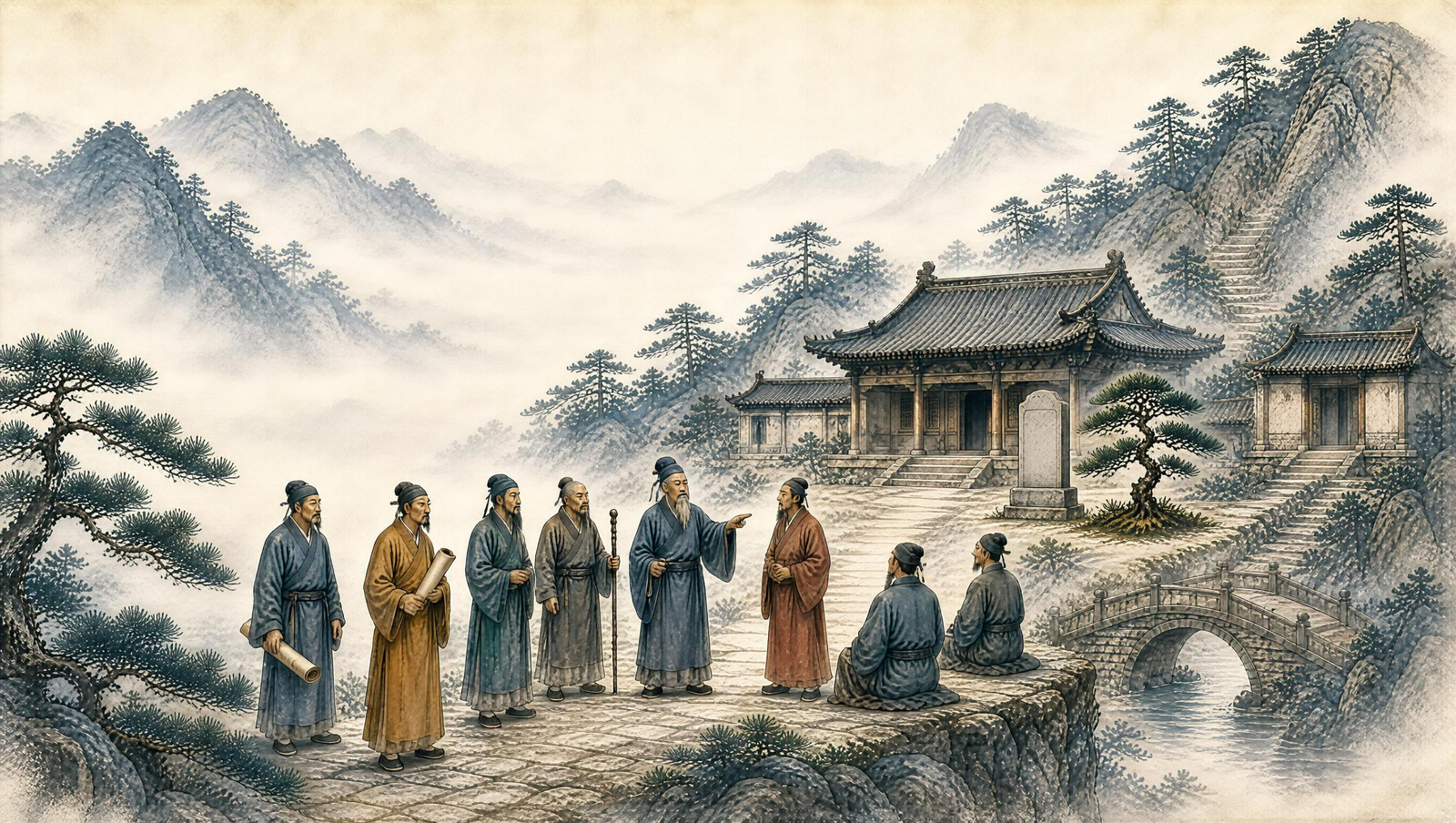
The Quanzhen seven disciples were the group Wang Chongyang gathered in Shandong between 1167 and 1170 — Ma Yu, Sun Buer, Qiu Chuji, Tan Chuduan, Liu Chuxuan, Wang Chuyi and Hao Datong. The Quanzhen school they carried outlived its founder by eight centuries, and it did so because the seven were planted in seven different counties rather than kept in one monastery.
A Teacher Who Arrived Late
Wang Chongyang (1113-1170) was a landowner's son from Shaanxi who spent years preparing for the imperial examinations and did not pass. The traditional account places his turn in 1159 at Ganhe, near modern Huxian, where he met two immortals — Lü Dongbin and Zhongli Quan — who instructed him in inner practice. He then dug a chamber near the Zhongnan mountains, named it the Tomb of the Living Dead, and sat in it for years.
In 1167 he burned the hut and walked east into Shandong. Within three years he had collected the men and one woman later called the Quanzhen seven disciples, fixed the name of the Quanzhen school, and died on the road back west in 1170. That is a very short teaching career for a movement of this size, which is why the seven matter more than the founder's own output.
The Seven, Briefly
- Ma Yu (1123-1183), Danyang. Wealthy, married, and the first to submit. He wrote constantly — poems and letters telling students to keep working, keep farming, marry normally, and stay clear of drink, meat and anger.
- Sun Buer (1119-1182), Qingjing. Ma Yu's wife, and the only woman in the group. The lineage tradition named for her title treats her as its ancestor.
- Qiu Chuji (1148-1227), Changchun. The most consequential of the seven, for reasons that were political rather than literary.
- Tan Chuduan (1123-1185), Changzhen. From Ninghai, remembered for patience under abuse; he died at Luoyang.
- Liu Chuxuan (1147-1203), Changsheng. Took over leadership of the school in its second generation, after Ma Yu and Tan Chuduan.
- Wang Chuyi (1142-1217), Yuyang. From Ninghai, known for healing work and for a relationship with the Jin court that eventually got him questioned.
- Hao Datong (1140-1212), Guangning. A diviner and physician before he joined; later associated with the Huashan connection.
What Held the School Together
Quanzhen's reforming temper came from its syncretism. The three teachings — Taoism, Confucianism and Buddhism — were taught as one body of instruction rather than three rivals, and the school's founding belongs to that same period when popular Taoism had accumulated a great deal of paid ritual. The Quanzhen answer was blunt: attainment is inner, and no amount of expenditure substitutes for it.
That made the school poor and portable. Members travelled, lived in simple hermitages, and supported themselves. It also made it legible to people who could not afford a full liturgical funeral or a temple donation — a point worth remembering whenever the Quanzhen seven disciples are presented purely as a literary circle.
Qiu Chuji and the Mongol Court
In 1219 Genghis Khan, then campaigning in Central Asia, sent for a Taoist known to be long-lived. Qiu Chuji left Shandong in 1220 with a small party, crossed into Mongolia and Central Asia, and met the khan near the Hindu Kush in 1222. The record of the conversations, the Changchun zhenren xiyou ji, has him arguing against indiscriminate slaughter and pressing the case for moderation.
He did not get a convert. He got something more durable: authority over Taoist institutions across north China, and the tax and corvée exemptions that came with it. When he returned, the White Cloud Temple in Beijing became the centre of the tradition traced to him, the Dragon Gate lineage.
Why Seven and Not One
A single monastery produces one institution. A circle of seven, each with local standing in a different district, produces a network — and networks survive wars, dynastic change and the suppression of a patron's line. Quanzhen was banned and revived more than once after the Yuan, and each time it was rebuilt from local centres rather than from a capital.
That is the useful lesson in the Quanzhen seven disciples: the founder supplied the idea and the practice, and the students supplied the geography. Anyone studying the school's history should read the seven as an administrative decision as much as a spiritual one. Our library carries the classical texts that came out of that tradition, and the FAQ comparison of Taoism and Buddhism is a useful companion, since Quanzhen deliberately blurred the two.
每週智慧,直送你的電郵
隨筆、時令指引與能量洞察——每週一信,絕無雜訊。