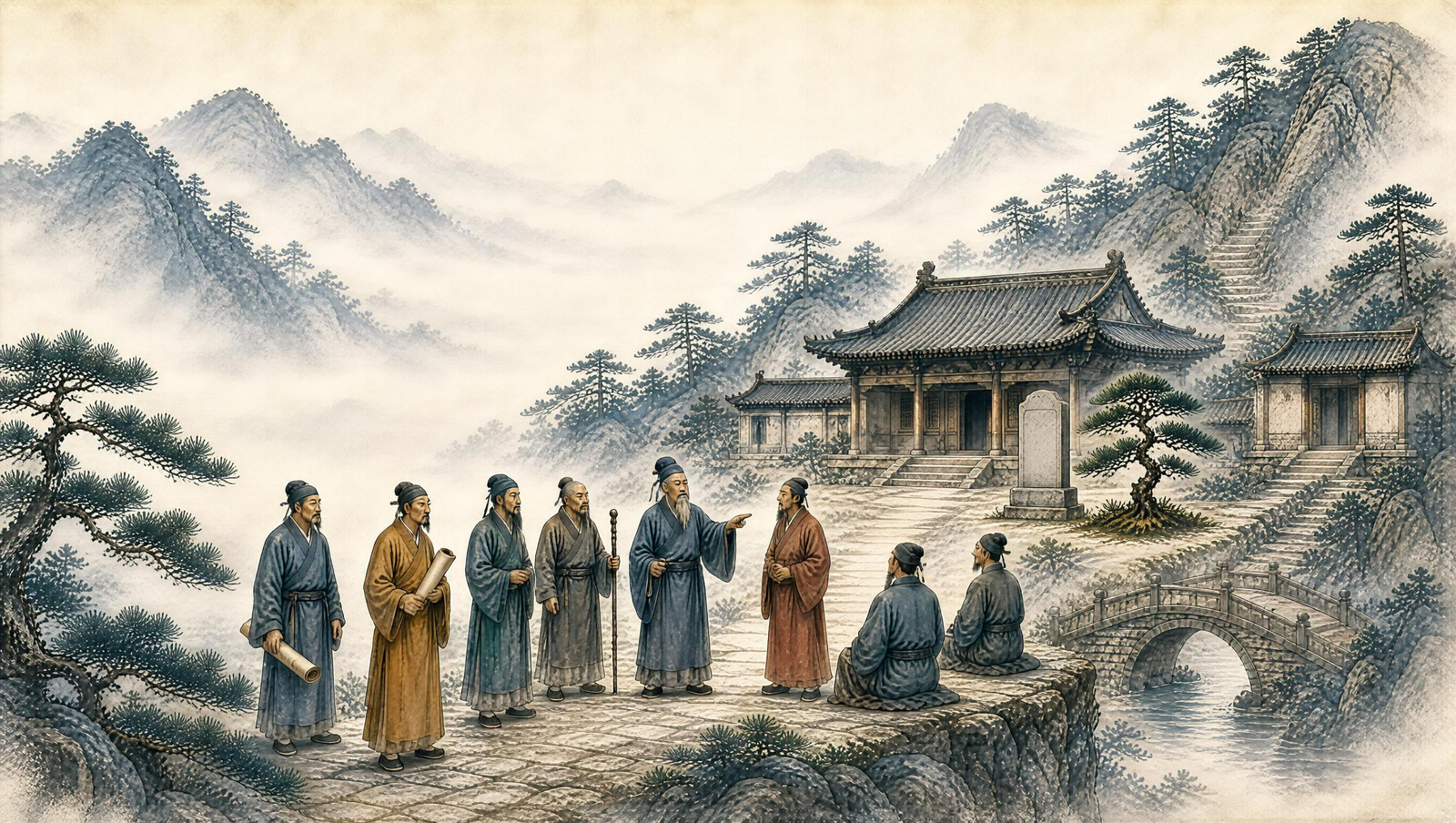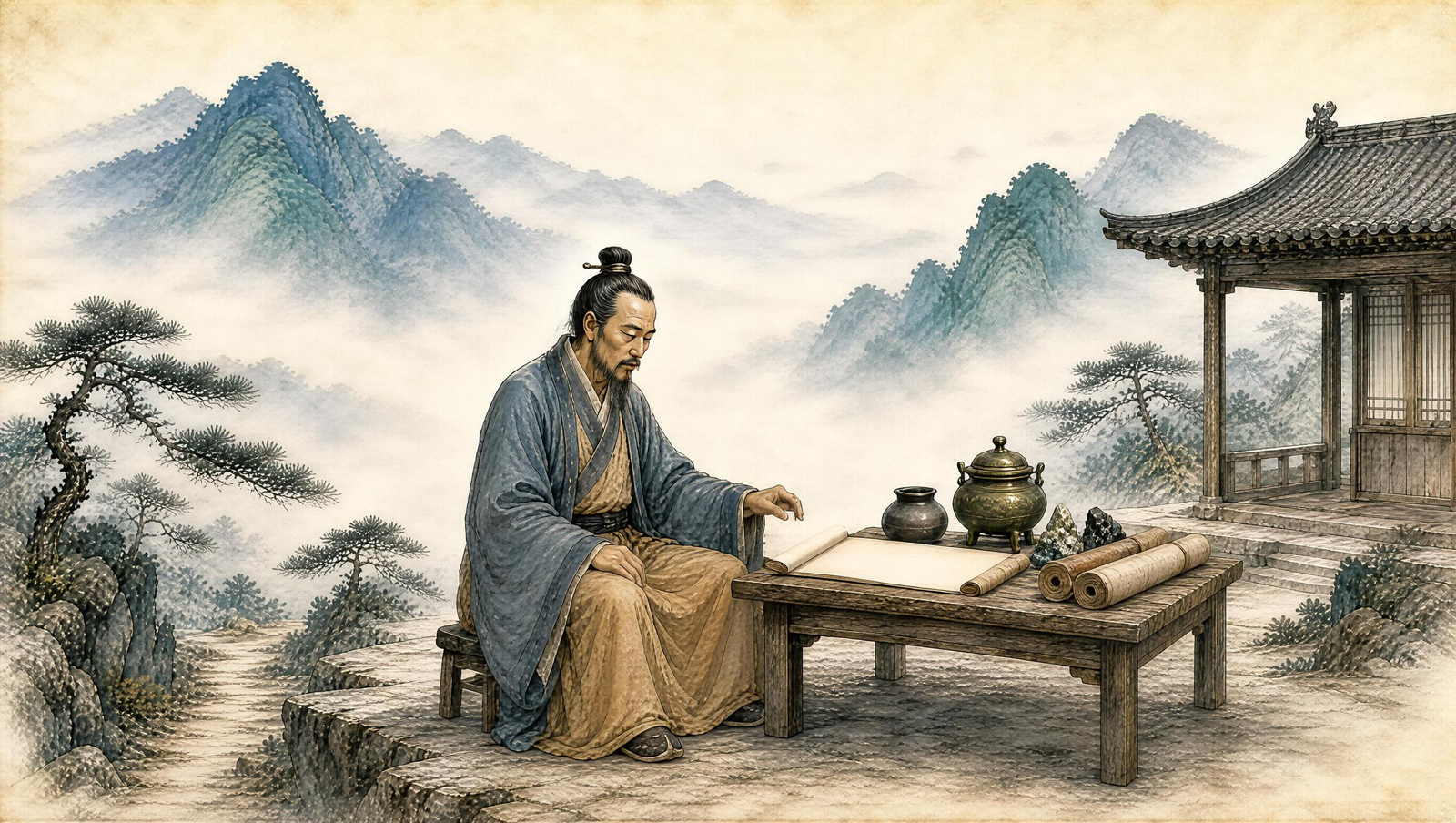
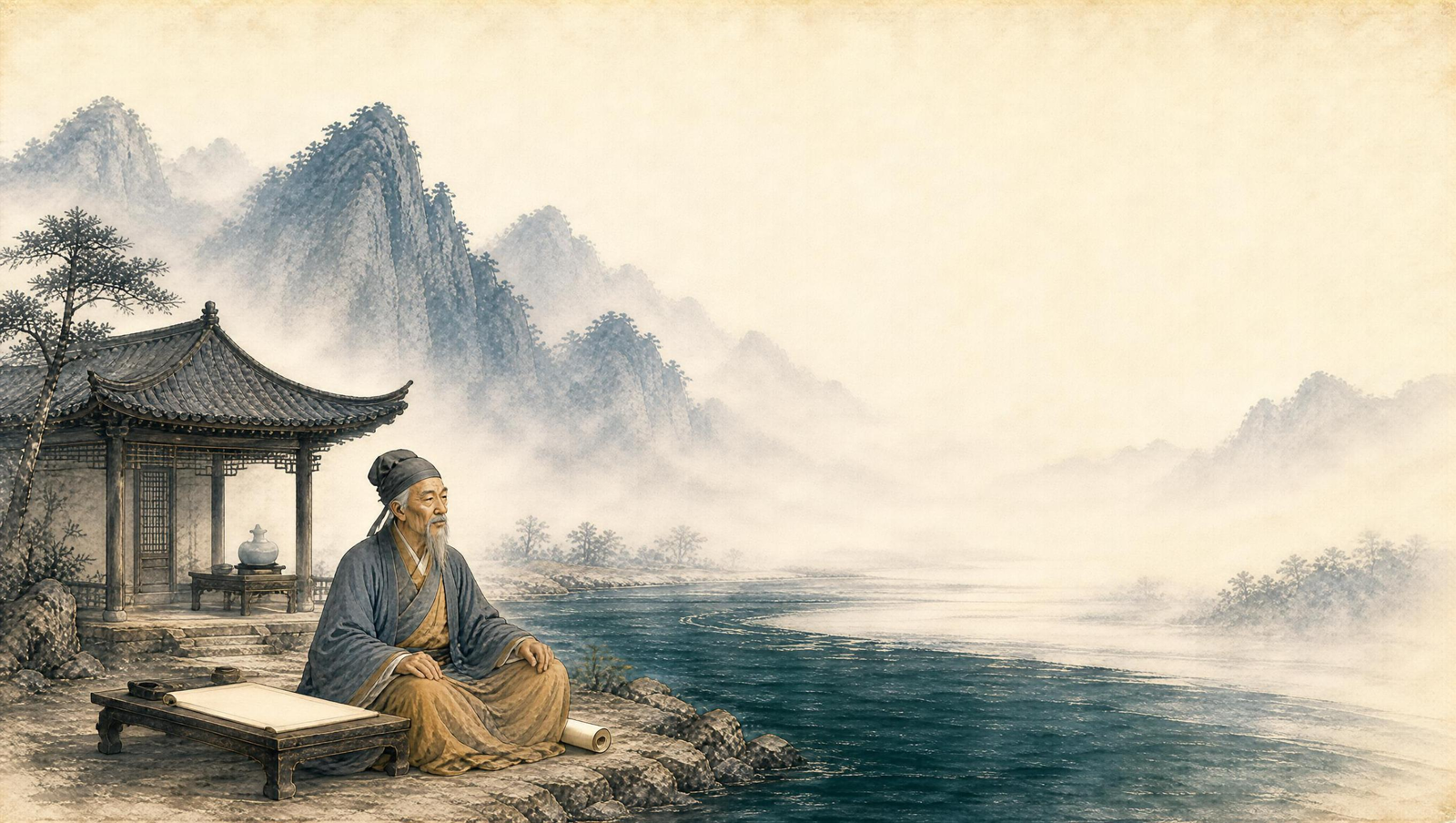
Zhang Boduan (987–1082) was a Northern Song official from Tiantai in Zhejiang who wrote the Wuzhen Pian — "Chapters on Awakening to Reality" — in 1075, and in doing so gave the Southern School of Taoist inner alchemy its founding text. He wrote it in regulated verse rather than prose, which is why it is quoted far more often than it is explained.
That choice of form is the source of both its staying power and its reputation for being impenetrable. The poem never says "circulate the breath" or "still the mind." It says lead and mercury, dragon and tiger, the infant and the maiden.
A Life Before the Text
The outline of Zhang Boduan's career is not in dispute. He was born in 987, took the civil examinations, and held minor posts — the records place him in charge of a district's records, then a prefectural office. He was, by the standards of the Song bureaucracy, unremarkable.
The turning point belongs to tradition rather than to the official record. The standard account says he encountered the immortal Liu Haichan in Chengdu around 1065 and received from him the method of the golden elixir, including the fire-phase timings that govern when each stage of practice is undertaken. Liu Haichan is better known today as one of the Eight Immortals, the boy carrying a string of cash. Whether the meeting happened as described or stands for a chain of teachers whose names were not preserved, the lineage that follows from it is real: Zhang Boduan, Shi Tai, Xue Daoguang, Chen Nan, Bai Yuchan — the five patriarchs of the Southern School.
His own preface is unusually unguarded about failure. It records that he transmitted the method to the wrong people more than once and suffered for it, a warning aimed squarely at readers who intended to pass the teaching along.
Why the Wuzhen Pian Is Written in Verse
The received text opens with sixteen seven-character regulated verses, continues into sixty-four quatrains, and closes with a set of twelve Xijiang Yue lyrics, followed by a prose postface. Nearly a hundred pieces, none of them a manual.
The compression is deliberate. Inner alchemy in the eleventh century was not merely hard to practise — it was dangerous to publicise, and writing in cipher kept it inside a circle of readers who had already been given the key. Terms like qian and kun, kan and li, water and fire, are not decorative. Each stands for a specific relation between two things in the body and in the practice.
There is a second reason. Verse is memorable. A student with no teacher and no printed book could carry the core of the method in his head, and the Wuzhen Pian was written to travel.
Later readers placed it beside Wei Boyang's Cantong qi of the Eastern Han as one of the two foundational works of the field, and that pairing has held for close to a thousand years.
The Three Stages the Poem Describes
Strip the imagery away and the Wuzhen Pian describes a sequence that most later inner-alchemy texts adopted as standard. What follows is the framework, not instructions — the practice itself requires a teacher.
Refining the essence to become qi. The first stage works on the body's substance, understood as a kind of stored resource. It relies on stillness, on posture, and on breathing that is not forced, and it is the stage most commonly attempted without supervision. See what neidan is for the vocabulary this stage uses.
Refining qi to become spirit. The middle stage concerns what happens when that resource is no longer being spent as fast as it accumulates. The old texts describe it in terms of heat and timing, and the fire-phase schedules attributed to Liu Haichan belong here.
Returning the spirit to emptiness. The final stage is the one the Wuzhen Pian treats as its real subject. It is also the stage that made the text contentious, because the closing lyrics borrow freely from Chan Buddhist vocabulary — mind, Buddha-nature, sudden awakening — and the postface argues that the alchemical and contemplative paths arrive at the same place.
That last move is why the Wuzhen Pian is read outside Taoist circles. A Song-dynasty alchemical poem that ends in Buddhist language tells you something about how porous the two traditions were in the eleventh century — the same overlap our article on why Taoism appears later than Buddhism in the written record approaches from the other direction.
What Happened to the Text Afterward
The Wuzhen Pian was not lost, and it was not protected either. It was commented on continuously — by Taoists, by Neo-Confucian scholars, and by later inner-alchemy writers who read their own systems back into it. By the Ming and Qing dynasties the number of commentaries ran into the dozens, and disagreements over individual lines were treated as disagreements about practice itself.
The Southern School it founded was absorbed, re-argued, and eventually cross-fertilised with the Northern School of Wang Chongyang, whose heirs approached the same three stages from a deliberately more ascetic starting point. Zhang Boduan's Tiantai burial site is remembered, and the honorific Ziyang Zhenren — "Master of the Purple Yang" — is the name most often attached to him in later texts.
A modern reader who wants the text in English has options, and they differ sharply in how much of the cipher they unpack. That variation is itself informative.
Reading It Without a Teacher
The honest position is this. The Wuzhen Pian is a primary source and worth reading as one — for what it shows about how Song Taoists thought about body, time and language, and for the way a technical tradition chose to encode itself.
It is not a course of instruction. The cipher works in one direction only: a reader who already holds the method can recognise it in the verse. A reader who does not will construct a plausible method that is not the one in the text, and the text's own preface says what happens to people who then teach it onward.
For the wider context — how inner alchemy relates to the other Taoist practices, and where it sits in the tradition more broadly — our library of longer essays is the place to start, and the account of who founded Taoism explains why a Northern Song official was writing a founding text at all.
每週智慧,直送你的電郵
隨筆、時令指引與能量洞察——每週一信,絕無雜訊。