Wealth vase placement follows two rules before any ornament is bought: the vase sits in the wealth corner of the room it actually serves, and it holds something that represents stored rather than spent value. Size, material and colour are refinements of those two decisions, not substitutes for them.
Most disappointing wealth vases fail for a plain reason. The owner picked the object first and then hunted for a corner to justify it.
Find the Wealth Corner Before You Buy the Vase
Classical practice locates the wealth corner in two different ways, and the two answers do not always agree.
The first is the visible one. Stand at the door of the room and look in. The far corner diagonally opposite the door — the one you cannot see from the threshold — is treated as the room's wealth position. This is the corner most Chinese homes use, and it is the one worth using if you are placing a single vase in a living room or shop.
The second is calculated. On the bagua frame, the wealth sector sits in the southeast of the fixed map; on the flying-star frame, the position of the wealth star changes with the building's period and facing. A practitioner with a luopan will give you a different corner from the one your eye finds.
If you are not working with a compass reading, use the diagonal corner. It is the conventional answer, it is stable year to year, and a vase placed there will not move every time a star shifts. If you want the calculated position, that is a conversation, not a guess — see how to book a consultation.
One caution: the wealth corner must be a corner of a room people use. A vase in a storage cupboard or behind a sofa is placement in name only.
Choose a Vase That Can Hold
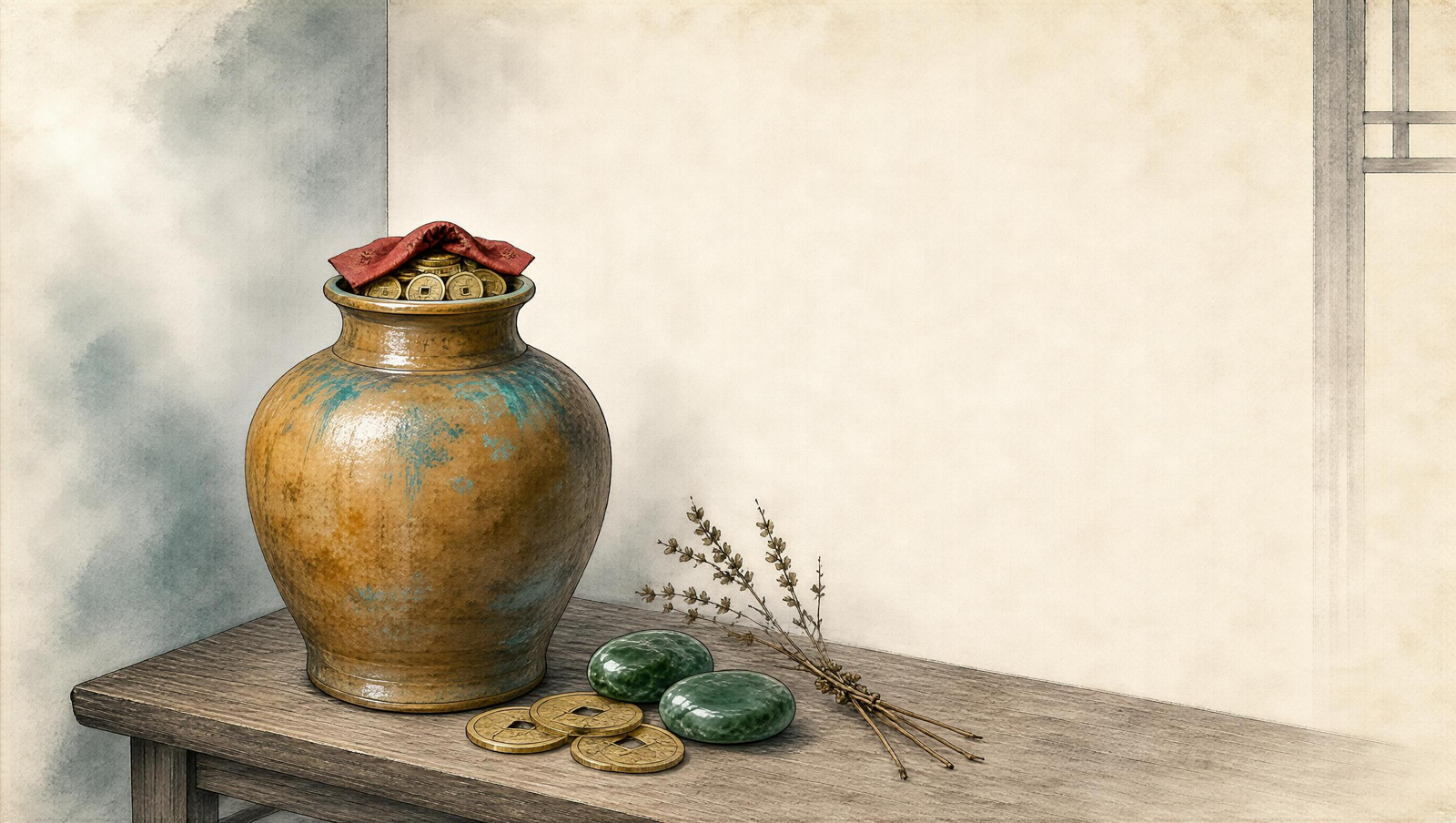
The shape carries the meaning. A vase with a narrow mouth and a full belly is the standard form, because it reads as a container that receives and keeps. Wide-mouthed urns and open bowls are fine as decoration but poor as wealth vessels: nothing stays in them.
Material follows the element of the sector. Porcelain and ceramic suit earth and metal sectors; bronze and brass suit metal; crystal suits the water and earth readings. Height should be proportionate to the room — roughly knee to waist height beside a sofa, smaller on a shelf.
Three things to reject outright: cracked or chipped vases, vases repaired with visible glue lines, and vases you inherited from a household that went bankrupt. A wealth vase is supposed to be a sound container. A broken one is a sentence that stops halfway.
Fill It With Stored Value
What goes inside matters more than what the vase looks like from across the room. The classical fillings are all things that hold value rather than circulate it.
- Coins, especially the five-emperor coins, laid flat at the bottom. These are treated as a physical anchor for wealth, and they are the one filling nearly every practitioner agrees on. Our article on five emperors coins and wealth feng shui covers which reigns are used and why.
- Clean water, in a smaller inner vessel or a sealed dish, so the vase is never dry.
- Five-colour stones or clear crystal points, one set, not a mixed handful of loose stones.
- Grain — rice, millet or wheat, in a small linen bag, representing stored food as stored wealth. Replace it if it attracts insects.
- A written figure of the amount you intend to hold, folded and buried under the coins. This is a private commitment, not a charm.
Salt is a common substitution for grain and works about as well. What does not belong: dried flowers, dead branches, artificial banknotes, and anything plastic moulded to look like a gold ingot and priced accordingly. These are imitations of value, and placing imitations in a wealth vessel is exactly the wrong signal.
Some households put a small image of the God of Wealth beside or behind the vase. That is a separate practice with its own rules about facing, and it should not be reduced to an accessory for the vase.
Place It Where Money Is Discussed
The wealth corner of a living room is the usual answer, but the most effective placement is in the room where financial decisions are actually made. A study or home office with a desk, a shop's counter area, an accountant's back room — these are where the vase earns its keep.
Place it against a solid wall, at a height between knee and chest, with a clear view from the doorway. Do not place it:
- directly under a ceiling beam,
- on the floor in a walkway where it will be kicked,
- facing a toilet or bathroom door,
- beside a bin, a broken clock, or a mirror that reflects it back at itself,
- on a shelf above a bed, where its weight and its symbolism both press down.
In a shop, the vase goes behind the counter or at the far diagonal from the entrance, never in the window where it faces outward all day. A wealth vase that faces the street is a vase trying to leave.
The dining room deserves a mention because wealth and food share a vocabulary in Chinese practice. If your dining table layout is already fixed to its auspicious wall, the wealth corner of that same room is a reasonable second position — but not a third. One vase per room.
Maintain It, or It Stops Working
A wealth vase is not furniture. It accumulates dust, and dust is the visible sign of neglect.
Change or top up the water weekly if it is open. Wipe the vase monthly. Check the coins and stones for corrosion or cracking. If a vase is knocked over and chips, replace it — do not glue it and continue. If the room is redecorated and the vase is moved into a cupboard for six months, that is a decision, not a neutral act.
Keep it away from anything dead. A wilting arrangement next to a wealth vase is the single most common mistake we see in photographs sent for review, and it undoes more good than the vase creates.
How This Relates to Qi
A wealth vase is not a generator. It is a small, disciplined object that keeps a household's attention on the condition of one corner of one room. That attention is the mechanism — the same idea behind what qi is and why it matters. The general feng shui overview in our FAQ puts the vase in its proper place: one instrument among many, working on the shape and use of a space rather than on luck directly.
If the room's orientation, its period, or the occupants' birth data need to be taken into account, a compass reading will point to a different corner and a different filling. That work is available through a consultation, and readers who want to study the underlying methods themselves can work through the membership material instead.
每週智慧,直送你的電郵
隨筆、時令指引與能量洞察——每週一信,絕無雜訊。