Dining table feng shui is judged mainly by three things: whether every seat can be reached without turning your back to the door, whether the table's shape lets qi move rather than pool in a sharp corner, and whether the room sits close enough to the kitchen to stay in daily use. Of the three, the seating carries the most weight — more than the wood, the colour, or the pendant light above it.
Put the Seats Before the Table
Walk around the table and sit in every chair in turn. What you are checking is plain: can you see the door of the room without craning, and is there a wall or a solid surface behind you? Those two conditions produce what Chinese practice calls a command position — the same idea applied to a desk or a bed.
Seat the person who carries the household's decisions, or its longest-standing member, in that position. It is usually the chair with a wall at its back, set diagonal to the entrance. In a rectangular room that is a corner seat; in an open-plan flat it may be the end facing the kitchen.
Then look for the two problems that show up most often:
- A back to the door. Whoever sits with their back to the entrance tends to eat faster and talk less, because the body keeps half its attention behind it. Rotate that chair, or move the table.
- A path running through the table. If people walk between the table and the wall to cross the room, the table is sitting in a corridor. Shift it twenty or thirty centimetres; sometimes a sideboard is what stops the traffic.
Shape and Material
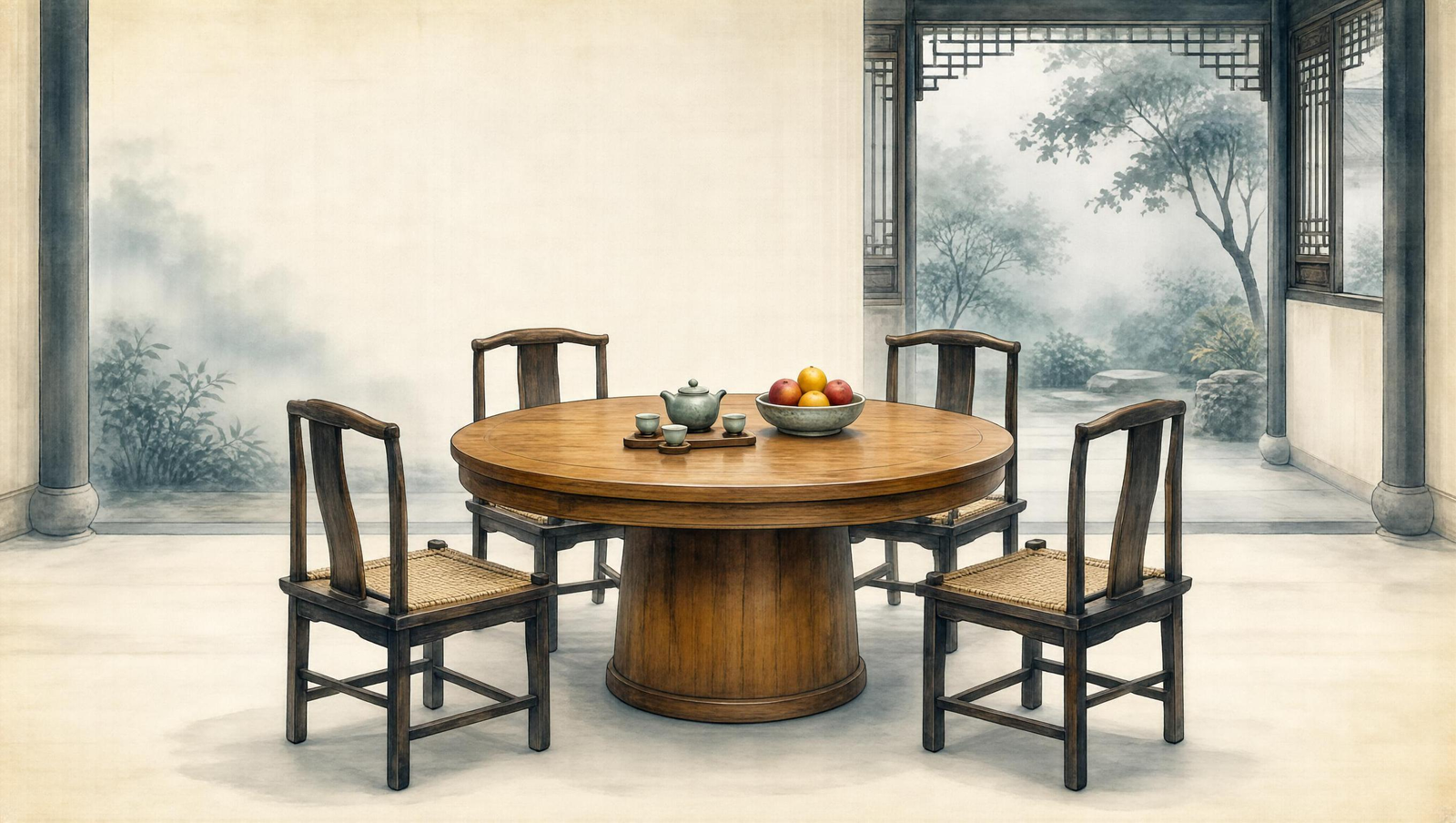
Round tables have no head and no corners, so nothing points at anybody and the conversation distributes evenly. They suit households with children, or anyone who wants meals to feel unhurried.
Rectangular and square tables are fine as well. The rule is not the shape but the aim: a corner directed at a seat, or at a doorway, is what practitioners flag. If the room only fits a rectangle, soften the edges at least visually — a runner with round ends, a plant at the exposed corner, cushions on the sharp seats.
Material follows the balance of the room. Heavy dark wood suits a room that already feels busy; light wood, glass or stone cools a room that has turned static and airless. Read the room first — the broader framework sits in the FAQ — and then choose. Glass carries one practical caveat: it shows every fingerprint, and a table nobody wants to wipe is a table people stop using.
Where the Table Sits
A dining table belongs somewhere between kitchen and living room, close enough that serving food does not cross the whole house. Distance matters more here than compass direction. If the kitchen and the dining area are separated by more than a room's length, the table drifts into being a display piece and meals migrate to the sofa. The living-room layout rules show the same principle from the other direction: furniture placed to fit the room's real traffic pattern stays in use, furniture placed by taste alone gets abandoned.
Two placements worth avoiding:
- Directly under a beam. The discomfort is literal. Sitting under a heavy beam or a low pendant line makes people hunch and eat quickly. Move the table, or raise the fixture.
- Facing a toilet door, or with a mirror throwing that doorway back at the table. If the door cannot be moved, keep it closed and hang a curtain or a slim screen.
What Stands on the Table
Keep the surface sparse. Fresh fruit, a small bowl of water, or one low arrangement of flowers is enough. A table crowded with bills, homework and charging cables stops reading as a place to eat.
Avoid plastic flowers and dried, brittle arrangements. Avoid a standing knife block or letter opener left in view. Skip the mirror hung so that diners watch themselves all evening — a few households enjoy the sense of abundance, most find it unsettling. And treat dead electronics as a warning sign: a small speaker playing quiet music during a meal is one thing, a laptop parked at the head of the table with the screen open is another.
A Ten-Minute Reset
If nothing can be moved, these changes cost nothing:
- Clear the surface and wipe it down.
- Turn the chair that faces away from the door by thirty to forty-five degrees.
- Open a window for five minutes while the room is empty.
- Replace anything drying, brittle or broken on or near the table.
- Eat one meal a week at the table with no devices present.
Then leave it alone. Dining table feng shui is not really about the object; it is about whether the object gets used. A table that hosts meals gathers the circulation practitioners write about without anyone arranging a thing. If the reasoning behind these placements interests you, the answer on qi explains what is actually supposed to be moving — and a short consultation is the faster route when the room's shape fights every option.
每週智慧,直送你的電郵
隨筆、時令指引與能量洞察——每週一信,絕無雜訊。