What tai chi actually is
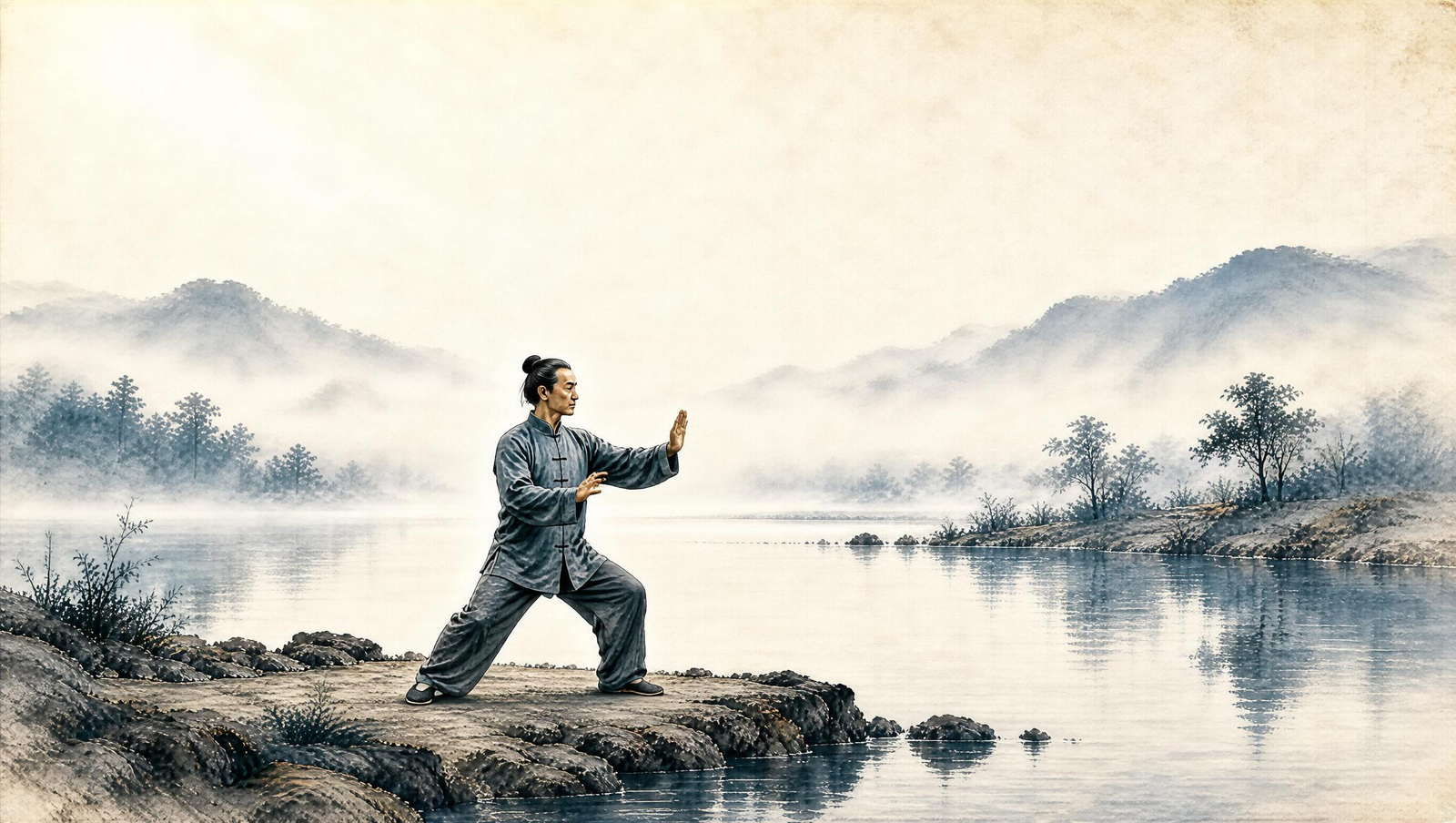
Tai chi (taijiquan, 太极拳) is a Chinese martial art practiced as a slow, continuous sequence of movements — part self-defense system, part moving meditation, and part health exercise. Born from Taoist ideas about softness overcoming hardness and Qi flowing like water, it trains the body and mind as one. You do not need to be young, flexible, or athletic to begin; most people first meet tai chi as a gentle daily practice in a park at dawn.
Where tai chi comes from
The art's documented history reaches back to the late Ming and early Qing dynasties. The Chen family village in Henan is widely credited with the oldest surviving form, from which the Yang, Wu, and Sun styles later branched (National Library Board Singapore, Infopedia; Fujen Catholic University Daoist Studies Centre). Later legend ties the art to the Taoist priest Zhang Sanfeng and Wudang Mountain, where breath and posture training had long blurred the line between health practice and martial skill. Whether or not Zhang Sanfeng was historical, the Wudang connection expresses tai chi's core identity: a Taoist method that turns ordinary movement into cultivation.
Tai chi, qigong, and meditation — what differs
People often confuse the three. Qigong (氣功) is the broader family of breath, posture, and intention exercises for circulating Qi. Meditation stills the mind in seated or standing stillness. Tai chi is the middle path: meditation that moves. Its signature principle, "use softness to defeat hardness," mirrors the Taoist concept of wu wei — acting in step with circumstance rather than against it (see our FAQ on what Qi is and why it matters). The slow form is not slow because the art is weak; it is slow so the practitioner can feel every transition of weight, breath, and attention.
The health case for practice
Modern interest in tai chi is driven less by combat than by measurable well-being. Regular practice improves balance and lower-limb strength, eases stress, and supports calmer breathing — benefits the Taoist tradition has long described in the language of nourishing life (yang sheng, 養生). Our FAQ on the Taoist approach to health and longevity frames the same logic from the inside: keep Qi sufficient, balanced, and moving. Tai chi is simply that principle made physical. Because the load is low, it suits older adults and people recovering from injury better than most exercise.
How to begin, the Taoist way
Start with a short, repeated sequence rather than the full long form. Practice on level ground, in loose clothing, at the same time each day so the rhythm becomes habitual. Let the breath lead and the limbs follow; never force a stretch. If you want to see where the art's mythology meets its mountains, read our piece on Wudang Mountain and Taoism. The point is not to perform but to persevere — a few minutes daily beats an occasional hour.
Common misconceptions
A few ideas trip up beginners. First, tai chi is not only for the elderly — though it suits them, younger practitioners use it for posture, focus, and injury prevention. Second, "slow" is not "easy"; a correct form is physically demanding in ways weight training is not. Third, you cannot learn it from a video alone for long; a teacher corrects the tiny habits — a dropped knee, a tilted pelvis — that silently undermine the practice. Approached honestly, tai chi is a lifetime study, not a week-long trend.
Why it matters
Tai chi is Taoism you can feel in your body: soft strength, flowing Qi, and presence without strain. Begin small, move slowly, and let the practice carry you.
每週智慧,直送你的電郵
隨筆、時令指引與能量洞察——每週一信,絕無雜訊。