What Taoist ritual music is
Taoist ritual music (道教音樂, Daojiao yinyue) is the chant, percussion, and wind that turns a ceremony into a journey. It is not concert music performed for its own sake; it is the sonic vehicle that carries petitions upward, accompanies the priest's movements, and marks the stages of a rite from invitation to dismissal of the gods. Where a Taoist ritual is the body of the ceremony, the music is its breath.
As the Hong Kong Daoist Association's cultural archive explains, the music is inseparable from the liturgy it serves — every melodic phrase corresponds to a step of the rite Hong Kong Daoist Culture Centre.
The instruments and the vocal line
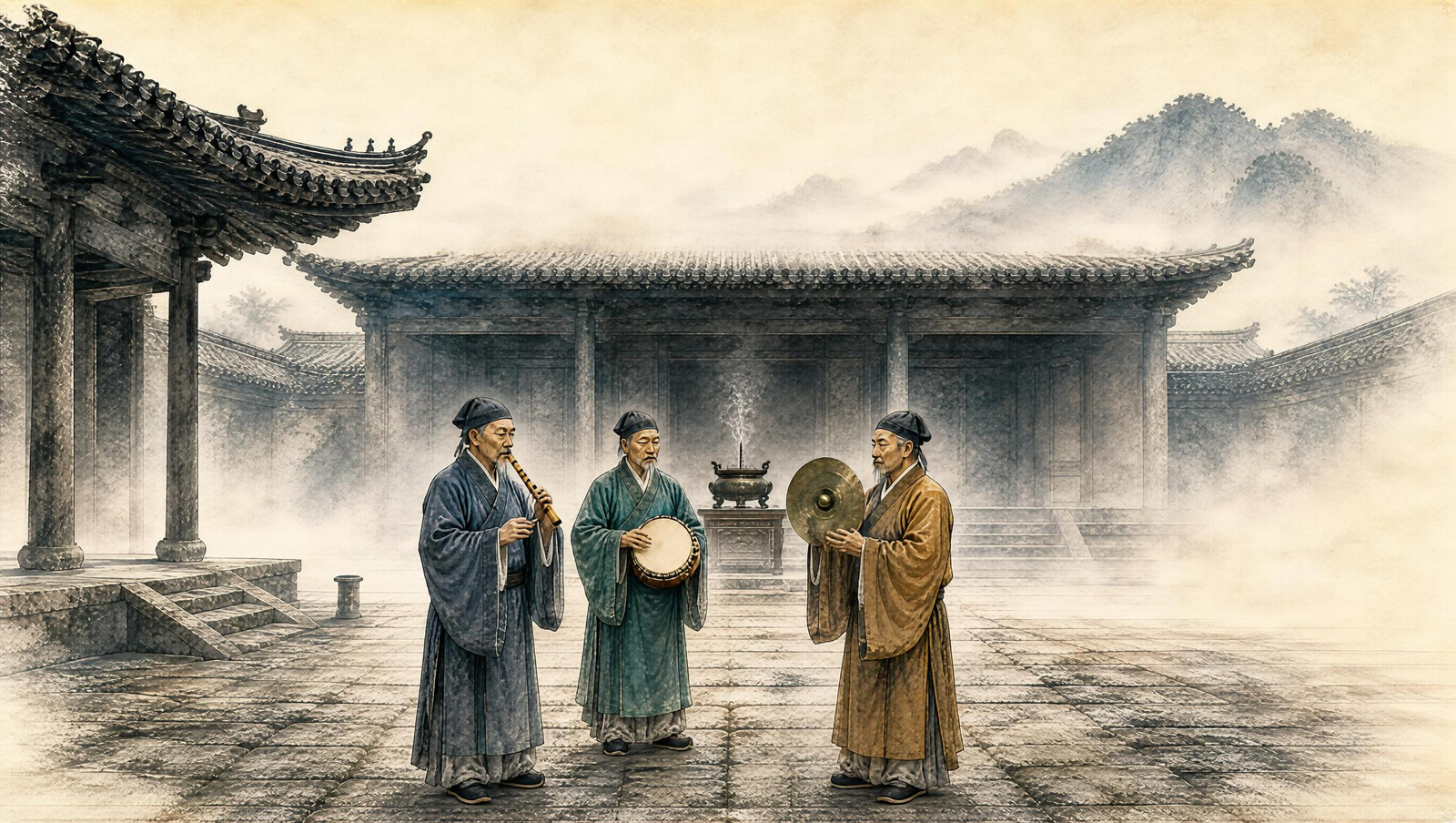
A Taoist ensemble is built around the human voice first. Priests chant scriptures in a stylised, pitched recitation, often joined by a small choir of lay musicians. Around them sits a percussion section — drums, bells (鈴 ling), gongs (鐃 nao), and the wooden fish (木魚 muyu) — that sets the tempo and signals transitions. Melody instruments, especially the double-reed guan (管) and the end-blown xiao (簫) flute, weave the airy lines that evoke the heavens. The balance of voice, skin, and reed gives the music its unmistakable ritual colour.
Roots in the Taoist Canon
The repertoire is ancient and codified. Many melodies and their texts descend from the Taoist Canon (道藏, Daozang), the vast collection of scriptures compiled across dynasties, and from regional ritual manuals passed master to student. Different lineages sound different: the solemn, restrained style of the Beijing White Cloud Temple contrasts with the brighter, faster tempo of the southern Guangdong and Hong Kong traditions. Reporting on living performers, Sixth Tone has covered how younger musicians are keeping these regional styles alive Sixth Tone.
Intangible heritage status
Taoist ritual music is recognised as part of China's intangible cultural heritage, listed by the national authority that safeguards traditional arts China Intangible Cultural Heritage. In Singapore and Malaysia, Taoist music societies maintain their own strands, and The Straits Times has reported on community efforts to transmit the repertoire to the next generation The Straits Times. The recognition matters because the music lives only through performance; without carriers, a melody dies.
How to listen today
You need not wait for a festival. Many temples stream or record their major rites, and several heritage groups publish performances online. The best first listen is a complete jiao (醮) thanksgiving ceremony, where the full arc of invitation, offering, and farewell shows the music doing its job. For the surrounding context, see our guide to Taoist ritual and the FAQ on spiritual diagnosis, which explains why sound is central to reading a situation's pattern.
Why the music matters for practitioners
For the devotee, the music is not background but instruction. The rising and falling phrases train the breath, the steady drum steadies the heart, and the recited scriptures plant the cosmology in memory. Practitioners often say a well-sung rite "lifts the roof" — the signal that the gods have arrived. In a tradition that distrusts idle talk, the music does what words cannot: it enacts the cosmology rather than merely describing it.
Closing takeaway
Taoist ritual music is the part of the ceremony you can hear but never quite separate from the rite itself — sound as sacrament: the bell, the drum, and the chant are not decoration but the working edge of the rite itself. For the Traditional Chinese companion read Taoist Ritual Music (繁體中文), and start with our introduction to Taoist ritual.
Weekly wisdom, straight to your inbox
Essays, seasonal guidance, and energy insights - one letter a week, no noise.
DaoMind Pro
Read your own chart
Generate your full Ba Zi chart and elemental balance - the same data a practitioner opens with.
Open Destiny Atlas →