What a talisman is
A Taoist talisman (符籙, fulu) is a sheet of paper—or sometimes silk or wood—inscribed with a deity's name, a command in celestial script, and a seal, used to bless, heal, or protect the bearer. It is not a spell in the Western sense; it is a written authorization, like a pass stamped by a higher office, that links the human request to the authority of a god. The Chinese Text Project's Daoism library preserves liturgical manuals describing fulu as part of the Celestial Masters' transmitted rites source.
How a talisman is made
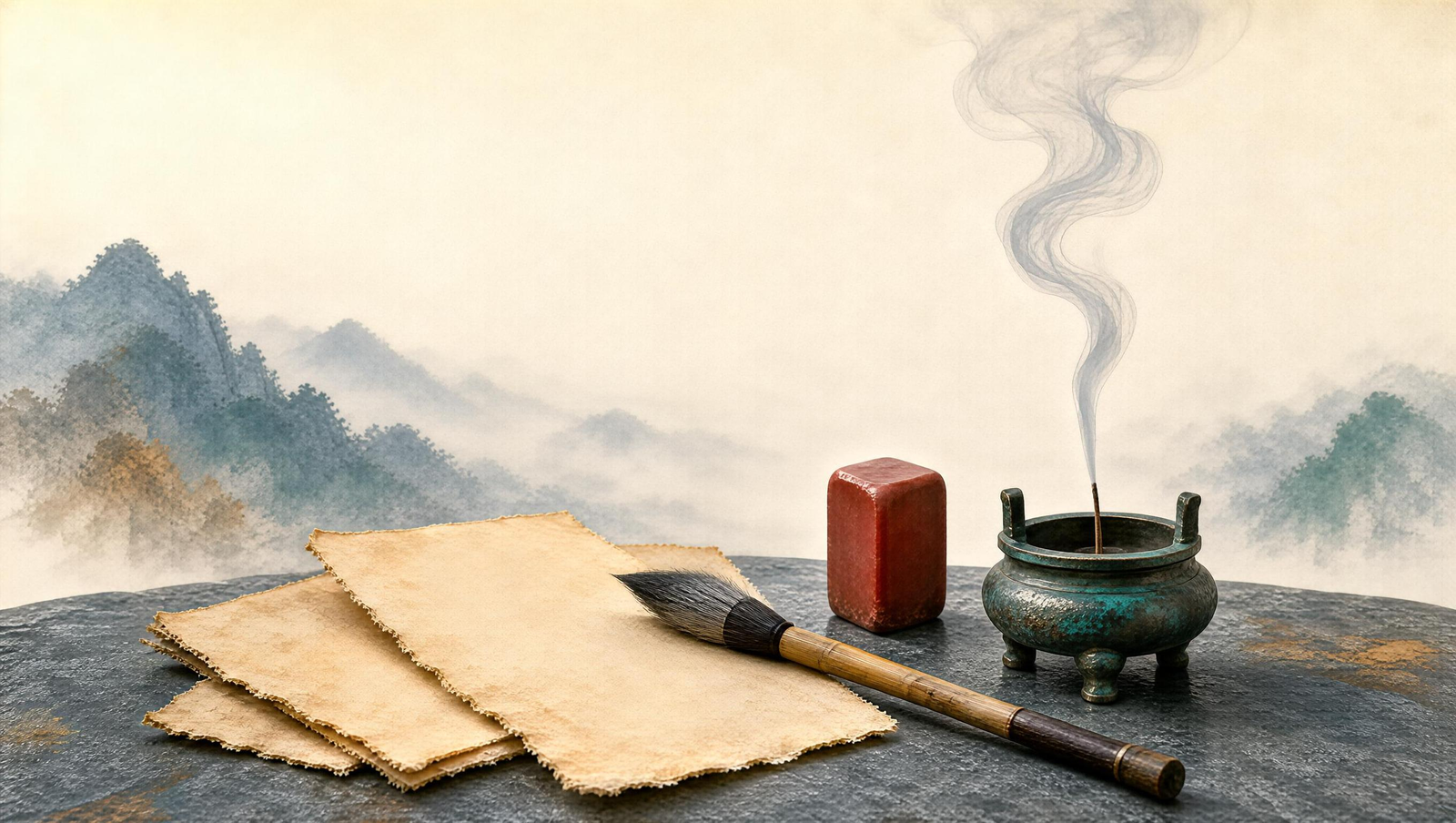
Creating a talisman is itself a ritual, not a craft done casually. The priest first purifies and settles his own breath, then writes the characters at an auspicious time using the correct strokes, often in mirrored or "cloud" script that ordinary eyes cannot read. A named deity is invited to descend into the paper, and the master's seal activates it. The Stanford Encyclopedia of Philosophy frames Taoist ritual as a structured technology of the body and cosmos rather than superstition, as detailed in its entry on Daoism source. Without the proper transmission and state of mind, the paper is just paper.
Common types of fulu
Talismans are not one generic object but a graded toolkit. A household charm (an zhai fu) guards a home against misfortune and restless spirits; a healing writ (zhi bing fu) is often burned and the ash mixed into water for a patient to drink; an oath talisman records a vow between a devotee and a god, witnessed by the bureau of heaven; and a petition (zhang) is a formal memorial submitted upward through the spirit ranks. Each type follows a fixed grammar of lines, seals, and named officials, so that the written object functions like a properly addressed and stamped document in a celestial administration.
Blessing, healing, protection
Talismans are commissioned for concrete needs: a household charm against misfortune, a writ to calm a restless spirit, a paper burned into water for a sick person to drink, a contract of oath between a devotee and a god. In each case the logic is the same—align the small pattern of a human life with the larger pattern of heaven, so that blocked Qi can move again. Taoism.net's popular explanations describe fulu as one of the most visible expressions of Taoist "responding to the world" source. The effect is understood as harmony restored, not as a violation of nature.
Transmission and ethics
A talisman's power is held to depend on the master's ordination and inner cultivation, not on the ink alone. Talismans are therefore handed down through lineage initiation rather than sold as commodities, and a responsible priest will pair the paper with advice on conduct—because the document only works if the petitioner's life is roughly aligned with the order it invokes. This is why fulu sits closer to spiritual discipline than to merchandise, and why the same symbol means little outside the relationship of trust between master, deity, and devotee.
Talismans and the wider Taoist craft
Fulu belongs to the same family as the other Taoist arts: it rests on the same diagnosis of imbalance that a Taoist spiritual diagnosis performs, it is enacted inside the formal Taoist ritual of altar and invocation, and it shares with Neidan internal alchemy the belief that essence, breath, and spirit can be refined and directed. A talisman is simply the outward, written edge of an inward discipline. Handed down through ordination rather than sold as a product, it remains one of the clearest signs of Taoism's practical, this-worldly care for ordinary lives.
Weekly wisdom, straight to your inbox
Essays, seasonal guidance, and energy insights - one letter a week, no noise.
DaoMind Pro
Read your own chart
Generate your full Ba Zi chart and elemental balance - the same data a practitioner opens with.
Open Destiny Atlas →