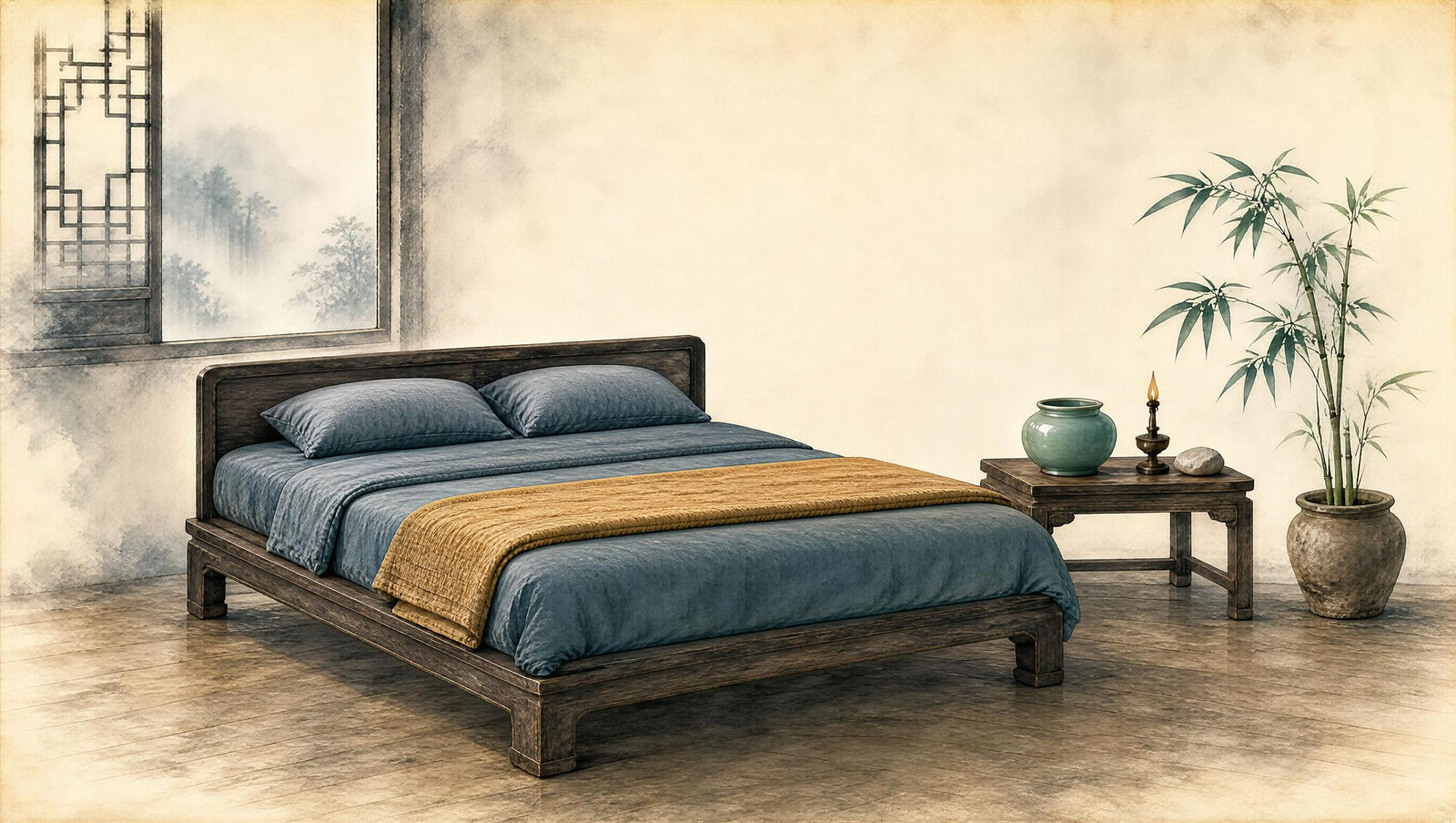
A reader in Singapore told a sleep writer in 2026 that she had woken at 3 a.m. for months, until she showed a practitioner a photo of her bedroom and changed one thing in five minutes. The fix was not a pill or a gadget. It was bedroom energy — the quiet movement of life through a space that either supports rest or quietly fights it.
Most people treat a bad night as a problem of the mind. Taoist practice treats it as a problem of the room first. A bed is not furniture; it is where the body lets go of the day. If the space around it holds tension, the body keeps a fraction of that tension all night, and the morning arrives short.
Why your room decides your rest
The classical view is plain. Qi, the vital energy moving through body, land, and sky, needs to enter a room, move gently, and leave without being trapped. A bedroom that fails at one of these becomes a place the nervous system will not fully trust.
You feel this before you can name it. A mirror facing the bed, a door whose sightline lands straight on the mattress, a pile of unfinished work at arm's reach — each one asks a small question of your attention while you are trying to disappear into sleep. None of them is loud. All of them add up.
The good news is that arrangement is the cheapest medicine in the tradition. You rarely need to buy or build. You need to notice, then move.
What "energy" means in a bedroom
Energy here is not mystic weather. It is the summed signal of light, air, sightlines, and order. When those four are calm, the room reads as safe, and the body downshifts into rest. When one of them is sharp, the room keeps asking for a response.
Think of a good room as a slow river. Water enters, curves, and exits. A bad room is a backed-up pipe — everything arrives and nothing leaves, so the same stale charge circulates and the sleeper stays lightly braced.
This is why the first move is almost never to add something. It is to remove. Clear the floor, close the laptop, and let the surfaces go empty. An empty surface is a surface the eye can rest on instead of reading.
Three moves that let energy settle
Move one: give the bed a wall. Place the head against a solid wall rather than under a window. A window behind the head leaves the sleeper exposed to shifting light and drafts; a wall gives the nervous system a backing it can trust through the night.
Move two: turn the mirror away. A mirror that reflects the bed doubles the room's motion and, in the old teaching, doubles the sleeper's awareness of the space. Angle it to a wall or cover it at night so the room does not seem to watch you back.
Move three: break the door's straight line. If the door opens to point directly at the mattress, shift the bed a quarter turn or hang a soft screen. The aim is not superstition but the simple relief of not being "in the path" the moment the door moves.
These three rules cover most restless rooms. They cost nothing and take minutes.
The bed, the door, and the mirror
These are the usual suspects. A 2026 report in Tom's Guide described exactly this pattern: a reader who could not sleep through the night until a practitioner read her bedroom photo and found a five-minute rearrangement. The specific detail mattered less than the principle — energy that cannot settle will not let you settle.
Keep the path between door and bed indirect. Keep the space under the bed clear so air can pass. Keep electronics out of sight, not merely out of hand, because a glowing edge is a small promise of more attention. Each rule removes a tug.
A cluttered room is not a moral failure. It is a room that has not been given a chance to breathe. Ten minutes of clearing changes more than people expect.
A five-minute evening reset
You do not need a full redesign to feel a difference tonight. Try this short sequence:
- Open the window for two minutes of fresh air.
- Put every screen face-down or in another room.
- Fold the day's clothes and clear the chair.
- Dim to a single warm light.
- Stand at the door and look at the bed — if anything "points" at you, move it.
That is the whole ritual. Five minutes, no purchase, and the room meets you as a place to arrive rather than a list to finish.
Reading the room like a practitioner
A practitioner does not guess. They read the same four signals — light, air, sightlines, order — and weigh which one is doing the most harm. In a city flat the usual culprit is sightlines: too many straight lines, too little backing. In a family home it is order: surfaces that never go empty because life is full.
Start with the one that bothers you most. If the room feels exposed, fix the bed's backing. If it feels busy, clear the surfaces. Small, specific changes beat a full makeover you will never start.
When arrangement is not enough
Space helps, but space is one layer. If sleep stays broken, the tradition looks at the body's own patterns — diet that warms the spleen, a sleep window before midnight that follows the sun, and movement that circulates rather than exhausts. Rest is built during the day, not only earned at night.
For the deeper mechanics of how energy moves through a home, see what Feng Shui actually is and why Qi matters. A room is only the outer half of rest; the inner half is the body you bring to it.
Read the companion piece in Traditional Chinese: 臥室能量與好眠:道家布局指南. For daily practice, begin with our twenty-minute Taoist routine and the Taoist approach to health and longevity.
每週智慧,直送你的電郵
隨筆、時令指引與能量洞察——每週一信,絕無雜訊。