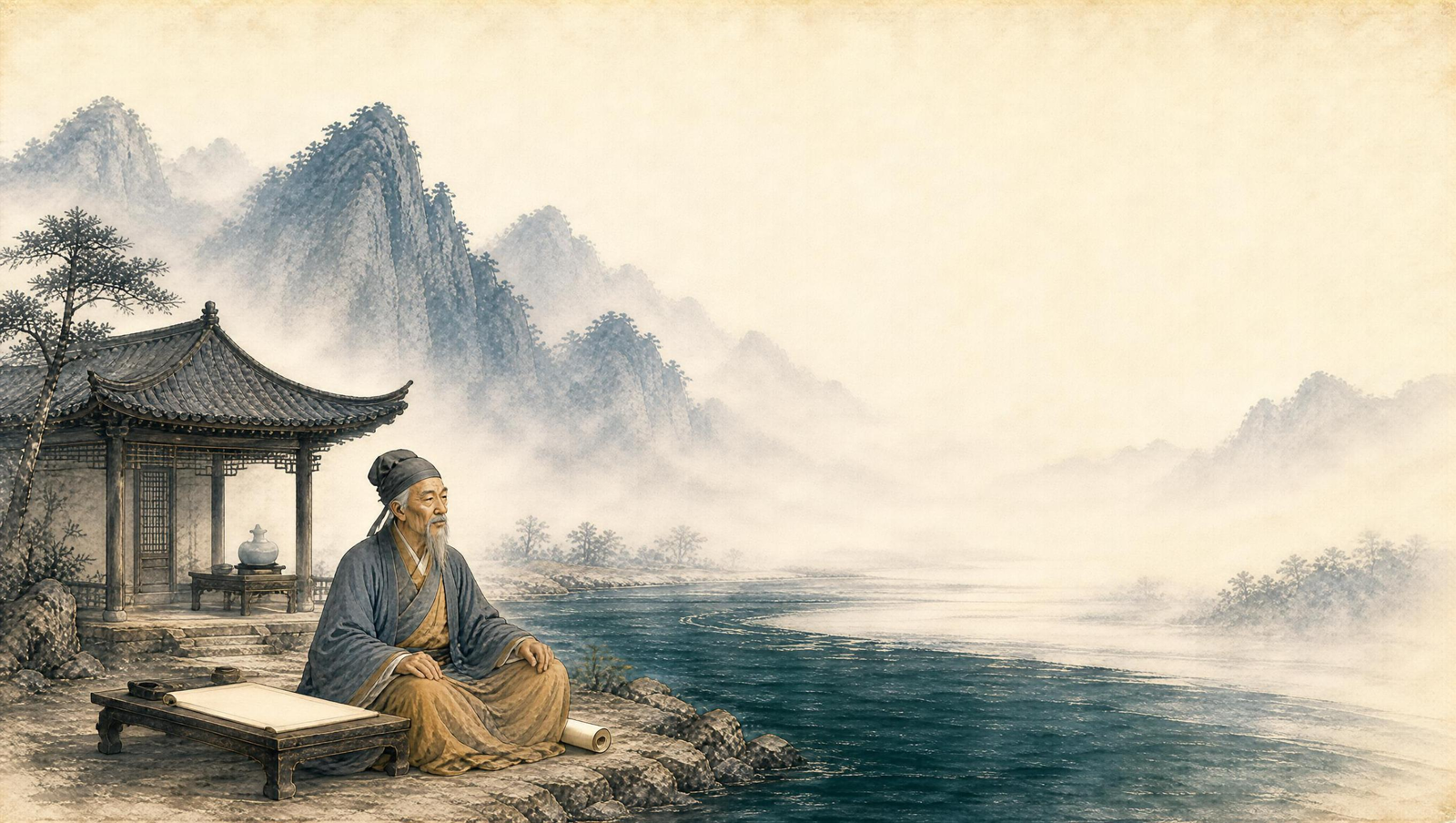
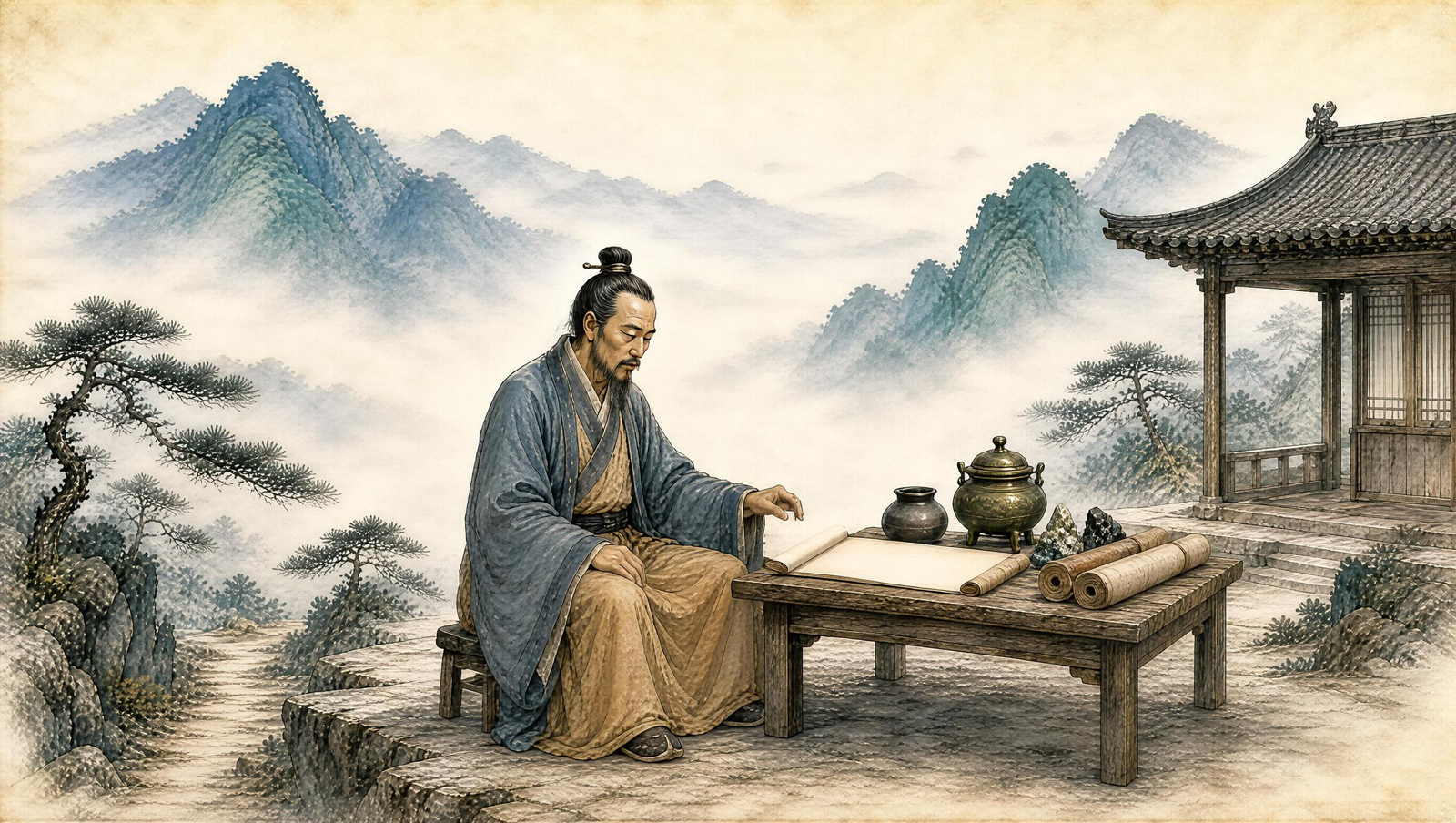
A young man of the Jin dynasty, orphaned and poor, copied books by hand by day and studied by night because he could not afford to buy them. That man, Ge Hong (283–343), would become the Taoist who first gathered the scattered arts of alchemy, herbal medicine, and breath cultivation into a single coherent body of teaching. His work did not invent the pursuit of longevity—it organized it.
Who was Ge Hong
Ge Hong lived through a fractured China, serving briefly in the military and refusing most official posts afterward. He trained under Zheng Yin, who passed to him the scriptures of the Supreme Clarity (Shangqing) current, and he married a fellow adept, Bao Gu. His life straddled two worlds: the courtly scholar who wrote on governance and the mountain hermit who sought the elixir.
What sets him apart is temperament. He was a skeptical empiricist inside a mystic tradition—warning that many "elixirs" were frauds, yet insisting that careful method could lengthen life. That combination made his writing survive when flashier claims faded.
The Baopuzi: a handbook of the way
His masterwork, the Baopuzi ("Master Embracing Simplicity"), splits into two parts. The "Inner Chapters" deal with the Taoist arts: alchemical recipes, meditation, dietary restriction, and the avoidance of the three death-bringers. The "Outer Chapters" cover governance, education, and social criticism. Together they argue that the same discipline that orders a state can order a body.
For readers who want the scriptural backbone of the tradition, our guide to the main Taoist scriptures places the Baopuzi in context alongside the Tao Te Ching and Zhuangzi.
Alchemy before internal alchemy
Ge Hong's alchemy was largely external—compounds of minerals, chief among them cinnabar (mercury sulfide), prepared through precise heating. He believed the right preparation could transmute base metal and, taken rightly, sustain the body. History judges those compounds harshly; mercury is poison. Yet his methodological seriousness—recorded temperatures, sequences, and warnings—seeded something larger.
That larger thing became neidan, internal alchemy. Where Ge Hong heated minerals, later adepts learned to "heat" the body's own essences. To follow that thread, read what Neidan is and our longer study of internal alchemy.
Why his legacy lasted
Ge Hong's lasting gift was not a single recipe but a framework: that longevity is a craft with principles, not a lottery of lucky charms. Later schools— Shangqing, Lingbao, and the internal-alchemy lineages that followed—built directly on his insistence that practice must be orderly, recorded, and self-critical.
He also preserved hundreds of recipes and observations that are now primary sources for the history of Chinese science. The Baopuzi is quoted by historians of medicine, chemistry, and botany alike, well beyond the Taoist shelf.
A practice echoing his method
You need not seek cinnabar to learn from Ge Hong. His core move—replace superstition with disciplined observation—applies to any modern practice. Keep a simple record. Change one variable at a time. Note what actually shifts in sleep, mood, and energy. That is the same empiricism he preached on the mountain.
The Taoist Library carries the classical texts he drew upon, so you can read the sources rather than the summaries.
The discipline he would approve
Ge Hong would likely distrust any promise of effortless immortality. What he offered was steadier and harder to sell: a method, written down, tested against experience, and handed on to the next person willing to copy it by candlelight. The elixir may have been the wrong compound—mercury is a poison, not a medicine—but the discipline behind the search was the right one. In that sense the scholar-adept of the Jin dynasty is still teaching, through a book assembled by a poor young man who refused to stop learning. His real gift was not a recipe for living forever, but a way of approaching the question that later generations could continue.
每週智慧,直送你的電郵
隨筆、時令指引與能量洞察——每週一信,絕無雜訊。