
What is qi? Qi (气, also spelled chi) is the vital energy that flows through the human body, the living land, and the sky above. In Taoist practice, health, meditation, Feng Shui, and internal alchemy are all ways of cultivating, balancing, and guiding qi so that life can move smoothly rather than stagnate. The idea is not mystical energy floating on its own; it is the living current that connects breath, posture, thought, and environment into one continuous field.
What Is Qi in the Taoist Body?
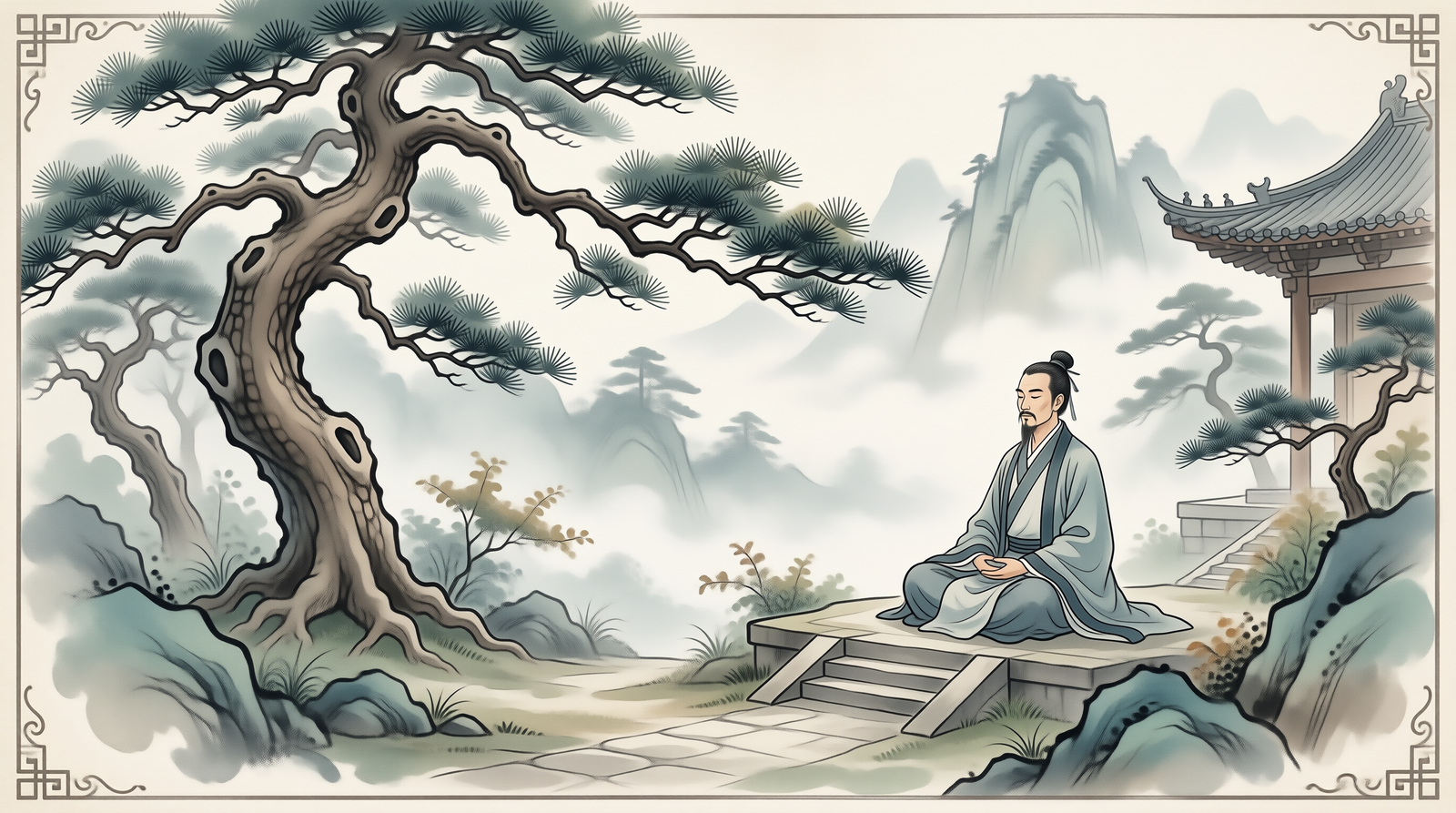
Taoist meditation begins with the simplest fact: the body is full of energy currents. The Daoist Foundation, which runs structured remote programs in jìngzuò 靜坐 (quiet sitting), treats meditation as a practical technology for settling the mind and letting the body's natural energy reorganize itself (Daoist Foundation Resources). Quiet sitting is not about forcing a blank mind; it is about sitting still long enough for the breath to slow, the muscles to release, and the flow of qi to become noticeable. Where the energy flows freely, practitioners report warmth, tingling, or a sense of expansion; where it is blocked, there is tension, coldness, or fatigue.
This is why Qigong, Tai Chi, and Daoist yoga are not treated as exercise routines alone. They are methods for moving qi through the joints and meridians. The goal is not to become stronger in a gym sense, but to become unobstructed: removing the knots that interrupt the current so that the body's own intelligence can repair and restore itself.
Qi in the Living Space
The same current is believed to run through buildings, rooms, and cities. Feng Shui literally means "wind and water," the two things that carry and channel qi across the land. WOFS World of Feng Shui notes that the bedroom is the most influential room for personal luck because it is where the body and the room's energy intersect during sleep (WOFS World of Feng Shui). A bed placed against a solid wall, with clear sight lines to the door and no overhead beam, allows the sleeper to rest inside a stable field of qi.
The Global Feng Shui Association, a professional body that certifies Feng Shui practitioners, treats qi diagnosis as a real discipline rather than a folk belief (Global Feng Shui Association). Practitioners learn to read how light, air, shape, and compass direction affect the quality of energy in a space. A dark corner with clutter is said to stagnate qi; a bright hallway with gentle curves lets it gather and circulate.
Why Qi Still Matters Today
Modern life often treats the body and the environment as separate machines. Taoist qi theory does the opposite. It says that the same energy animates both, and that improving one tends to improve the other. A person who meditates daily begins to notice the quality of air in a room. Someone who clears the clutter under a bed often reports sleeping more deeply. These are not coincidences in the Taoist view; they are the same qi becoming unobstructed.
Learning to feel qi does not require special belief. It begins with attention: slow the breath, relax the shoulders, and notice the difference between a cramped space and an open one. The tradition offers many tools—meditation, Qigong, acupuncture, and Feng Shui—but the starting point is the same: recognize that energy is moving through you right now, and learn to cooperate with it rather than fight it.
Common Questions About Qi
Beginners often ask whether qi can be measured with scientific instruments. The answer is nuanced. The experience of qi—warmth, tingling, balance, calm—is subjective and well-documented across meditation and martial-arts traditions. The concept of qi also overlaps with modern ideas about bioelectricity, breath chemistry, and nervous-system regulation, even though the two vocabularies do not map perfectly. Taoist practice is less interested in proving qi in a lab than in learning to work with it reliably in daily life.
If you want to go deeper, start with the body's own signs: signs your qi is blocked and how to clear it, or learn how the Five Elements shape your qi. For a direct answer to the broader idea, see what is qi and why does it matter.
每週智慧,直送你的電郵
隨筆、時令指引與能量洞察——每週一信,絕無雜訊。