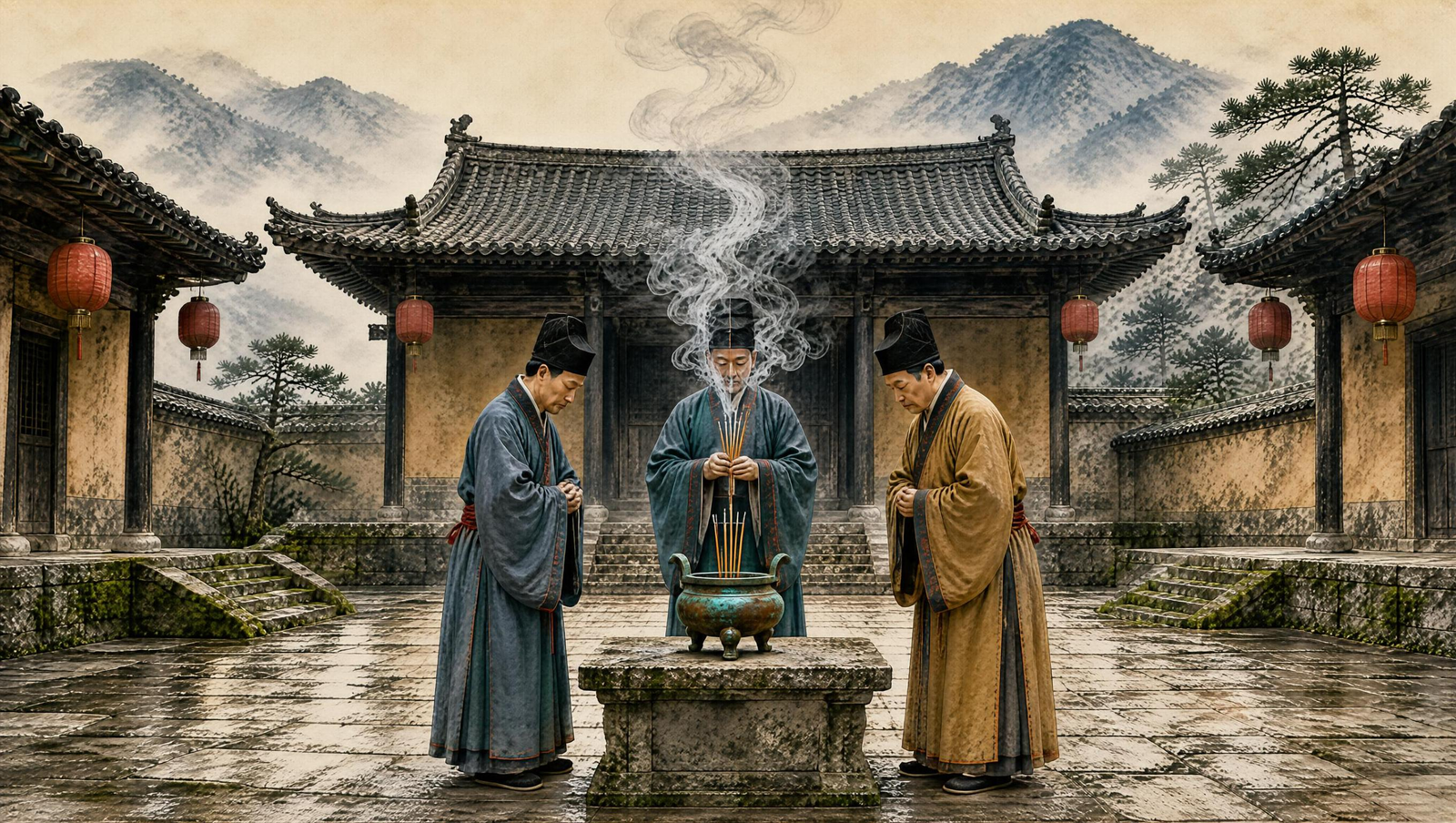
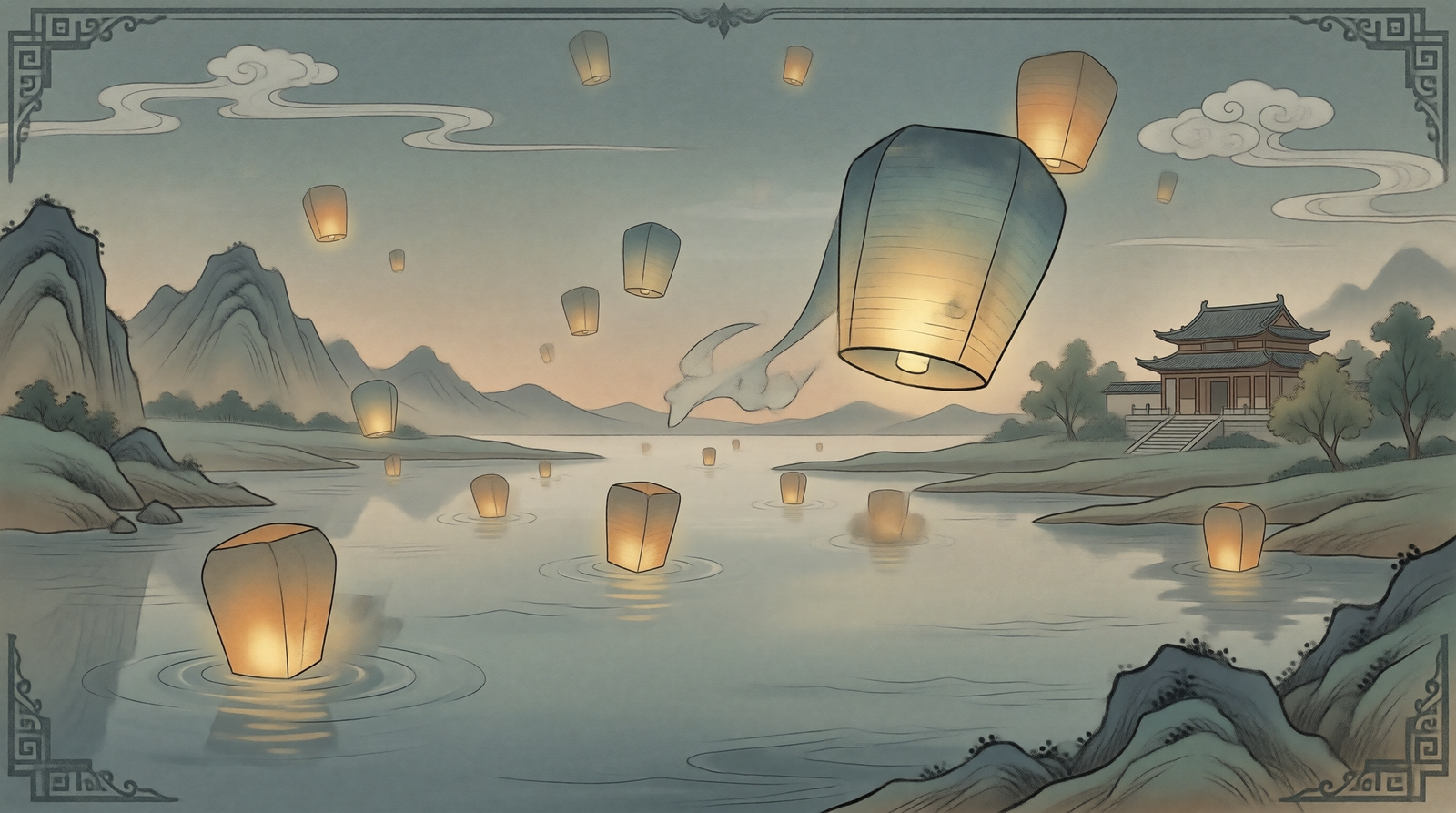
The Hungry Ghost Festival, also called the Zhongyuan Festival 中元節, falls on the fifteenth day of the seventh lunar month. In Taoist and Chinese folk belief, this is the day when the gates of the underworld open and spirits without descendants, or those who died in unfortunate circumstances, are allowed to return to the world of the living. Families and temples respond with offerings of food, incense, paper money, and prayers, hoping to feed the hungry ghosts and transfer merit so that the dead may find peace.
The Taoist Origins of the Hungry Ghost Festival
The festival is not a random superstition; it is rooted in the Taoist veneration of the Three Officials, or Sanguan 三官. The Earth Official, or Diguan 地官, is said to preside over the underworld and to grant pardons on the fifteenth of the seventh month. This is why the day is called Zhongyuan: it is the middle of the three cosmic realms associated with heaven, earth, and water. A detailed popular article from The Paper explains that the festival's origins trace back through Taoist cosmology, where the Three Officials examine and judge the dead, and the seventh month becomes a window for releasing and feeding wandering spirits (The Paper).
Another report from Caixin Global adds historical depth, noting that the association of vegetarian practice with the seventh month also has imperial roots, with Emperor Wu of Liang later linked to the promotion of vegetarian observances during this period (Caixin Global). The combination of Taoist cosmology, imperial custom, and family piety created the festival as it is practiced today across the Chinese-speaking world.
How Temples Celebrate Today
Major temples mark the festival with formal rituals. In Hong Kong, the Fung Ying Seen Koon announces special opening hours during its Zhongyuan Dharma Assembly so that devotees can come to make offerings for their ancestors and for wandering spirits (Fung Ying Seen Koon). The ceremony is led by ordained priests who chant scriptures, burn memorials, and direct the merit toward the dead.
In Taiwan, the Beigang Chaotian Temple—one of the island's most important Mazu centers—opens registration for its Zhongyuan Universal Salvation Dharma Assembly, where families sponsor offerings for the hungry ghosts and pray for peace in the community (Beigang Chaotian Temple). The scale can be large, with public altars, opera performances for the spirits, and processions of lanterns to guide the dead back to their realm.
Family Practices and Taboos
At home, families set out food, fruit, tea, and incense before small altars on the street or in front of their doors. They may burn joss paper shaped as money, houses, or clothing so that the dead have what they need in the afterlife. Some believe that leaving food overnight, hanging laundry at night, or swimming during the seventh month invites unwanted spiritual attention. Whether taken literally or as respectful caution, these taboos keep the festival solemn.
The modern Feng Shui publisher WOFS World of Feng Shui summarizes the festival's meaning for contemporary practitioners, noting the dates, rituals, taboos, and spiritual protection practices commonly observed during the Hungry Ghost Month (WOFS World of Feng Shui). The guidance reflects a living tradition: the festival is not only about fear of ghosts but about caring for the forgotten dead and maintaining cosmic balance between yin and yang, the seen and the unseen.
Why the Festival Still Matters
In an increasingly secular world, the Hungry Ghost Festival survives because it addresses a lasting human need: the relationship with the dead. It reminds the living that they are part of a chain that includes ancestors, parents, and those who came before. Offering food and merit to wandering spirits is also a way of acknowledging luck, privilege, and the fragile boundary between having a home and being homeless, both in this life and the next.
For the Taoist framework behind these rites, read what is a Taoist ritual. To understand the deities involved, see who is the Jade Emperor. And for the calendar of spiritual protection, visit what is Tai Sui and what does it mean to offend it.
每週智慧,直送你的電郵
隨筆、時令指引與能量洞察——每週一信,絕無雜訊。