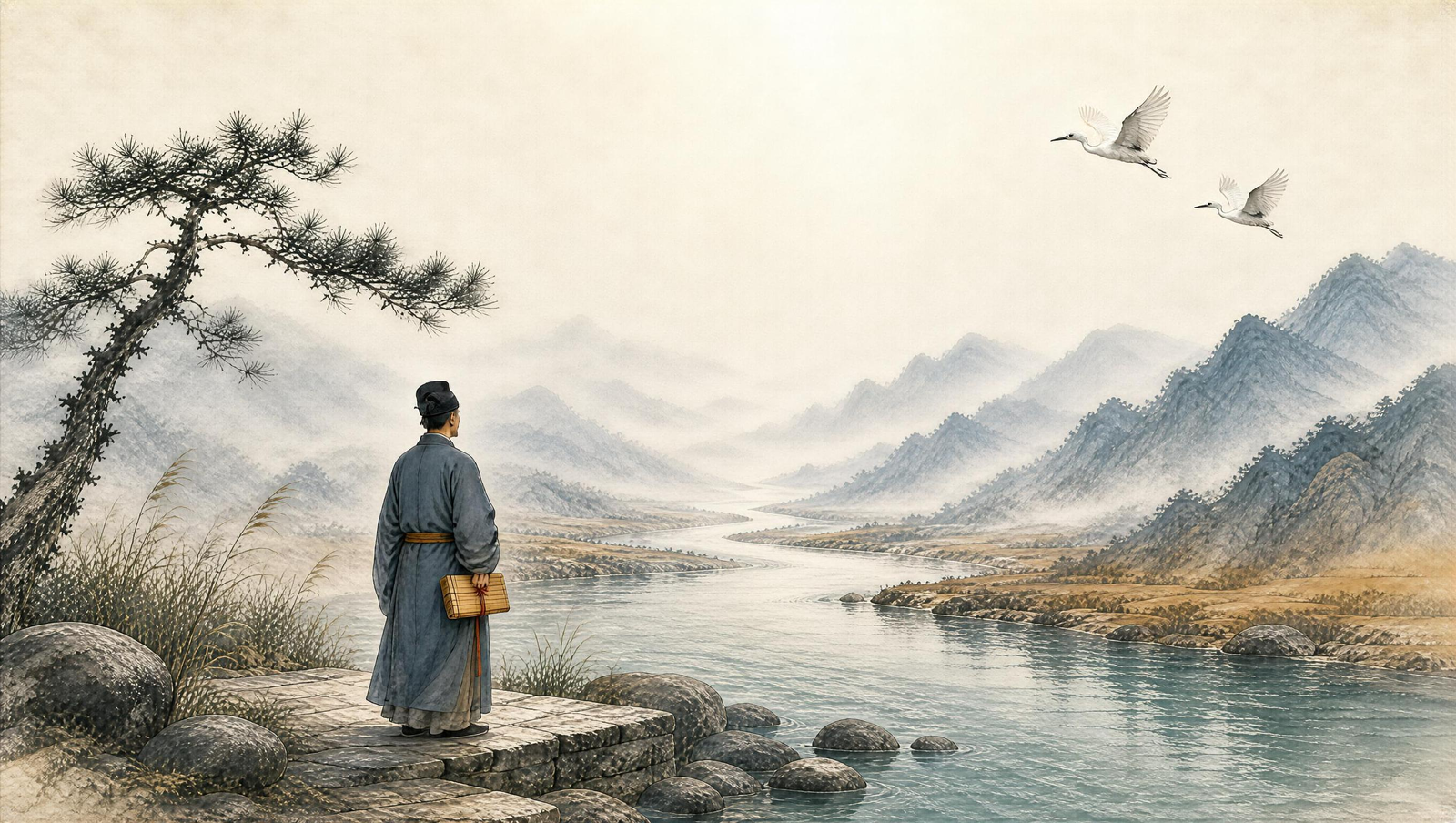
The Yinfu Jing is one of the shortest texts in the Daoist canon and one of the most commented on: roughly three hundred characters, traditionally attributed to the Yellow Emperor, and treated for more than a thousand years as a manual for acting at the right moment rather than acting more. Its opening line — observe the way of heaven, hold to the movement of heaven — is the whole instruction compressed into eight characters.
What follows is a reading of the text's structure and its central images, with the textual questions kept separate from the practice.
What the Yinfu Jing is
The title is usually rendered "Hidden Talisman Classic," though earlier catalogues also record it as "Hidden Convergence" — the character fu carrying both senses. The text is not a ritual manual and not a cosmological diagram. It reads more like a set of operating notes: brief, imperative, and mostly about timing.
It is short enough to memorise in an afternoon and dense enough that the major commentaries disagree on nearly every line. That combination is why the Yinfu Jing sits alongside the Daode Jing and the Nanhua Jing in the small group of texts a serious reader returns to rather than finishes.
The three parts of the Yinfu Jing
The recension that became standard divides into three sections, and the division is itself an interpretation of the text:
- Upper section — "the immortal embraces the one." The subject is cultivation: what a person does with attention, breath, and the senses over time.
- Middle section — "enriching the state, securing the people." The subject is governance and household management, read as the same skill applied at a larger scale.
- Lower section — "strong troops, victorious battle." The subject is conflict, and the section is famously not about aggression. It is about position, restraint, and striking only when the configuration is already decided.
Read together, the three sections argue that inner cultivation, administration, and warfare are one discipline at three scales — which is also the argument of the classical military and political texts that quote the Yinfu Jing heavily.
Observe the way of heaven, hold to the movement of heaven
The opening instruction is a pair of verbs, not a pair of ideas. Observing is receptive; holding is active. The text never suggests that a person should imitate nature in general. It asks for something narrower — read how a situation is already moving, then move with it rather than against it.
The image that follows is timing. The text notes that when one eats at the right season the body is ordered, and when one moves at the right moment the ten thousand transformations settle. Nothing in the sentence promises success from effort alone. Effort applied early or late is the same as no effort at all, or worse.
The three thieves
The most quoted line in the text is also the strangest: heaven and earth steal from the ten thousand things, the ten thousand things steal from people, and people steal from the ten thousand things. When the three thefts are in accord, the three powers are at rest.
Commentators read the "theft" as consumption — the exchange of what is taken and given back in any living system. Nothing here is moralised. Eating is a theft; breathing is a theft; a field taking water from a river is a theft. The instruction attached to the image is balance of exchange, not abstinence from it. A household or a business that only takes, without returning anything to the system it draws from, is running the cycle into a corner.
The same section carries the practical corollary, often quoted in Chinese on its own: cut off profit at its single source and you command ten times the force. Concentration of intention, not multiplication of effort.
Who wrote it, and when
The traditional attribution is to the Yellow Emperor, and the Tang-dynasty commentary by Li Quan records a story of receiving the text on Mount Song from a woman of Mount Li. The Tang is also when the text entered wide circulation, which is exactly why later scholars doubted the attribution. Zhu Xi examined the text specifically to test its date and concluded it belonged to the Tang or the period just before it.
For a reader today the dispute changes less than it sounds. The Yinfu Jing was read for centuries as a Tang and Song text by people who also read it as ancient, and the commentaries — Li Quan, Zhang Guo, and the later compilers — are part of the text's working meaning. Read the commentary with the text, not instead of it.
How to read a very short classic
Three hundred characters reward a slower method than a long book does. Read the whole thing once for shape. Then take one line a week and look for where it applies in your own week — a decision made too early, a claim staked too late, an exchange that only runs one direction.
The library holds the classical texts in reading order, and two FAQ entries set the frame: which scriptures matter in Daoism and what Taoism is. If you want a reading sequence rather than a single text, the Daode Jing explained is the natural next step.
每週智慧,直送你的電郵
隨筆、時令指引與能量洞察——每週一信,絕無雜訊。