Most bedrooms get arranged around the bed first, and everything else is squeezed into the space that is left. The wardrobe is the piece that ends up wherever a wall happens to be — and it is usually the piece that decides how heavy the room feels at night.
Bedroom wardrobe placement comes down to four questions: what the cabinet blocks, what it faces, how close it sits to the bed, and whether its doors stay closed. Answer those four and the rest is size, colour, and finish.
Why bedroom wardrobe placement matters more than it looks
A bedroom holds two large masses: the bed and the wardrobe. The bed should read as the lightest thing in the room, because it is where the body goes soft. A wardrobe is the opposite — a tall, dense, unmoving block. Traditional practice treats it as mountain rather than water: it anchors a wall, and it does not belong on the bed's axis. That is the reasoning behind the feng shui treatment of solid objects, and it is also why a wardrobe placed badly makes a room feel smaller than its measurements suggest.
There is a practical layer underneath. A wardrobe one metre from the foot of the bed narrows the walking path, blocks the window's light, and traps air behind its back panel, so the room never quite clears the qi that hangs in a closed corner. None of that needs a chart to detect. The objection to a badly placed wardrobe is often just the room telling you it feels cramped.
Where a wardrobe should stand
Most of bedroom wardrobe placement is settled here. The default position is against a solid wall, on the side of the room the bed does not face. Three placements are worth avoiding.
- Directly opposite the foot of the bed. Standing up and looking straight into a wall of closed doors, every morning, is not restful. Where the bed faces the wardrobe at close range, thin the mass visually: choose a lower unit, or a shallow one, or a colour close to the wall.
- Facing the bedroom door and close to it. A large cabinet immediately inside the doorway crowds the entrance and turns the first thing the eye meets into a hard edge. Where possible, give the door a clear metre, or put the wardrobe on the adjacent wall instead of the opposite one.
- In front of a window. Wardrobes in front of glazing cut daylight and block the only natural air path most bedrooms have. Where the room leaves no choice, keep the top of the unit below the sill line.
Under a structural beam is the fourth item on the list. If the wardrobe already stands there and cannot move, practice usually softens the line above it — a pelmet, or a painted soffit in the ceiling colour. The cleaner remedy is to shift the cabinet so the beam crosses open floor instead.
Distance rules are worth following even without any other reasoning. Leave 60 to 90 cm of clear floor between the wardrobe doors and the bed, and keep a full door swing free. If the room cannot spare 60 cm, the wardrobe is in the wrong room rather than the wrong corner. Bedrooms that are tight for space usually have a bed-orientation problem first; where the bed points decides how much floor is left over for everything else.
Mirrored doors and the bed
Sliding doors with full-height mirror panels are the most common mistake in modern bedrooms, because they solve a real problem — floor space — with a solution that puts a mirror where it was never meant to be.
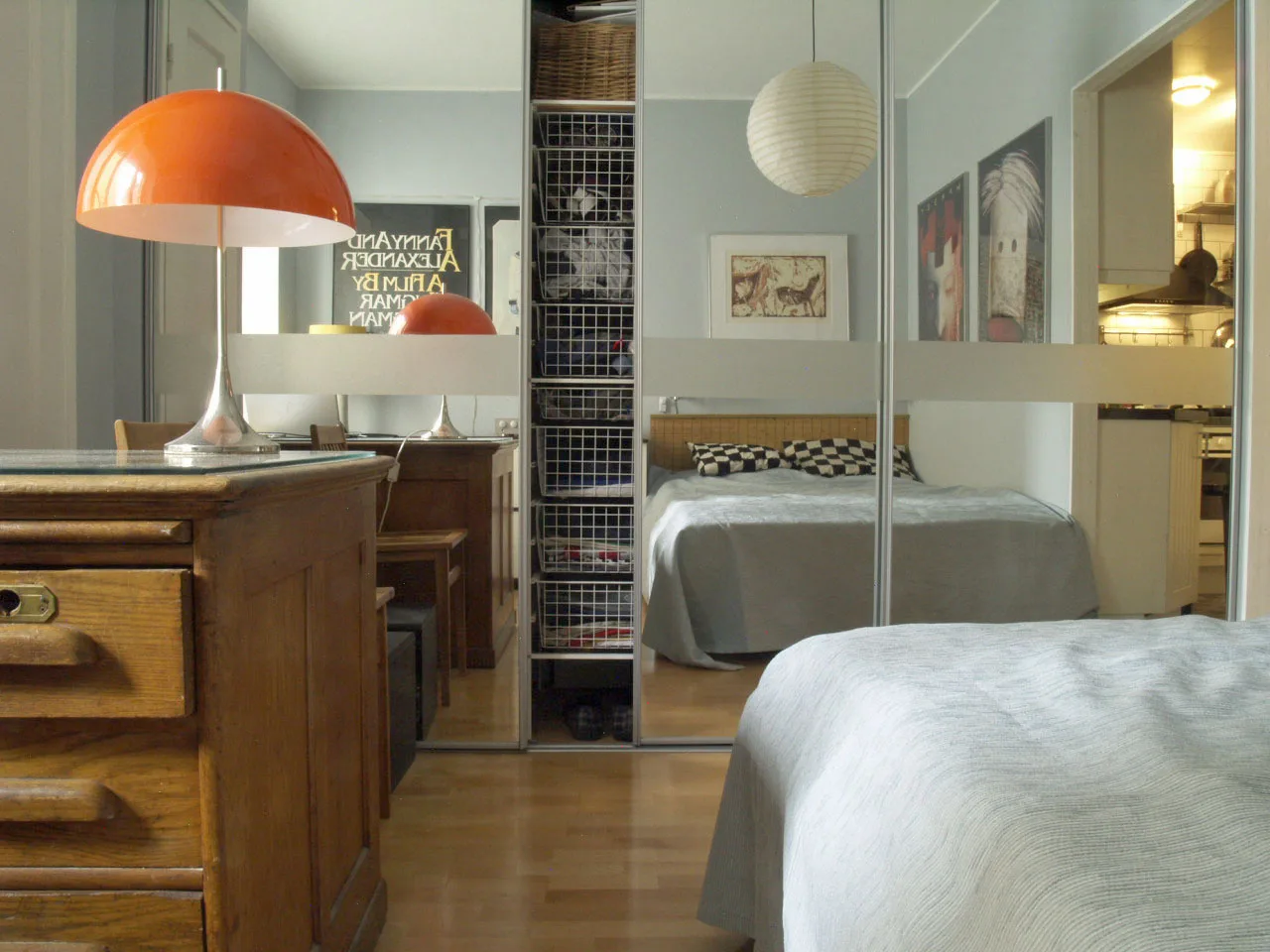
The rule is old: a mirror should not reflect the bed. The traditional reasoning concerns startled waking. The practical reasoning is that a large reflective surface at the foot or side of the bed catches any light in the room and throws it back at a sleeping person. Either way the fix is the same. Where the mirror cannot be removed, cover it at night, choose a frosted or brushed panel, or rehang the door so the reflective side faces the wardrobe interior rather than the room.
Wardrobe doors themselves should stay shut. An open wardrobe is a stack of loose objects in view, which is exactly what a bedroom should not be, and the same reasoning applies to the pile of clothes on the chair beside it — clearing that drift does more for a bedroom than any rearrangement of furniture.
When the bedroom is small
Small rooms invert the usual advice in one respect: the wardrobe should become part of the wall rather than a piece of furniture.
- Go full height and shallow, so the unit reads as joinery and stops at the ceiling line.
- Prefer sliding doors over hinged ones, and keep the door fronts flush and quiet in colour.
- Move everything that is not clothing inside — bags, boxes, paperwork. An open shelf above a bed is not extra storage, it is clutter at eye level.
- Keep the bed's head against one solid wall, and leave the opposite wall as clear as the room allows, even if the wardrobe has to take a side wall.
A short checklist
- Wardrobe against a solid wall, not on the bed's axis.
- No mirror facing the bed, at any distance.
- 60 cm of clear floor between the doors and the bed.
- Nothing in front of the window, nothing boxing in the doorway.
- Doors closed, contents contained, top of the unit clear.
The test afterwards is immediate. Sit on the edge of the bed in the evening with the lights off, and notice which surface the eye keeps returning to. If it is the wardrobe, the placement is still doing work it should not be doing.
Weekly wisdom, straight to your inbox
Essays, seasonal guidance, and energy insights - one letter a week, no noise.
DaoMind Pro
Read your own chart
Generate your full Ba Zi chart and elemental balance - the same data a practitioner opens with.
Open Destiny Atlas →