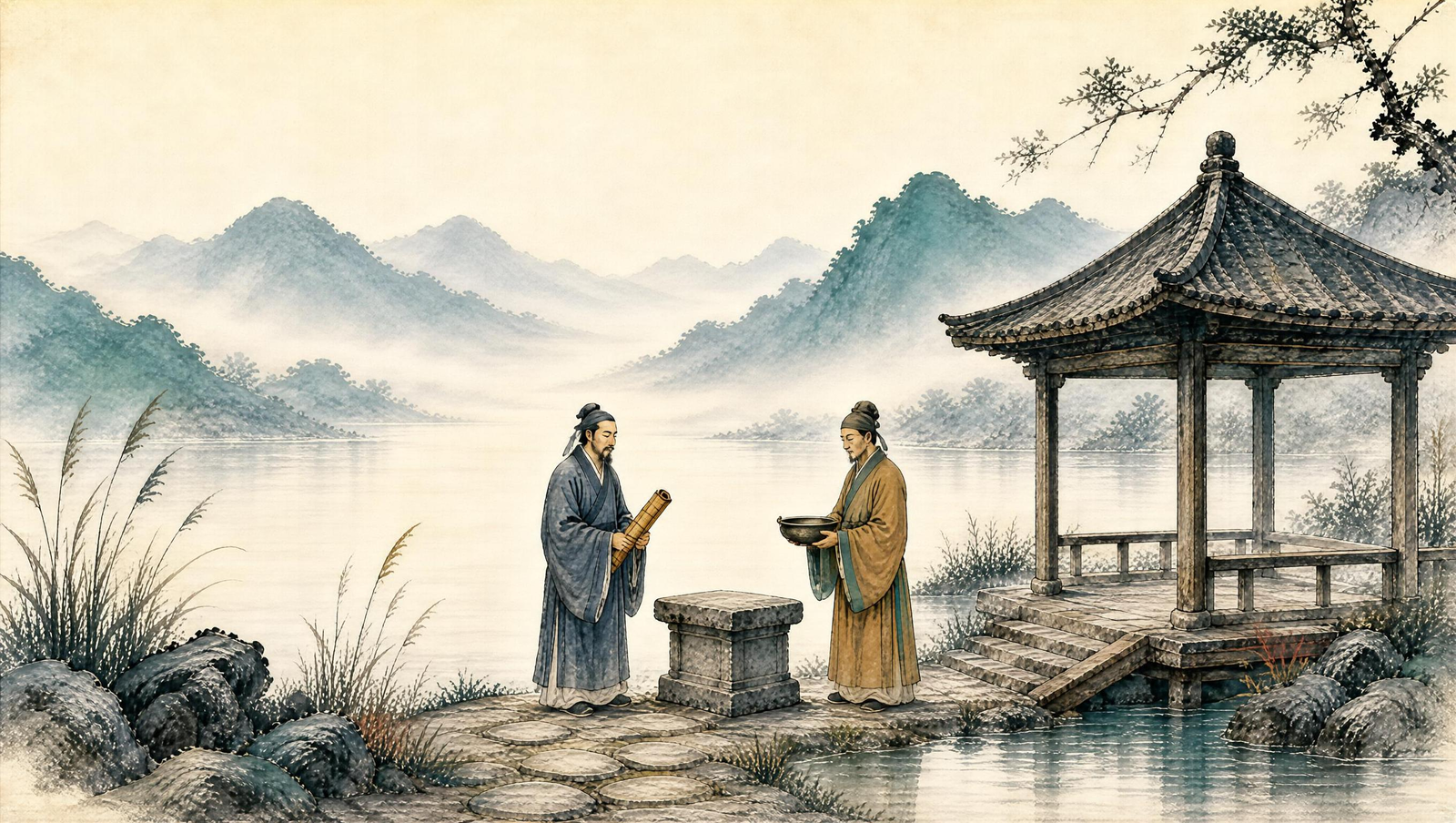
Ke Yi (科儀), often translated as "Taoist ritual" or "liturgical ceremony," is the bridge between the abstract Tao and the lived religion. Where the Tao Te Ching speaks of a Way that cannot be named, ke yi gives that Way a body: incense, chant, gesture, and community. In short, taoist ritual is philosophy made observable, and it is how the formless becomes form.
From the Way to the rite
The Tao is formless and beyond words, yet human beings need form to practice. Ke yi answers this need. A rite is "ke" (the fixed structure, the steps) plus "yi" (the proper ceremony or protocol). Together they let a congregation align with cosmic order. The Hong Kong Daoist Culture Centre describes ke yi as the disciplined heart of Taoist public worship, the part of the tradition most visitors actually meet (Daoist Culture Centre). Silence and form are not opposites here: meditation seeks the formless within, while ritual brings the formless outward, so the two practices complete each other.
What happens in a ke yi
A full taoist ritual follows a clear sequence: purification, invitation of the deities, offering, scripture chanting, petition, and dismissal. Priests move through prescribed steps in robes and with bells, fu talismans, and registers that prove their transmitted authority. The Chinese Religious Text Authority documents how these liturgies preserve classical texts and lineages across generations, making each rite a living archive (Chinese Religious Text Authority). Nothing in the sequence is decorative; every gesture carries a meaning handed down through centuries, so the rite is at once prayer, theatre, and memory.
Why ritual matters to the Way
Ritual is not decoration. It trains attention, builds community, and dedicates merit. A well-formed ke yi turns individual intention into shared harmony with the Tao. For background on how the religion took its structured form, see Who founded Taoism? - the Celestial Masters established the lineages that still perform these rites today, across the Zhengyi and Quanzhen schools alike. When many voices chant one text together, the boundary between the self and the group softens, and that softening is itself a lesson in wu wei.
The priest, the register, and transmitted authority
A ke yi is never performed by an individual acting alone. The presiding priest carries a lu (籙, register) - the documented proof of a transmitted lineage going back through the Zhengyi or Quanzhen orders. This register is what makes the rite valid: without transmitted authority, the gestures are only theatre. It is the same logic that runs through all of Taoist practice - realization is passed teacher to student, not invented on the spot. Visitors who attend a major festival often notice the priests moving as one body; that unity is the visible fruit of a shared, inherited discipline, not the result of a single gifted performer.
Ke yi vs. personal cultivation
Taoist ritual and personal practice are two wings of one tradition. Meditation and qigong refine the self in silence; ke yi refines the community in form. Both aim at the same goal - alignment with the Tao. The scriptures chanted in rites are themselves gateways: the main scriptures of Taoism introduce the texts behind the chanting, from the Tao Te Ching to the liturgical canon. A practitioner may begin alone on a cushion and later find the same stillness amplified a hundredfold in a temple full of chanting.
How to experience it
You can read a deeper breakdown in our guide to Taoist ritual (ke yi), and explore how chant and music carry the liturgy in Taoist ritual music. Visiting a temple during a festival is the best way to feel ke yi as living practice, when the boundary between philosophy and form simply disappears. Arrive early, stand at the back, and let the rhythm of bell and breath do the teaching; you do not need to understand every word to be changed by the ceremony.
中文讀者請見:道與科儀:儀式如何體現道
Weekly wisdom, straight to your inbox
Essays, seasonal guidance, and energy insights - one letter a week, no noise.
DaoMind Pro
Read your own chart
Generate your full Ba Zi chart and elemental balance - the same data a practitioner opens with.
Open Destiny Atlas →