
Ziran, in plain words
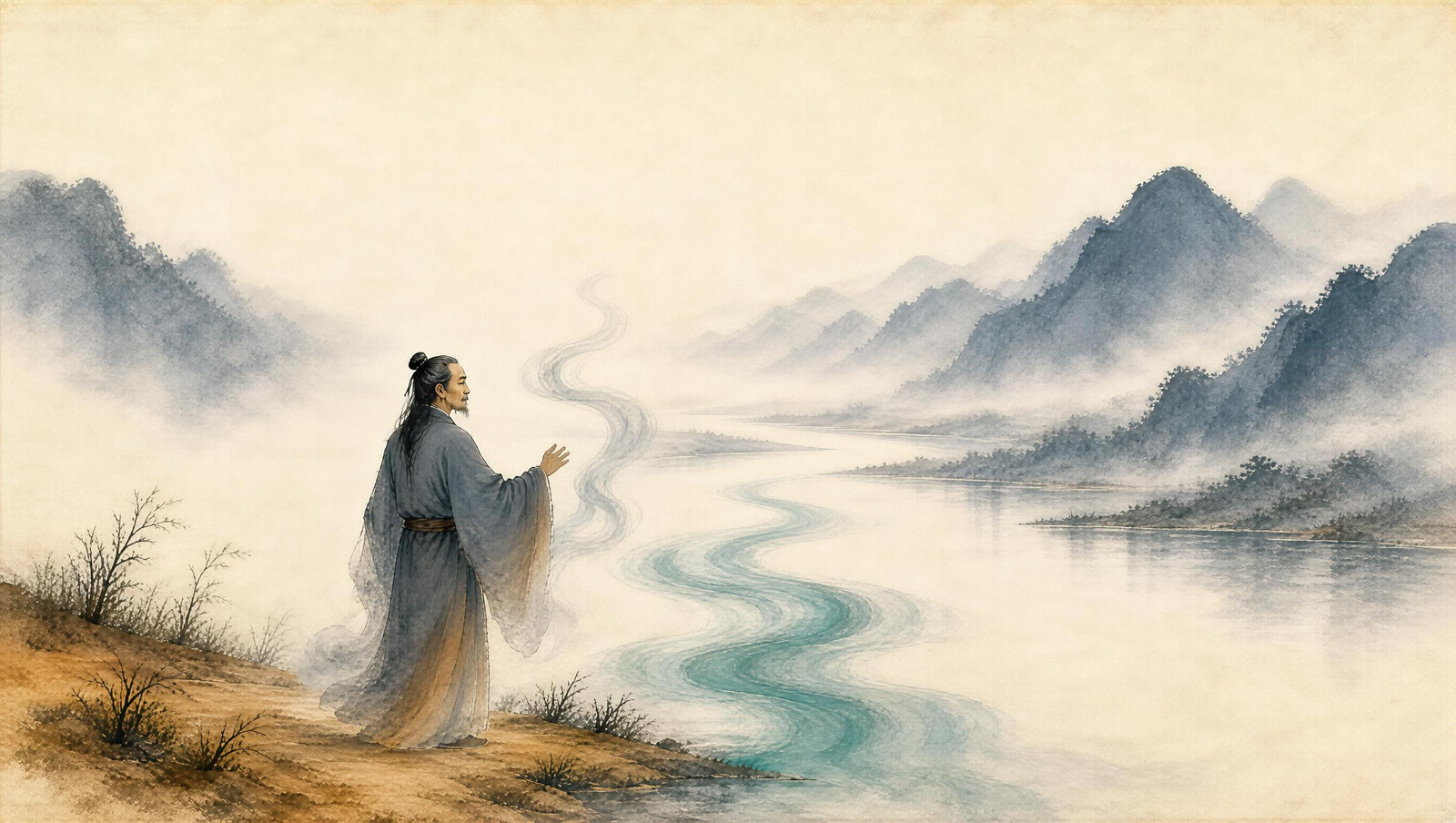
Ziran (自然) is the Taoist concept usually translated as "naturalness," "spontaneity," or "self-so." At its core it means things happening as they inherently do, without coercion, pretense, or outside interference. A stream finding its own course is ziran; a policy that forces the stream into a concrete channel is not. It is the descriptive ideal behind wu wei (non-forcing) and, for many readers, the single most useful idea the Tao Te Ching offers for modern life.
Where the word comes from
The character 自 means "self" and 然 means "so" or "thus" — literally "self-so," the condition of being thus from oneself. In classical Chinese it rarely meant the physical "nature" of rocks and trees in the modern sense; it pointed to an activity, a way of arising from one's own principle. The earliest sustained philosophical use appears in the Tao Te Ching and the Zhuangzi, where the sage is praised not for imposing order but for letting things be what they already are (source, the Stanford Encyclopedia of Philosophy's entry on Daoism treats ziran as central to Laozi's non-coercive politics).
Ziran and the Tao
Ziran is often said to be "the mark of the Tao." The Tao Te Ching states that the Tao "models itself on what is so of itself" (道法自然) — a famous line scholars read as: even the Tao takes ziran as its standard. This is not nature-worship in the modern ecological sense; it is a claim about how reality governs itself when left to its own patterning. To live according to the Tao is, in practice, to live ziran: acting from genuine nature rather than from borrowed roles, fear, or ambition.
For the conceptual background, see What is the Tao (the Dao)?, and for the practice that follows from it, What does Wu Wei actually mean?. Our longer essay Wu Wei, explained shows how the two ideas work together.
Ziran in everyday life
Stripped of metaphysics, ziran is a diagnostic and a discipline. As a diagnostic, it asks: is this action coming from who I actually am, or from a script I borrowed? As a discipline, it means removing the layers — expectation, performance, anxiety — that block a situation from resolving on its own. A teacher who explains less and lets students discover more is practicing ziran; so is a manager who sets a clear frame and then trusts the team.
The Internet Encyclopedia of Philosophy's treatment of Daoist philosophy notes that ziran underwrites the tradition's suspicion of rigid laws and heavy-handed control — a point that travels well from ancient courts to modern organizations (source, the IEP entry remains a standard open-access reference for this reading).
Ziran in nature and art
The aesthetic wing of Taoism extends ziran into art and landscape. A painting prized for "birthing without showing the brush" is one where the artist's hand disappears and the forms seem to have arranged themselves. Garden design, too, aims for the "uncarved block" feeling — rocks placed as if they had always been there, water led as if it had always flowed. In each case the goal is not randomness but the removal of visible forcing: the work should carry the signature of no signature. This is ziran as a standard of beauty, not only of conduct, and it is why the tradition repeatedly returns to spontaneity as the highest craft.
Why it matters now
In a culture optimized for optimization, ziran is a corrective. It does not forbid effort; it forbids effort spent forcing outcomes that a quieter approach would have delivered anyway. The Taoist claim is empirical before it is spiritual: most systems, left with good boundaries and minimal interference, self-organize. Trusting that — without abdicating responsibility — is the daily practice of naturalness.
Weekly wisdom, straight to your inbox
Essays, seasonal guidance, and energy insights - one letter a week, no noise.
DaoMind Pro
Read your own chart
Generate your full Ba Zi chart and elemental balance - the same data a practitioner opens with.
Open Destiny Atlas →