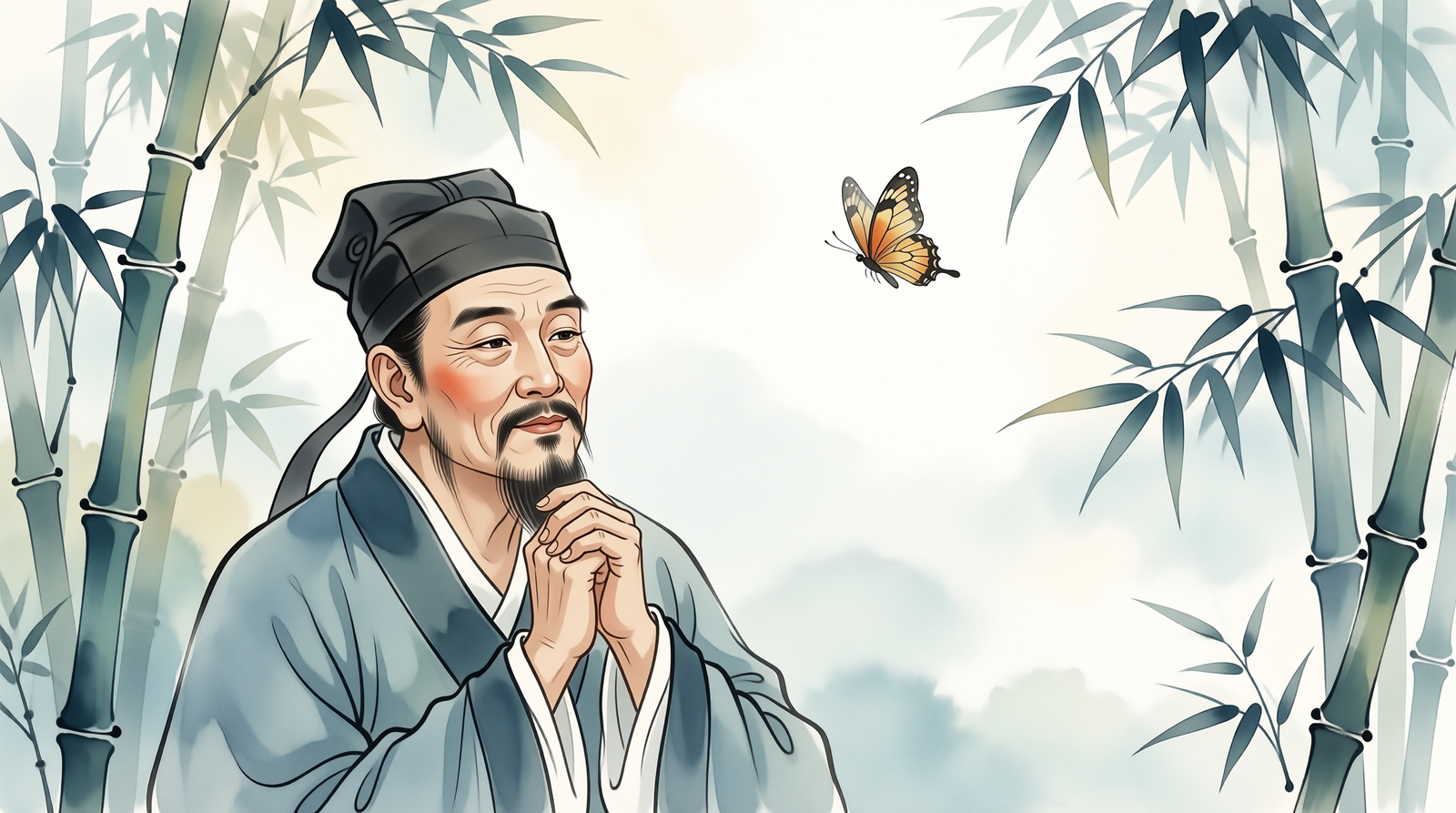
Chuang Tzu, known in Mandarin as Zhuangzi 庄子, is the second great figure of classical Taoist philosophy alongside Laozi. While the Tao Te Ching speaks in short, dense verses, the Chuang Tzu bursts with stories: a man who dreams he is a butterfly, a butcher whose knife never dulls, a gnarled tree useless to carpenters yet alive for centuries. These parables are not entertainment; they are arguments for freedom, flexibility, and a life that follows the Tao rather than social convention.
What the Historical Sources Say
Most scholars agree that Chuang Tzu lived during the Warring States period, around the fourth century BCE. A recent academic discussion published in Frontiers explores the spiritual healing dimension of both Yan Hui, a Confucian disciple, and Chuang Tzu, treating the two as complementary peaks of Chinese thought rather than rivals (Frontiers). That framing is itself Taoist: no single school owns the truth, and wisdom can appear in many forms.
The text that bears his name, the Chuang Tzu, was probably compiled by later followers as well as by the sage himself. Its current form contains thirty-three chapters, though the original may have been larger. The first seven chapters, called the "inner chapters," are usually attributed to Chuang Tzu himself, while the "outer" and "miscellaneous" chapters contain material from his school.
The Core Ideas: Freedom and Non-Attachment
Taoism.net, which hosts an online translation of the Chuang Tzu, presents the text as a practical guide to living without rigid self-importance (Taoism.net). One famous story tells of a huge fish named Kun that transforms into a giant bird called Peng. The point is not that magic happens; it is that the same being can take completely different forms depending on context. Applied to human life, the story asks: why cling to one identity, one career, one opinion, when existence itself is constantly changing?
Another well-known passage describes a cook named Ting who butchers oxen for nineteen years without sharpening his knife. He does not force the blade; he finds the empty spaces between the joints. This is the Taoist ideal of wu wei, or non-forcing action. Skill comes not from aggression but from intimate knowledge of how things naturally separate and connect.
Chuang Tzu and Laozi: Two Voices, One Tradition
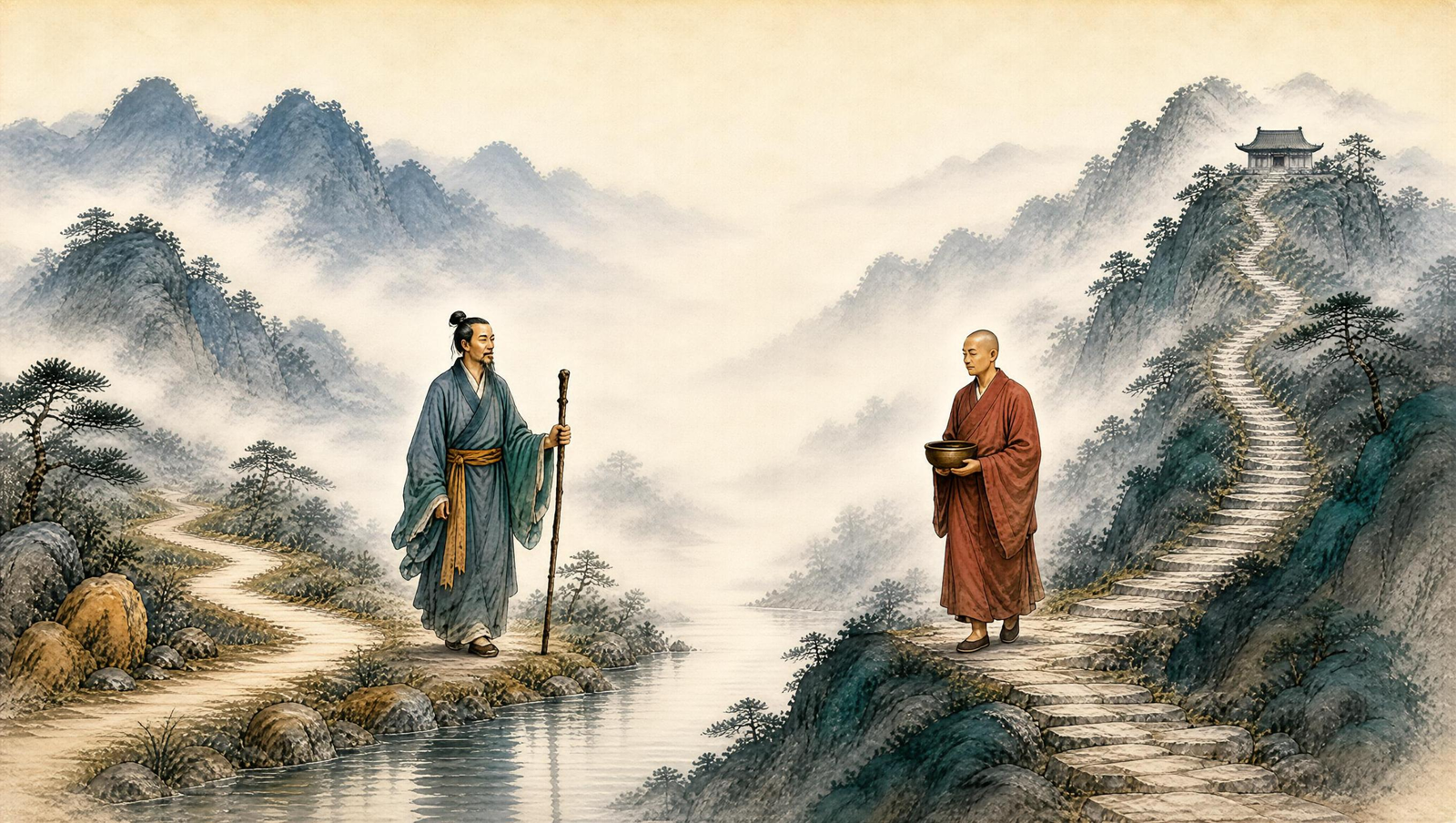
Laozi is usually seen as the founder of Taoist philosophy, writing the Tao Te Ching as a manual for rulers and seekers. Chuang Tzu is the wilder, funnier voice. Where Laozi advises stillness and simplicity, Chuang Tzu laughs at pretension, mourns the limits of language, and celebrates the uselessness of things society calls worthless. Together they form the philosophical foundation of Taoism: Laozi gives the map, and Chuang Tzu gives the journey.
This pairing is why serious students of Taoism read both texts. The Tao Te Ching teaches how to govern oneself and others; the Chuang Tzu teaches how to be free inside any system. One is sober; the other is playful. Both point to the same Tao.
Reading Chuang Tzu Today
You do not need to be a scholar to benefit from Chuang Tzu. The stories are short and strange enough to remember. The butterfly dream—"I do not know whether I was then a man dreaming I was a butterfly, or whether I am now a butterfly dreaming I am a man"—is a direct attack on the certainty of the ego. The gnarled tree shows that usefulness is not the only measure of value. The butcher's knife is a lesson in skillful action.
For a deeper introduction to the first text of the tradition, read Tao Te Ching explained. To meet the philosopher credited with writing it, see Laozi and the Tao Te Ching. For the Taoist canon as a whole, visit what are the main scriptures of Taoism.
每週智慧,直送你的電郵
隨筆、時令指引與能量洞察——每週一信,絕無雜訊。