Zhuangzi's Autumn Floods is the seventeenth chapter of the Zhuangzi, and its opening lesson is about scale: a river god, swollen with seasonal rain, travels to the sea and discovers that his own grandeur was the measure of a very small pond. Everything in the chapter follows from that discovery — how perspective is chosen, why arguments about proof run in circles, and why a person who has seen the ocean stops boasting about the river.
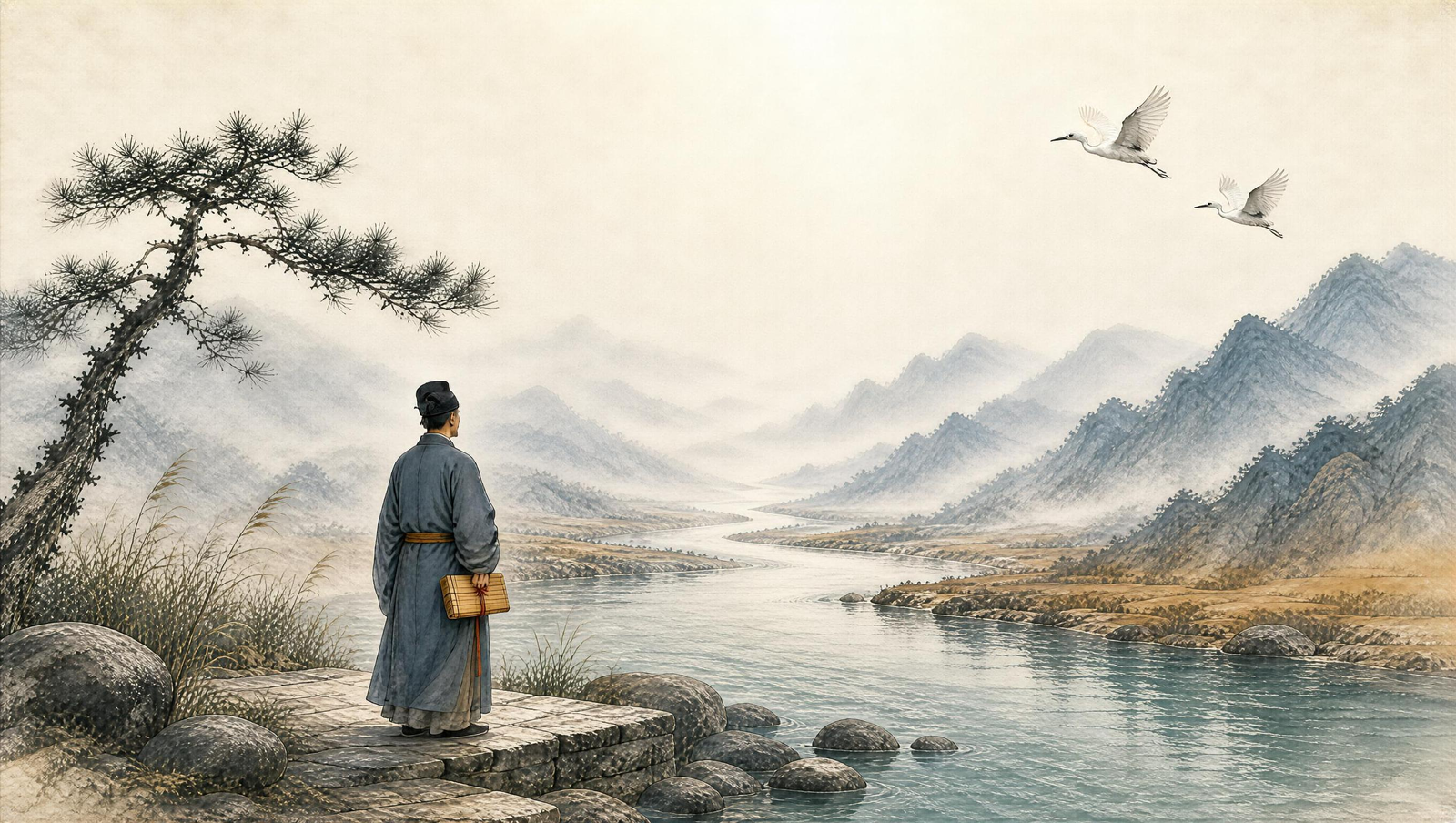
The scene is concrete. Autumn arrives, a hundred streams pour into the Yellow River, and the water rises until you cannot tell a cow from a horse on the far bank. The river god, He Bo, is delighted: all the beauty of the world, he decides, has collected in him. Then he flows east, reaches the North Sea, looks out, and sees no end to the water.
The turn of a face
The most famous image in the chapter is a change of expression. He Bo, writes Zhuangzi, "then turned his face" and sighed towards Ruo, the spirit of the North Sea. He quotes a common saying against himself: to hear the Way spoken of a hundred times and conclude that no one equals you — that, he says, is me.
It is worth pausing on the structure. Nothing external punished him. The sea did not argue with him. He travelled, looked, and revised his estimate of himself. The correction came from a wider view, not from defeat.
What the sea says about small views
Ruo's answer is where the chapter becomes a tool rather than a story. A well-frog cannot be spoken to about the sea, he says, because it is bound by its hollow; a summer insect cannot be spoken to about ice, because it is bound by its season; a scholar of crooked views cannot be spoken to about the Way, because he is bound by his own teaching.
Three bindings, one mechanism: whatever you live inside becomes the boundary of what you can hear. The sea then adds the condition for progress — now that He Bo has left the riverbanks, seen the ocean, and understood his own smallness, he can be spoken to about the larger pattern.
The sea does not boast either
The next move is easy to miss. Ruo does not claim superiority. Compared with heaven and earth, he says, the four seas are little more than a small hole in a marsh. His point is not that the sea is great but that "great" and "small" are positions in a comparison, and the comparison is always chosen.
Then the line that carries the whole chapter: seen from the Way, things have no noble or base; seen from things, each esteems itself and disparages the others; seen from custom, worth is decided by others rather than by you. The argument is not that all views are equal. It is that the verdict depends on the frame you took up, and the frame was your choice.
Where proof runs out: the bridge over the Hao
The chapter ends on a river bridge with a friend and an argument.
Zhuangzi, watching small fish dart about, says: this is the happiness of fish. Hui Shi, a logician by temperament, objects — you are not a fish, so how can you know the happiness of fish? Zhuangzi replies: you are not me, so how can you know that I do not know it? Hui Shi presses the point, and Zhuangzi answers with a pun. The word he used, an (安), can mean either "how" or "where". So: you asked how I know — I know it here, from the bridge over the Hao.
Read as sophistry this is a cheap trick. Read as criticism it is sharp: the demand for proof arrives already carrying an assumption about how knowledge is acquired, and sometimes the assumption is the thing to examine. The bridge is also the answer to the earlier question about frames. Zhuangzi states where he is standing before he states what he knows.
Reading the chapter without flattening it
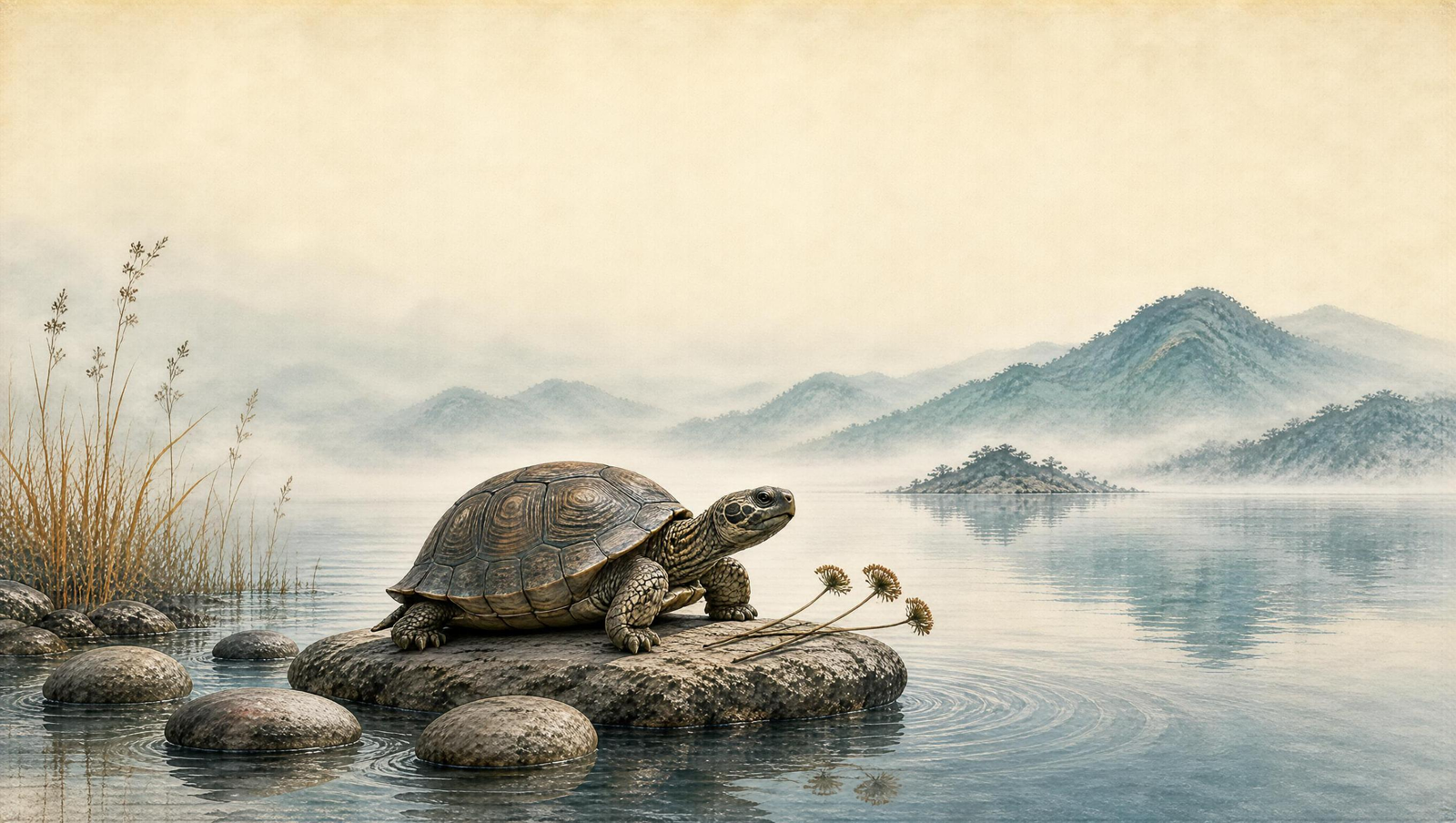
Autumn Floods survives in modern Chinese as a single idiom — sighing at the ocean — which reduces a long, varied text to one gesture of humility. The chapter is far wider than that. It contains Confucius trapped by a mob outside Kuang, and the story of the frog in the collapsing well, told by a philosopher to a bewildered logician. It contains Zhuangzi refusing a court post because a sacred turtle would rather drag its tail in the mud than sit varnished on an altar. It contains an owl guarding a rotting rat and screeching at a bird passing overhead.
The practice the chapter suggests is small and repeatable. When you reach a confident verdict about someone's limits — or your own — check where you are standing, and whether the frame you took up was the only one available. That is the same move described elsewhere as wu wei in action: less forcing, more noticing.
Read Zhuangzi's Autumn Floods as a method for revising your own estimate of scale, and it stops being a story about a river god. For background on the author and his place in the tradition, start with who Zhuangzi was and the Tao Te Ching explained. The question of whether this is philosophy or religion is answered separately in the DaoMind FAQ.
Weekly wisdom, straight to your inbox
Essays, seasonal guidance, and energy insights - one letter a week, no noise.
DaoMind Pro
Read your own chart
Generate your full Ba Zi chart and elemental balance - the same data a practitioner opens with.
Open Destiny Atlas →