
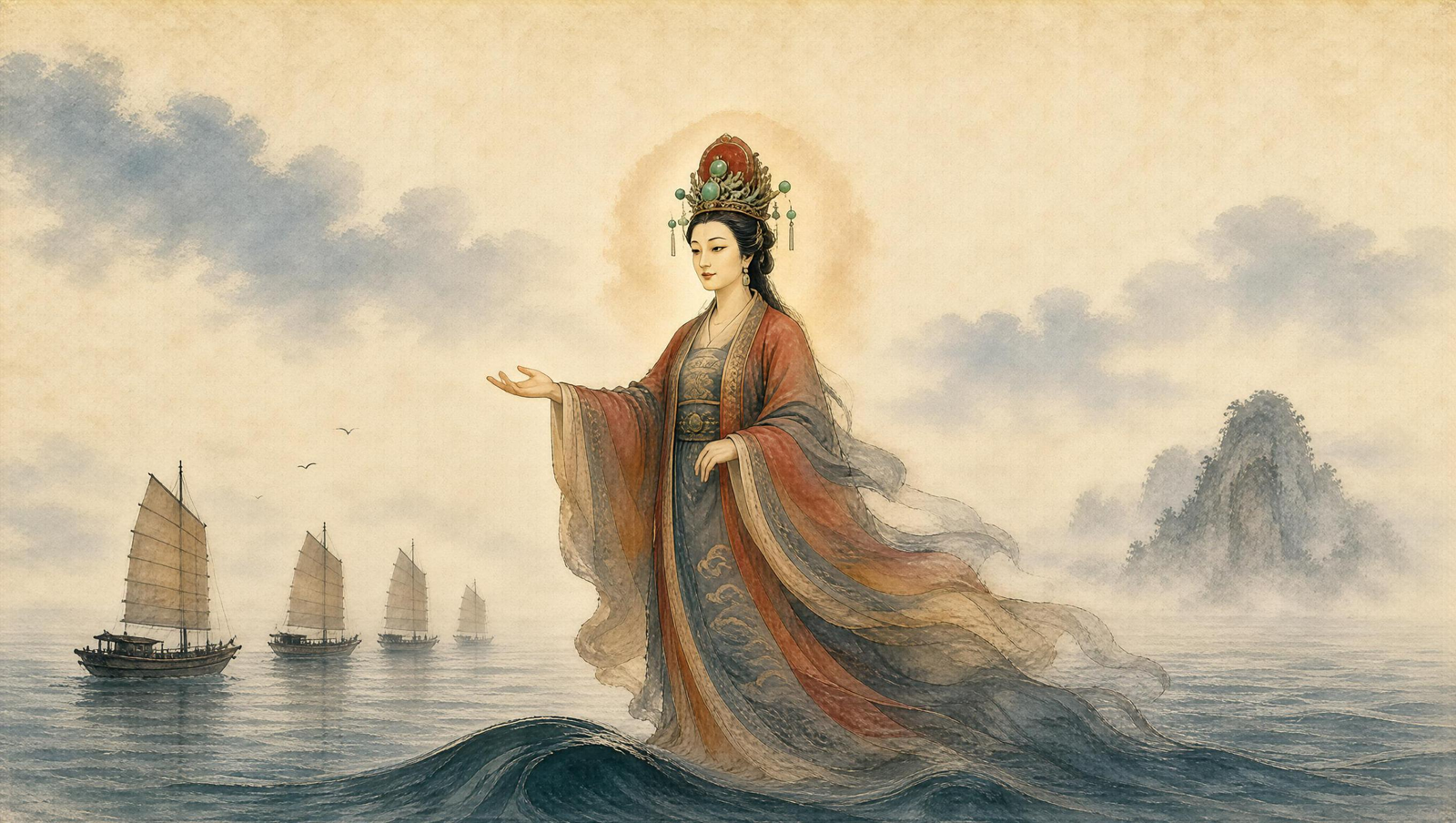
Who is Mazu, in one breath
Mazu is the Taoist and folk sea goddess who guards those who travel on water — fishermen, sailors, and the millions of migrants who crossed the South China Sea in her name. Her story begins with a real woman, Lin Mo (林默), said to have lived in the 10th century on Meizhou Island in Fujian. Centuries of devotion turned a local girl renowned for compassion and weather sense into one of the most widely worshipped deities in the Chinese world.
From Lin Mo to the Queen of Heaven
The historical core of the legend places Lin Mo's birth around 960 CE, during the early Song dynasty, in a fishing village on Meizhou Island. Accounts agree that she was unusually gifted — some say she could foresee storms and calm the sea through trance and prayer — and that she died young, never marrying, after exhausting herself rescuing sailors. Within a few generations, coastal communities built small shrines to "Ancestral Mother" (祖媽 / 媽祖), and the Song court began granting her official titles.
By the Yuan and Ming periods, as maritime trade expanded, her rank climbed from "ladyship" to "celestial consort" to "Heavenly Empress" (天后, Tianhou). The title most used today, Matsu (媽祖) or Mazu, is a southern Min honorific meaning "Ancestral Mother." Her elevation was less theology than recognition: an empire that depended on sea routes needed a protector whose power was explicitly over water and wind.
What Mazu protects
Mazu's domain is the boundary between land and sea — the most dangerous margin in a maritime culture. Devotees ask her for safe passage, calm weather, the return of missing boats, and protection for families separated by migration. Her festivals still open with the lighting of lanterns and the carrying of a sedan-borne statue through port towns, reenacting the processions that once saw emigrants off to Taiwan, Southeast Asia, and the Pacific.
Two facts anchor her modern scale. First, the Mazu belief and customs were inscribed by UNESCO on the Representative List of the Intangible Cultural Heritage of Humanity in 2009, recognizing a living tradition rather than a museum piece (source, the inscription remains active on the UNESCO heritage register). Second, her temples — numbering in the thousands — form a continuous cultural belt from Fujian and Taiwan through Malaysia, Singapore, Indonesia, and the Philippines, a network sustained by the same overseas Chinese communities that carried her statue in their hold.
Mazu in Taoist practice
Within religious Taoism, Mazu is honored among the celestial officials and protective deities rather than ranked with the high gods of the Three Pure Ones. She is approached through temple rites, votive offerings, and pilgrimage — most famously to Meizhou, her mythic birthplace, and to Beigang's Chaotian Temple in Taiwan, one of the faith's largest pilgrimage sites. For DaoMind's own lineage, she represents the Taoist conviction that protection flows through compassion made concrete: a human life so aligned with the needs of others that it becomes a permanent source of help.
If you are new to the tradition, start with What is Taoism? for the big picture, then read our longer piece on the Hungry Ghost Festival to see how folk and Taoist worship interweave around the calendar.
A goddess for a mobile world
Mazu's appeal has outlasted the sailing ships that spread her. In an age when families are again scattered across continents, her promise — safe passage and reunion — speaks directly to migration, trade, and the anxiety of those at sea literally and figuratively. She is less a distant sovereign than a mother who watches the horizon. That is why, more than a thousand years after Lin Mo walked Meizhou, her temples still burn incense at every dawn where water meets the shore.
For a broader map of the Taoist heavens, see Who are the Three Pure Ones?.
每週智慧,直送你的電郵
隨筆、時令指引與能量洞察——每週一信,絕無雜訊。