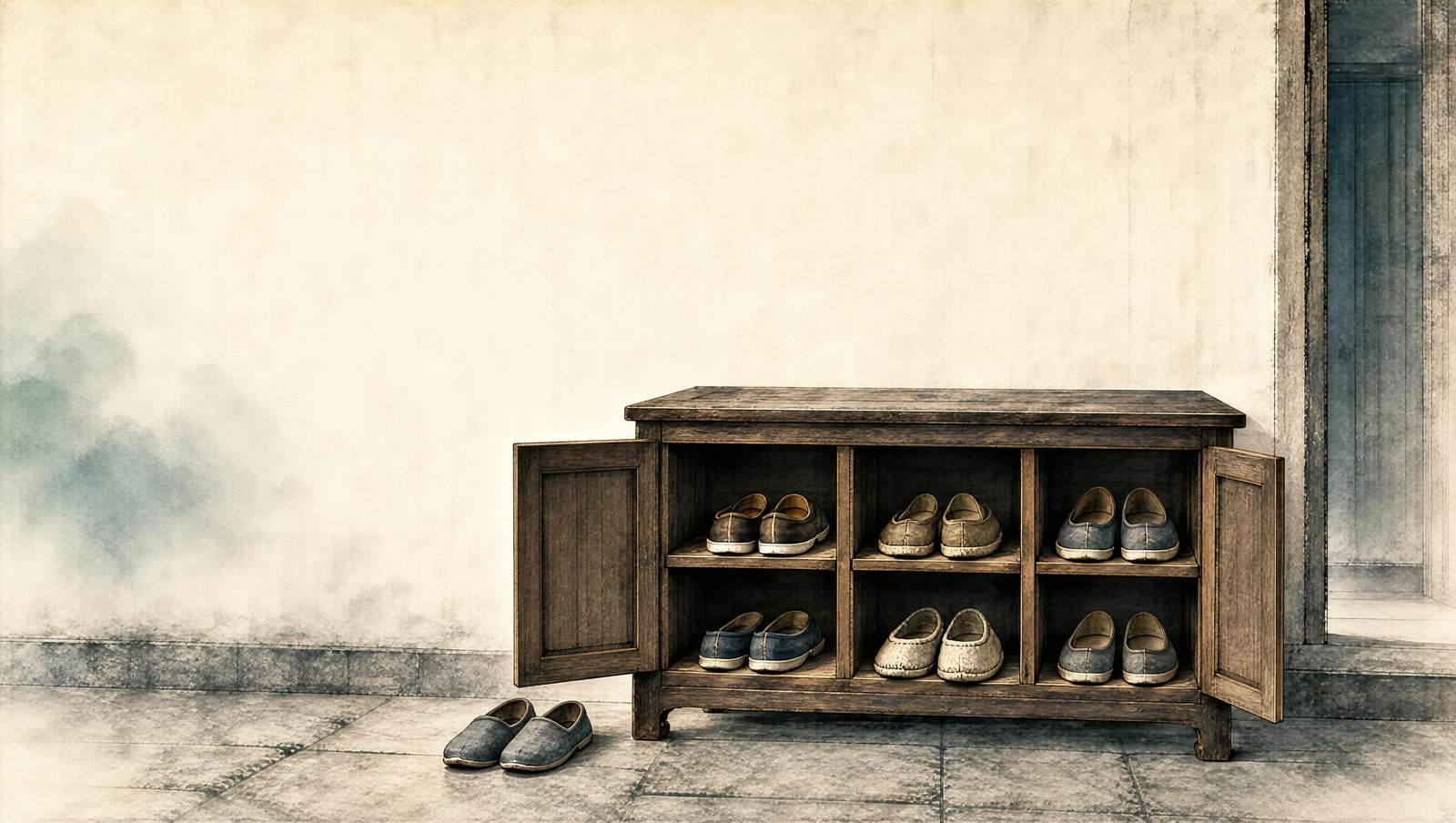
An entrance shoe cabinet should stand to the side of the door, stay below waist height, and keep its contents behind closed doors. Nothing in a home is used as often and seen as little as the shoe cabinet, which is why traditional practice treats its position as a decision rather than a purchase.
The doorway is a filter, not a showroom
Every dwelling has one place where two kinds of traffic meet: the street's and the household's. The doorway is that seam. Shoes, umbrellas, delivery boxes and bags all arrive there carrying outdoor dust, moisture and noise, and the household's job is to stop them travelling further in.
That is the logic behind the entrance rules rather than any single furniture item. Storage at the entrance is not decoration; it is a filtration system, and like every filter it works best when it is enclosed.
In September 2026 the Korea Times reported that tour operators in Asia are building walking routes around feng shui landmarks, with guides explaining how a doorway, a screen and a stairway each handle movement. The same principle applies at a scale of two square metres: an entrance shoe cabinet is a screen you can sit on.
Where an entrance shoe cabinet should stand
Position matters more than the cabinet itself. Three placements cover most apartments and houses.
- Beside the door, on either side. This is the default. The cabinet catches shoes as they come off and puts them out of the walking line.
- Not directly in front of the door. A cabinet that squares up to the entrance stops the household's own movement and puts the first thing a visitor sees at the level of their knees. If the entry is too narrow, use a shallow cabinet or a wall-mounted shelf with closed boxes instead.
- Not blocking the door swing. A cabinet that forces the door to be opened halfway turns the entrance into a squeeze, and squeeze points are exactly what entrance practice tries to remove.
If the entrance is a corridor with no side wall, the honest answer is to keep shoes in a closed cabinet further inside and leave the door area clear. A clear entrance beats a badly placed cabinet every time.
Height, doors and sightlines
Traditional entrance practice keeps shoe storage low. Two reasons, one practical and one structural.
Practically, shoes stored below waist height are reachable while standing and invisible while seated. Structurally, an entrance is the transition between the building's exterior and its interior, and low storage keeps the transition legible: at eye level you should see the room you are walking into, not a wall of footwear.
Closed doors matter as much as height. Doors keep dust and smell contained, and they also settle the visual question — an entrance with forty pairs of shoes on open shelves reads as unfinished no matter how neat the pairs are.
What should never sit at the entry
In August 2026 a feng shui practitioner told Better Homes & Gardens that the most common seasonal decorating mistake was not the choice of ornaments but clutter accumulating at the entry, where bags and shoes are dropped and then left. The article's specific complaints map neatly onto the traditional list.
- Broken or unworn shoes left in the open. Either repair them, wear them, or remove them from the house.
- Shoes pointing into the room. Turning them heel-out is a habit, not a superstition: it keeps the sole facing away from the interior and makes them easier to step into.
- A mirror hung directly opposite the door. Mirrors at the entry are common and useful, but a full-length mirror in the door line makes the entrance read as a corridor with no end.
- Dead plants and dried flowers. Living plants at the entrance need light; if there is none, choose a different material rather than keeping a plant that is slowly dying there.
- A key bowl the size of a suitcase. A shallow tray works; a wide open bowl collects everything and reads as clutter within a week.
Materials, light and upkeep
Wood, ceramic and woven fibre suit an entrance because they absorb sound. Glass and polished metal reflect it, and a small hard entrance with a full-length mirror and a metal shoe rack can feel loud even when it is empty.
Light should be warm and indirect. One ceiling light switched on at the door, plus a small lamp or a night light for the hours after dark, is enough. A cold spot downlight aimed at the shoe cabinet makes the entrance look like a shop.
Upkeep is the part that actually decides how an entrance feels. Ten minutes a week is plenty:
- Take out the shoes nobody has worn in a month.
- Wipe the inside of the cabinet with a barely damp cloth and let it dry before closing the doors.
- Check the mat — a mat that has stopped absorbing grit is now spreading it.
- Air the entrance for fifteen minutes with the door open.
- Put one thing back where it belongs that has drifted into the entry.
A five-minute entrance check
Stand outside the door, open it, and look in. You should see floor, light, and the shape of the room ahead. You should not see a row of shoes, a mirror pointing back at you, or a bag that has been there since last week. If the cabinet is on the side, closed, and below your waistline, the placement is doing its job — the rest is upkeep.
For the concepts underneath these habits, see what feng shui actually measures and what qi means in practice. If you want room-by-room positions rather than rules, the free tools cover the bagua map, and a consultation is the faster route for a specific floor plan.
Weekly wisdom, straight to your inbox
Essays, seasonal guidance, and energy insights - one letter a week, no noise.
DaoMind Pro
Read your own chart
Generate your full Ba Zi chart and elemental balance - the same data a practitioner opens with.
Open Destiny Atlas →