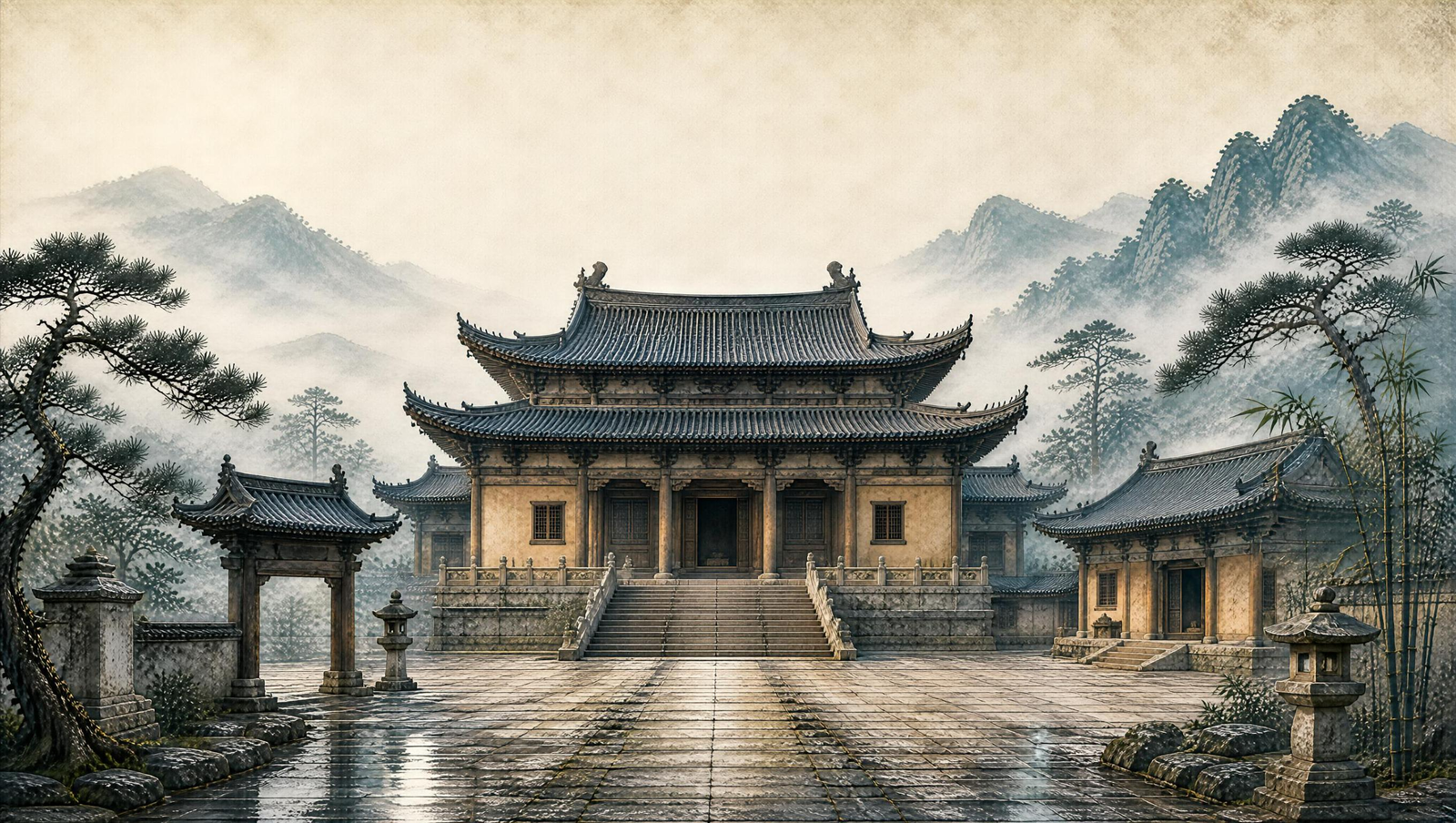
A Taoist temple is not merely a building; it is a diagram of the cosmos set on the ground. Its halls, gates, and courtyards are arranged to mirror the heavenly order, so that walking from the entrance to the inner sanctuary is a journey from the worldly to the sacred. Understanding the layout reveals why a temple feels the way it does.
The central axis and the Mountain Gate
Most Taoist temples follow a south-facing central axis. You enter through the Mountain Gate (山門, Shanmen), which marks the threshold between the profane outside and the consecrated inside. Ching Chung Koon, a major Taoist shrine in Hong Kong, presents exactly this progression — a clear axial sequence of courts leading the visitor inward source.
Behind the gate, the axis orders space by rank. The further in you go, the higher the deity enshrined, the more restrained the decoration, and the quieter the air. The building itself teaches hierarchy through movement.
The Hall of the Heavenly Kings and the main sanctuary
Past the gate stands the Hall of the Heavenly Kings (天王殿), guardian figures who screen the sacred core. Beyond it lies the main sanctuary, often dedicated to the temple's principal deity — Mazu at a sea temple, the Jade Emperor at a celestial one.
Taipei's Hsing Tian Kong (行天宮) shows the logic plainly: an open forecourt funnels the crowd toward a single focused hall, keeping the devotion collective and unhurried source. The layout is pastoral about attention — it tells the body where to bow.
The Three Pure Ones at the heart
The deepest hall enshrines the Three Pure Ones (三清, Sanqing), the highest emanations of the Tao. Their placement at the axis's far end is no accident: it positions the absolute source at the centre of the cosmos the temple diagrams. For the identities of these three, see our FAQ on the Three Pure Ones.
This innermost space is usually the most subdued — fewer visitors, lower light, slower chanting. The architecture reserves stillness for the source.
Symbolism in the details
Almost nothing is decorative by accident. Curved roofs shed more than rain; their sweep is read as a lift toward heaven. The number of steps, the pairing of dragons and cranes, the orientation to the sun — each carries meaning drawn from the same cosmology as Ba Zi and Feng Shui. The Singapore heritage portal Roots notes that temple building joins ritual, craft, and cosmology into a single acted text source.
Even the courtyard matters: it is the lung of the temple, where Qi gathers and circulates before rising into the halls. For how that same energy moves through the body, read What is Qi?.
Siting, orientation, and consecration
A temple is chosen, not merely built. Masters read the land for protecting hills, facing water, and an open bright hall (明堂, ming tang) before the gate, the same logic a Feng Shui audit applies to a home. Only after the site is accepted is the building consecrated — a rite that invites the deity to inhabit the statue and turns timber and tile into a living sanctuary. The act of consecration is why a temple is treated as a person, not a property.
What a temple teaches a visitor
A Taoist temple trains the person who walks it. The gate teaches boundary, the axis teaches order, the inner hall teaches stillness. You leave having practised, without a word of instruction, the core Taoist move of aligning the small self with the greater pattern.
For the living faith behind these walls, our FAQ on what Taoism is is the place to begin, and our piece on Mazu shows how one deity fills a working temple with meaning.
每週智慧,直送你的電郵
隨筆、時令指引與能量洞察——每週一信,絕無雜訊。