Ask a Chinese friend what happens on the ninth day of the ninth lunar month and you will usually hear three things: you climb a hill, you drink chrysanthemum wine, and you visit your grandparents. All three are correct, and none of them explains the others. The Double Ninth Festival is the one date in the calendar built on an overdose of yang — and the customs attached to it are a set of remedies for exactly that problem.
Why nine, twice, is a problem
Number theory arrives before folklore. In the traditional reckoning, odd numbers are yang and nine is the most yang of them, being the largest single digit. A day whose month and day are both nine is therefore 重陽 — doubled yang — in mid-October, as the year tips past its peak.
The classical reading of the Double Ninth Festival is not celebratory but cautionary. Anything that reaches an extreme begins to turn. Late autumn is the season of contraction, when the year's momentum is already withdrawing, and a day of maximal yang sitting inside that withdrawal is a day of tension between two directions. The famous customs are, in origin, precautions rather than parties.
The scholar, the plague, and the red bag
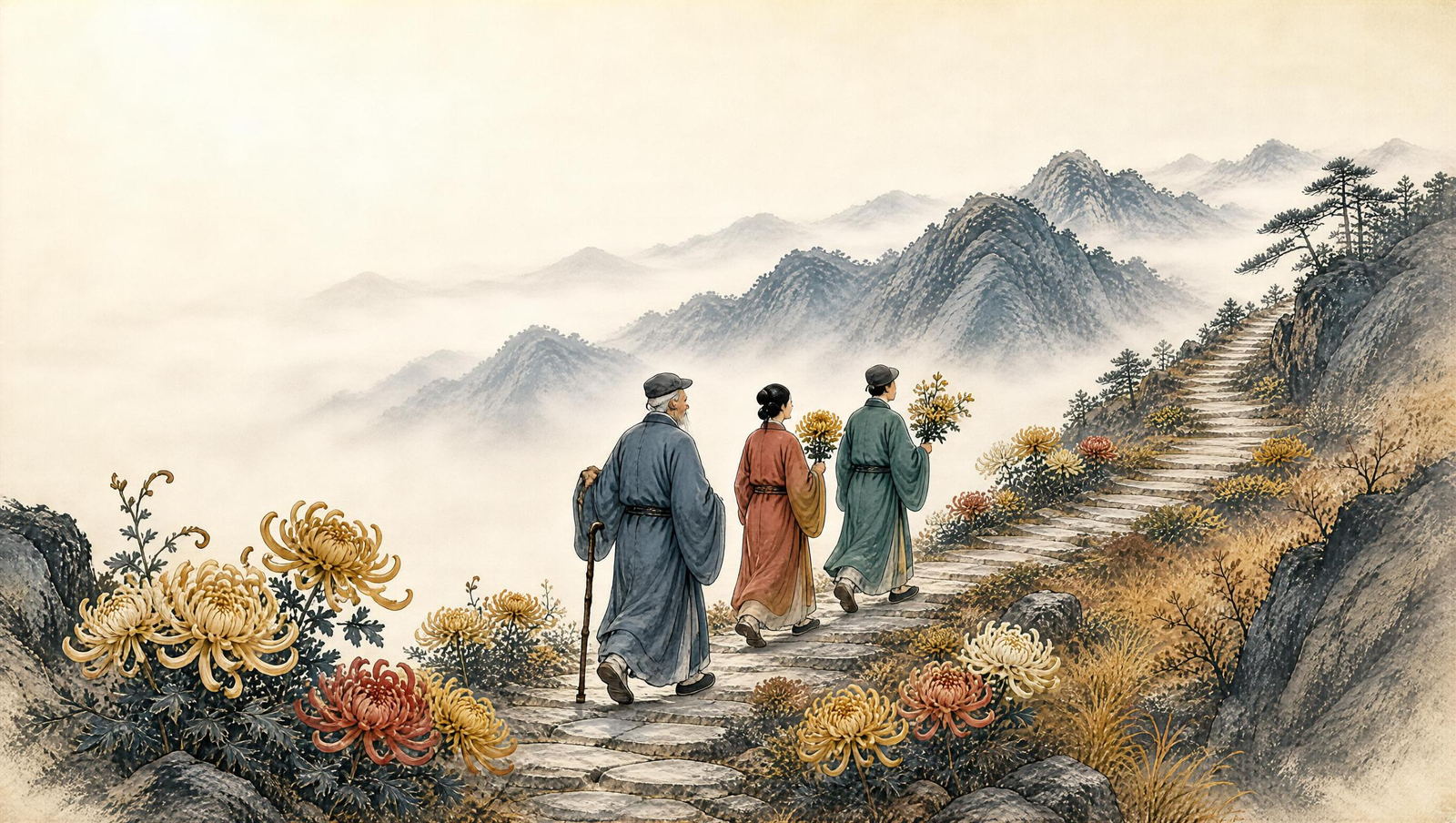
The legend that fixed the customs in popular memory comes from the Xu Qi Xie Ji (續齊諧記), a Southern Dynasties collection attributed to Wu Jun. A man named Huan Jing studied under the wonder-worker Fei Changfang. One day Fei warned him that on the ninth day of the ninth month a calamity would fall on his household, and told him to take his family to high ground, tie small red bags of zhuyu (茱萸, the fruit of Tetradium ruticarpum) to their arms, and drink chrysanthemum wine.
Huan Jing did as instructed. He returned at dusk to find the family's livestock dead and the household untouched. Whether the story reads as history or parable matters less than what it encodes: ascent, an aromatic fruit, and a bitter wine, applied together, on one specific date.
That trio still structures the day. Climbing — deliberately, on foot, to a height — is the centrepiece; zhuyu is worn or hung at the door; chrysanthemum is drunk, and in most modern households drunk as tea. Chrysanthemum is a cooling herb in Chinese medicine, which fits the logic of the date: something cool brought to a day of excess heat.
Nine Emperor Gods and the nine-day fast
For Taoist communities the ninth day is the closing of something larger. The Nine Emperor Gods Festival begins on the first day of the ninth lunar month and runs to the ninth — nine days, in which the nine stars of the Northern Dipper are invoked. In the Daoist reading these nine are the seven visible stars of the Big Dipper plus two accompanying stars, Fu and Bi; in the temple calendars of Singapore, Malaysia, Penang and southern Thailand they are honoured as the 九皇大帝 with vegetarian vows, processions, and bridge-crossing rites.
Many temple calendars also keep the ninth day of the ninth month as the birthday of Doumu (斗姆元君), the Dipper Mother, mother of the nine stars. This is where the festival's Taoist centre of gravity sits — not in hill-climbing, but in the Dipper.
A stranger footnote in Taoist history: the Quanzhen patriarch known as Wang Chongyang took the name Chongyang — literally "double ninth" — and the name is traditionally linked to the festival date and his period of retreat at a grave-site hermitage. A whole lineage of internal alchemy carries the day in its founder's title.
How it is kept now
Three layers have accumulated on the same date.
- Folk layer. Climbing, chrysanthemum, zhuyu, and a meal with family. Cakes printed with the character 九 are eaten in some regions.
- Temple layer. Dipper rites, vegetarian vows, and in Southeast Asia the closing of the Nine Emperor Gods festival, usually the loudest night of the autumn.
- Civic layer. Since 1989, China has marked the day as Senior's Day — an official turn toward respect for elders that sits comfortably beside the old custom of climbing to "ascend", since both involve looking after the older generation's footing.
Bringing the date into practice
If you keep nothing else, keep two things: move, and eat seasonal. Climb something — a hill, a long stair, a rooftop — on foot, in daylight. Make it tiring enough to notice. Then prepare chrysanthemum tea with a few dried blossoms rather than sweetened cordial, and take it warm.
For a family with an altar, the ninth day is a reasonable date for a simple offering of autumn fruit and a fresh pot of tea, no ritual specialist required. If you want the surrounding sequence, the Taoist festival calendar places the Double Ninth relative to the Hungry Ghost month and the winter solstice; the Three Primes explain the other festivals built around the same numerical logic. Readers who came here from the Dipper angle may want the beginner's answer on what Taoism holds before the theological footnotes.
The Double Ninth Festival survives mostly as a family visit, which is a reasonable outcome for a holiday that began as a plague warning. The precaution became a pleasure. The hill is still there.
每週智慧,直送你的電郵
隨筆、時令指引與能量洞察——每週一信,絕無雜訊。