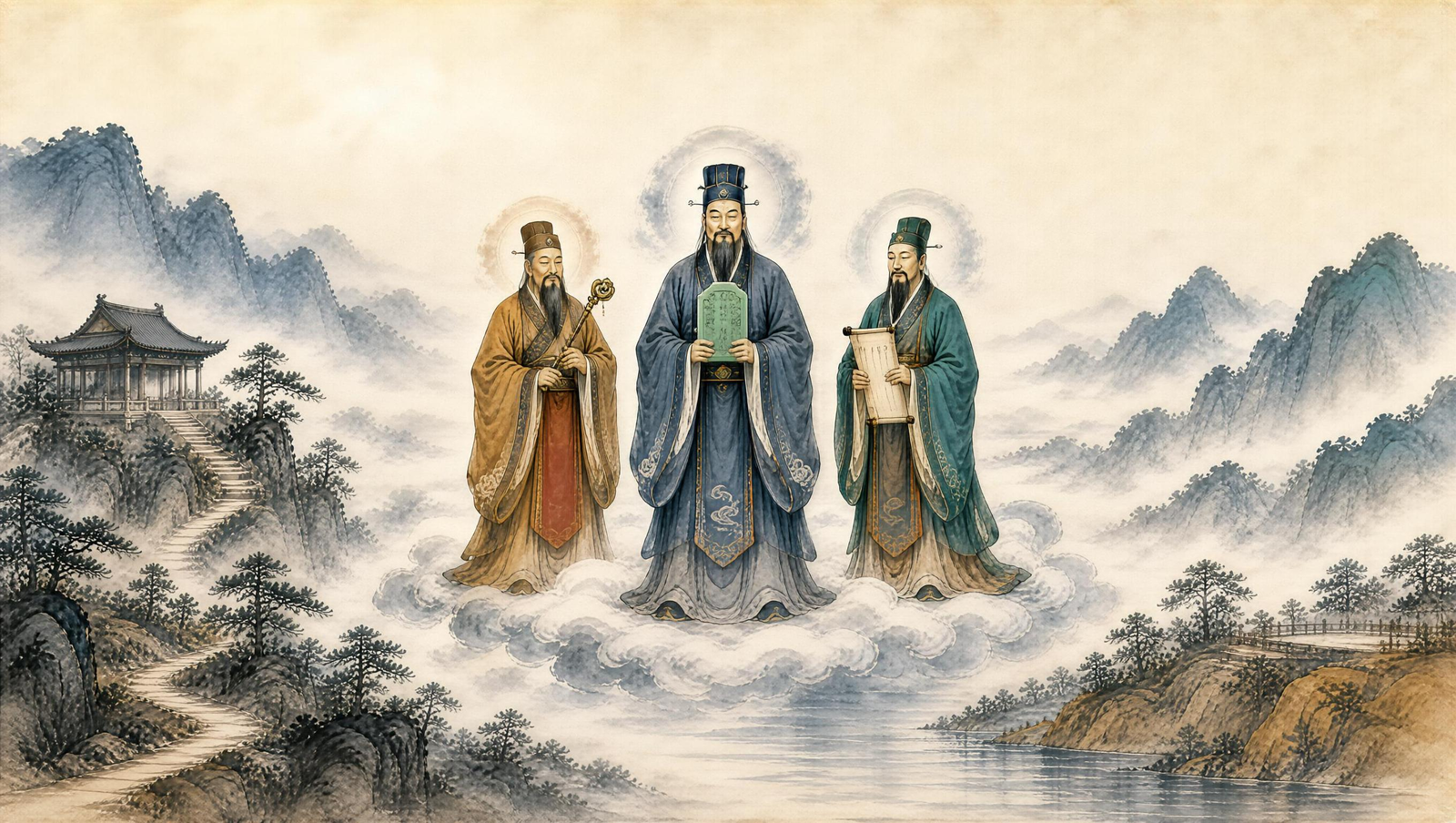
What the Three Yuan Festivals are
The Three Yuan Festivals (三元節, Sanyuan Jie) are the three great Taoist holidays built around the birthdays of the Three Officials — the Celestial Official of Heaven (天官 Tianguan), the Earth Official (地官 Diguan), and the Water Official (水官 Shuiguan). Each falls on the fifteenth day of a lunar month: the first, the seventh, and the tenth. Together they divide the year into three "primaries" (yuan), and on each the corresponding Official opens the ledgers of merit and fault for all beings.
Unlike the fixed solar holidays of the West, the Three Yuan move with the lunar calendar, so their Gregorian dates shift every year. They remain among the oldest continuously observed festivals in the Chinese religious year, rooted in early Taoist cosmology that reads the cosmos as a hierarchy of courts paralleling the human world — a theme we explore in our Taoist festival calendar.
The Three Officials behind the dates
The San Guan are not distant philosophers but active judges. The Celestial Official of Heaven grants blessing and records good deeds; the Earth Official pardons sin and relieves disaster; the Water Official clears offence and washes away affliction. According to the Taoist tradition preserved by temples such as Sik Sik Yuen Wong Tai Sin (啬色园), devotees still present petitions to the relevant Official during his month, asking that merit be increased or faults forgiven Sik Sik Yuen.
This Three-Official framework is distinct from the better-known pantheon of the Three Pure Ones. Where the Sanqing are the supreme embodiments of the Tao itself, the San Guan are functional ministers of the divine bureaucracy — closer to the Jade Emperor's court than to the formless source. Learn how they sit beneath the highest deities in our guide to the Three Pure Ones and the FAQ on the Taoist pantheon.
Shangyuan: the Upper Prime
Shangyuan (上元), the Upper Prime, lands on the fifteenth of the first lunar month — the night of the first full moon of the year, and the same evening as the Lantern Festival. It honours the Celestial Official of Heaven, who opens the register of blessings. Temples light lanterns, hold thank-offerings, and pray for a prosperous year. In imperial times it was a public holiday of lantern displays and street processions; today it survives most vividly in southern China, Taiwan, and the overseas diaspora.
Zhongyuan: the Middle Prime and the hungry ghost connection
Zhongyuan (中元), the Middle Prime, falls on the fifteenth of the seventh month — the heart of the lunar Ghost Month. It honours the Earth Official, who pardons the faults of the living and relieves the suffering of hungry ghosts. This is why Zhongyuan overlaps with the Hungry Ghost Festival: both turn the seventh month into a season of feeding ancestors and wandering spirits. Our guide to the Hungry Ghost Festival explains the overlapping rites in detail.
Xiayuan: the Lower Prime
Xiayuan (下元), the Lower Prime, arrives on the fifteenth of the tenth month and honours the Water Official, who clears offence and protects against water-borne calamity. It is the quietest of the three, observed mostly by offering thanks for the harvest and by rites of purification. In many regions it has faded from public view, surviving in temple liturgy rather than street festival.
How Taoist temples observe the Three Yuan today
Modern observance centres on the jiao (醮) thanksgiving rite and the burning of memorial petitions (疏文). On each Yuan eve, priests chant the corresponding scripture — the Celestial, Earth, or Water Officer's text — and place written prayers into the flame so the Official may read them. The intact living practice is documented among China's intangible cultural heritage listings China Intangible Cultural Heritage. Encyclopaedia Britannica likewise notes the Three Officials as a defining feature of popular Taoist worship Encyclopaedia Britannica.
Closing takeaway
The Three Yuan Festivals are Taoism's annual reminder that the cosmos keeps accounts — and that blessing, pardon, and cleansing each have their season. For the Traditional Chinese companion read The Three Yuan Festivals (繁體中文), and explore the rest of the year in our Taoist festival calendar.
每週智慧,直送你的電郵
隨筆、時令指引與能量洞察——每週一信,絕無雜訊。